Showing posts with label synthetic biology. Show all posts

Wednesday, October 15, 2014

Frankenstein Meets Genetic Modification

Biology concepts – Frankenstein, asystole, ethics, genetically modified organisms, genetically modified foods, synthetic biology, decomposers, electroconvulsive therapy


Mary Shelly was wedded to Percy and friend to Lord
Byron, one of the great poets of the early 19th century.
But she was a fair writer on her own. Note the bolts on the
monster's neck. These were added by make-up artist Jack
P. Pierce. He said they were electrodes, not bolts, even
though Mary Shelly never actually wrote that
the good doctor used electrodes on the body.
Can you think of anything scarier for Halloween than an irresponsible scientist letting his creation loose on the world? Now imagine that his creation is something that violates our sense of decency and our reverence for the dead. Well, that’s the story behind Mary Shelly’s Frankenstein.

Who's the victim of the story? Is it Dr. Frankenstein, who’s family is murdered or is it perhaps his monster, who was brought into the world and abandoned? He lives his second life shunned by all, misunderstood, lonely, unable to live with dignity or even die at all.

This is a big story for a 17 year old to pen. Yep, that’s how old Mary Shelly was when she wrote Frankenstein (published when she was 21 in 1818). Despite her age and inexperience, she rolled out one of the greatest novels ever. It was both romantic and a criticism of romance. It sparked the science fiction genre and was the beginning of horror stories.

The movies and stories about Frankenstein’s monster usually highlight the way in which the monster was created and his ugliness and hatred, but that isn’t what the book is about. It’s a story of responsibility in science and toward others.

The Age of Enlightenment had just ended when Frankenstein was written, and the Romantic period was in full bloom. A switch from science to emotion meant that the facts and discoveries about the world now needed to be examined, not just accepted. Here was Mary found her message – a person must be responsible for the things he/she creates – be they physical things, knowledge, or opinion.


Electrical impulses make muscles move. Adding salt to
freshly skinned frog legs is a lot like hitting the with a
mild jolt of electricity. This is like Galvani demonstrated
with the corpse of the murderer and the image Mary
Shelly evoked in her novella.
The science of the monster’s reanimation was not the focus, but Mary had good knowledge of the latest science of the day, and this is what informed her making of the monster. Sir Humphrey Davy of the Royal Institution of Science had just stated that chemistry would, eventually, control the conversion of dead matter into living matter.

This was combined with the advances in electricity at the time. Just before 1800, Luigi Galvani had published on the ability of electricity to excite the muscles of dead animals – the innate electrical force of living tissue came to be known as “galvanism.” In 1803, Galvani applied an electrical charge to the corpse of executed murderer Thomas Forster, and the body jolted and moved – a good visual for Mary.

So could a body be reanimated as Shelly relates in the novel? Nope…. at least, not yet. Let’s examine why.

Dr. Frankenstein uses a corpse, with some implied modifications through surgery. Not good. Immediately after death, cells that are starved for oxygen stop making ATP. ATP is required to maintain lipid membrane compartments and in general for the integrity of the cell. Once there is no oxygen and no flow of energy, the enzymes designed to break down wastes, toxins, and old organelles for recycling are released to the cytoplasm and start to destroy the cell.

Consider the process of rigor mortis. Muscle contraction requires ATP not to contract, but to release the contraction (see this post). With no ATP, the muscles become rigid in their contraction about 3-4 hours after death. Rigor lasts for about 12-20 hours, and is only released by the process of cell destruction that we described above.


Frankenstein’s monster better have been a very fresh
corpse. Decomposers like bacteria and fungi are already
in and on your body; it’s your immune system that keeps
them at bay. Once dead, we’re all just food for worms,
prokaryotes, protists , fungi, and of course buzzards.
Mary doesn’t describe anything to overcome this problem. But there are other problems as well. No life, no immune system. This is what keeps our fungal, bacterial, and protist flora in check. Without a working immune system, the microorganisms that are normally growing in and on us will be unchecked and start to grow and feed on the corpse. This is where they get their name, “decomposers.” Mary doesn’t mention anyway to overcome that problem either.

What about the electrical problem? We use electricity in our neural system and in our heart. Your brain is an electrochemical machine, using ions to generate and electrical current down axons. Electroconvulsive therapy (ECT) is useful in treating some forms of depression and schizophrenia and mania, but we don’t really know how it works yet.

Several hypotheses exist; none or all of which may be correct. ECT may alter neurotransmitter concentrations, which would change the degree to which impulses are transferred or suppressed from one neuron to another. It may work to prune back some neural connections in the brain, or it may work to stimulate hormone release that could alter the brain chemistry. A 2014 review provides more information on the various theories of ECT mechanism.
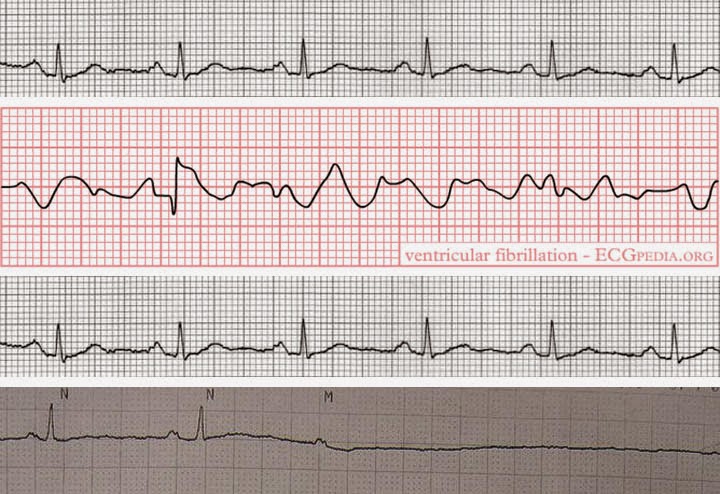

From top to bottom we see a normal heart rhythm, and a
then a ventricular fibrillation that CAN be treated with
electric shock. Below that is a pulseless rhythm, which
looks normal but doesn’t move the heart, and then asystole,
with no pulse at all. The bottom two CANNOT be treated by
shocking the heart. That’s why they called it a defibrillator,
not a heart starter.
Electricity is used in the heart as well. We can modulate the rhythm of the heartbeat with a pacemaker, which is just a low voltage shocking device. When a person is dying from a poor heart rhythm (ventricular tachycardia or fibrillation), we can use a defibrillator to shock the heart back toward a normal rhythm.

Mary’s error: electrical shock won’t start a stopped heart (called asystole, a = not, and systole = contraction), despite what you’ve seen on the TV shows. For asystole, the treatment is CPR with a shockingly large dose of adrenaline every 5 minutes.

Dr. Frankenstein couldn’t have reanimated his self-digesting, microbiological dinner plate of a corpse with an electric shock, but if the muscles hadn’t gone into rigor yet, he might have been able to get a short slam dance out of him. But then, this isn’t really the point of the story.

Frankenstein’s monster was alive and wandering the world alone a mere 1/5 of the way through the story, so it’s really a story of how to deal with the products of science. Erasmus Darwin (Charles’ grandfather) had introduced the idea of mutations or “monstrosities” being passed on or inherited – so Mary now had the essence of the story. Who is the monstrosity - the monster or the scientist who creates and then abandons it?


Erasmus Darwin was Charles granddad. He was an
inventor, poet, natural philosopher and I hear a great
cook. One of his poems predicted the discovery of the
Big Bang, he also suggested the idea of natural
selection and mutation and sketched out a liquid
oxygen and hydrogen rocket.
One indication that a story is a classic is whether its themes are applicable in different eras. Frankenstein may be even more applicable to our times than it was to Mary’s. Current debates are boiling over concerning the uses and limitations of science.

The issue most often compared to Frankenstein’s monster is genetically modified organisms (GMOs). Have you heard the term, “Frankenfoods?” This is the name that opponents of GMOs and particularly GM foods use to taint the agricultural biotechnology industry.

The fear is that by tampering with nature and introducing genes into organisms, we are creating monsters that might have unexpected effects on us. It’s a good marketing campaign idea, and it has stuck in the minds of the public.

Europe and Russia have banned all GM foods out of fears that they may contain toxins or mutagens that would harm the consumers. One fear is that DNA from the genetically modified organisms would be transferred to the eater and combine with their own DNA. That is a scary sounding idea.

The problem is, you take up DNA from the food you eat every day, although not whole genes as the fear warrants. Digestion breaks down DNA, so we take up mostly nucleotides and short stretches of nucleic acid. No recorded evidence exists of uptake of an entire gene.


Dr. Frankenstein used all natural body parts, no artificial
sweeteners, additives or preservatives, and good old-
fashioned electricity. If he was sold in the market, the
monster could be labeled as organic! No genetic
modification here.
Websites and books talk about the dangers of GM foods, but the evidence hasn’t shown up in the scientific literature. What few papers have announced negative ramifications of GM foods have been retracted or have such vague conclusions as to apply to any food at all. I’ll give a typical example.

In 2012, a researcher named Seralini from the U. of Caen announced that an herbicide used with GM foods (glyphosate in Roundup) causes tumors. He didn’t just publish it, he had a press conference and concurrent release of his book on the subject and videos in three different languages. It turns out that he also had a company that was preparing to market a product as a “protectant” against glyphosate. The study was subsequently retracted, but a modified version with a conclusion that “more study is needed” was re-published in a lesser journal (see note below).

Other studies on the dangers of GM foods have been correlative, meaning that when you see “A”, you often see “B.” But that doesn’t mean that A causes B, or that B causes A. Remember this: correlation does not imply causation.

The truth is, we need more studies. There are real issues to be dealt with, such as - does introduction of a particular gene cause plant toxins to be increased – this could be bad for us. The idea is the same as in Mary Shelly book – we must be responsible for those things we make. No GMO or GM food should go to market without extensive testing.

The testing to date shows that there are no health risks associated with GM foods. Longitudinal studies from 2014, 2013, and 2012 of live stock feeds showed that animals fed GM crops over five generations showed no ill health effects and their meat was exactly like that of animals fed conventional feed. By the middle of 2013, over 600 studies showing that GM foods carried no health risks had been peer-reviewed and published. The key is always the same - responsible and thorough testing.


Synthetic biology has arrived. Vanilla is a very expensive
crop to produce. But a gene has been constructed and
vanillin is now produced in yeast. They ferment sugar and
produce vanillin. This is more natural than artificial vanilla,
and contains many of the metabolites that make vanilla
taste like vanilla.
The problem of hidden agendas like Seralina's does go both ways; a 2014 editorial on the safety of GM foods was written by a Monsanto employee, the company that markets GM corn and soybeans. Society must be diligent and demand topnotch, transparent, and responsible science. This was one of Shelly’s themes, Frankenstein conducted his work in private, with no comment from society about how or whether it should be done at all.

The next generation of people will have more issues to deal with, like synthetic biology (not merely taking a gene from one organism and putting it another, but constructing a gene or genes from nucleotides and then inserting them). How to ensure good use of science? - transparent methods and results, no hidden agendas, no jumping to conclusions, and a very science literate population that can judge and reason for themselves. And that’s why we learn biology.

Next week - Halloween is a time to focus on what's scary and what's dead. Can you actually be scared to death?


The retraction of the 2012 study of Seralini in Food and Chemical Toxicology can be found here. It was republished in modified form in the journal, Environmental Sciences Europe in 2014, but with no peer-review.


Goldstein, D. (2014). Tempest in a Tea Pot: How did the Public Conversation on Genetically Modified Crops Drift so far from the Facts? Journal of Medical Toxicology, 10 (2), 194-201 DOI: 10.1007/s13181-014-0402-7

Tufarelli V, & Laudadio V (2013). Genetically Modified Feeds in Poultry Diet: Safety, Performance and Product Quality. Critical reviews in food science and nutrition PMID: 24915369

Van Eenennaam AL, & Young AE (2014). Prevalence and impacts of genetically engineered feedstuffs on livestock populations. Journal of animal science, 92 (10), 4255-78 PMID: 25184846

Snell C, Bernheim A, Bergé JB, Kuntz M, Pascal G, Paris A, & Ricroch AE (2012). Assessment of the health impact of GM plant diets in long-term and multigenerational animal feeding trials: a literature review. Food and chemical toxicology : an international journal published for the British Industrial Biological Research Association, 50 (3-4), 1134-48 PMID: 22155268

McCall WV, Andrade C, & Sienaert P (2014). Searching for the mechanism(s) of ECT's therapeutic effect. The journal of ECT, 30 (2), 87-9 PMID: 24755719

 
For more information or classroom activities, see:

Genetically modified organisms/foods –


Wednesday, July 30, 2014

Does Life Come In XXXS?

Biology concepts – characteristics of life, archaea, bacteria, mycoplasma, synthetic biology, symbiosis, parasitism, nanobacteria, genome

As part of this blog, we have talked about some pretty small life. Wolffia globosa is the smallest flowering plant, only 0.6 mm long. We also talked about archaea, a different kingdom than bacteria, but still on the smallish side of life. The tardigrade is the toughest animal, but is also one of the smallest, at 100 µm (0.00394 inch).


The organism on the top is T. dieteri, and arthropod, just
as is any crab or spider. The size is deceiving. The pictures
on the bottom are to scale and are copepods, also
arthropods. The organism on the top is a parasite of the
organisms on the bottom. The small blue line? That would
be the scaled size of T. dieteri. So…. it’s SMALL.
The question for today is – is there a minimum size for life? Candidates might include bacteria or archaea; heck there’s an arthropod, Tantulacus dieteri, that's only 85 µm long! As long as we can keep finding smaller and smaller cells, we know that the minimum size for life is that small or smaller. So we keep looking – you’d be surprised how important it is to keep looking for smaller life.

Here’s one thing we should be able to agree on, viruses don’t get to play in our game. Viruses are very small, but they're not life! We’ve talked about this before - the seven characteristics of life (see this post). Viruses need a host in order to replicate, they don’t manage homeostasis, and they aren’t cells, so they aren’t life.

So how small has actual life become? Let’s assume that since tardigrades and T. dieteri are over 50 µm, huge when compared to some bacteria, our current minimum for life is probably a bacterium or archaea.

Let’s go straight to the genus of smallest bacteria we know about – the mycoplasma (from mykes = fungus, and plasma = formed). They were first described in 1898, but the observer didn’t have a clue what he was looking at; hence the fungal part of the name.

Mycoplasma don’t have the traditional cell wall of many bacteria, so they look different and this might be why they were mistaken for fungi. Whatever the scientists thought of them, they were confusing enough to be roundly ignored for 50 years. Rediscovered in the 1950’s-1960’s, this time they were thought to be L-forms of bacteria. L-forms are organisms that for some reason have lost their cell wall.

There are stable forms of L-bacteria; they can live divide and live on without their cell wall. There are also unstable L-forms as well; those that may revert to walled bacteria at any moment. Are mycoplasma simply bacteria that have lost a cell wall? Nope. They didn’t have a cell wall to lose. They have no cell wall genes, so if they had a cell wall, it was millions of years ago, before they became their own genus.


The difference between some free living cells. You can
probably see the E. coli in bright green, but you may have
to squint to see the mycoplasma above it. It’s pink. Really,
it’s there. Compare these sizes to those of the arthropods
above. 1 mm is equal to 1000 µm.
Mycoplasma is really, really, SMALLLLLLL.
Mycoplasma are generally described in the range of 0.2-0.8 µm in diameter. But this is a little misleading, because they are often not spherical. Even without a cell wall, they can take interesting three-dimensional forms and maintain them. Mycoplasma pneumoniae, which causes a form of …..….. anyone?…….. right, pneumonia, is pear shaped, so its 0.25 µm diameter is actually the measurement on its short side.

So mycoplasma are small, but they still have to play by the rules. They contain DNA and salts and proteins and ribosomes and other things that take up room. A single ribosome is about 50 nm in diameter (0.05 µm or 0.00000005 m), so there must be a certain volume required for the cell to function – a minimum size for life.

Which of the mycoplasma species is the smallest? Mycoplasma genitalium is considered to be the smallest mycoplasma known, and the smallest form of free-living organism - my gosh – you can fit about 400 M. pneumoniae inside one E. coli! As such, it is the current minimum size for life that we have. M. genitalium is 200 nm (0.2 µm) x 600 nm (0.6 µm), so they’re pretty dawg on small. Let’s put it this way, there are 25,400,000 nm in one inch – mucho small.

It is important to note that M. genitalium is free living, but does need some help. It uses cholesterol in its membrane but doesn’t make it itself. It picks it up from the cells that it lives near……wait for it….. your genital epithelium.


One of the human diseases that is becoming more
convincingly associated with M. genitalium is pelvic
inflammatory disease (PID). Resulting when many
different sexually transmitted diseases go untreated,
PID can cause permanent damage to the reproductive
organs of women. It is important to get treatment early.
The inflammation of PID may be associated with the
fallopian tubes or ovary, and will cause a chronic pain
in the lower abdomen, bleeding and pain on urination.
M. genitalium is a cause of non-gonococcal urethritis (inflammation of the urethra). A late 2013 review states that 1-3% of the general population is infected with M. genitalium, more than with gonorrhea. It is linked to pelvic inflammatory disease, and the review cites studies showing that people infected with this mycoplasma are more at risk for HIV and have more dual infections. It’s a sexually transmitted organism, just another reason for proper restraint. But even though it's helped out by your genital epithelium, it can live on its own and divide outside a host, so it's considered a free-living organism.

The idea of free-living is important because M. genitalium also has a very small genome (amount of DNA in one cell, including the list of all its genes). M. genitalium has about 580 kbp of DNA where kbp = kilobase pairs. Remember that DNA is doubled stranded (usually) so each base is paired with another. Knowing this, we count them as a unit. In all, M. genitalium has just 520 or so genes; it can make about that many proteins.

Genome size could be another way of determining the minimum size of life - what's the minimum number of genes or number of base pairs of DNA for an organism to still meet all seven characteristics of life? As of summer 2014, no organism smaller in size than M. genitalium has been described, but there have been some other organisms discovered with smaller genomes.

Nanoarchaeum equitans was thought to have the smallest gene for a while, with only 491 kbp of DNA. It is an archaea that lives on the edge of hydrothermal vents at the bottom of the ocean. But it is an obligate symbiont with another archaea; it can’t survive without its partner, so can you say it has the minimal genome? It relies on another organism’s DNA.


On the left is the leafhopper in which N. deltocepahlinicola makes
his home. Well inside its cells that is. The leafhopper survives on
phloem and xylem; high in carbs but little protein. The bacterium
makes the amino acids the leafhopper can’t in exchange for energy
in the form of ATP. On the right is a colored photomicrograph of
the abdomen. The red is one type of endosymbiont bacteria,
the green is N. deltocephalinicola.
This is also true of Carsonella ruddii (159 kbp, 182 genes) and Nasuia deltocephalinicola. They are bacteria that must live inside insect cells, like those of grasshoppers. N. deltocephalinicola has the smallest known genome (112 kbp, 137 genes), but it doesn’t even make ATP, it steals it from the arthropod cells. This could hardly be considered free living, and so it can’t be considered the minimal genome for life. And even at that, their cell sizes are still bigger than M. genitalium.

So why is it important to find the minimal size and minimal genome for life? So we can use the information. J. Craig Venter (of the human genome project) wanted to develop a synthetic form of life (synthetic biology); a bacterium that could be developed to provide hydrogen for energy or eat waste to reduce pollution. Others say we need to know so that we can better recognize life on other planets, or life that may have come here from other planets (astrobiology).

Being J. Craig Venter, develop a synthetic form of life is exactly what he and his research institute did. It’s interesting that Venter was one of the scientists that first sequenced the entire M. genitalium genome in 1995. Some 15 years later, Venter’s JCVI-syn1.0 (2010) was the first synthetic life, housing 1000 kbp and 500 or so genes. The genome was based on that of another mycoplasma, M. mycoides. They modified the genome, and introduced it into a cell membrane that had been evacuated of all its constituents. The resulting cell was capable of growing, dividing, you know…. living.

If M. genitalium represents our current estimate for the minimum size of life, it’s only because we’re thinking of life as we know it. Perhaps we have already found life that is smaller, and the minimum size is actually much smaller than M. genitalium.


This is a photomicrograph of a meteorite from Mars. The
small spheres (like the ones the arrows point to, are
supposedly nanobacteria. Proof of life on Mars,
contamination from Earth nanobacteria, or just mineral
spheres that look a little like incredibly tiny bacteria?
The answer is C.
Something termed a nanobe and something else called a nanobacterium were described 20-30 years ago. Nanobes were first found in the rocks that came up during oil drilling in Australia, while nanobacteria were also found in surface rocks.  The size of both (about 1/20 size of M. genitalium) negates their use of ribosomes and DNA. They stain for DNA, but this may be artifact, the artificial result of other things picking up the stain.

But nanobes/nanobacteria have their proponents. Some scientists say that since no DNA has been exhibited, they are a completely different form of life, so size restriction (big enough to hold ribosomes) doesn’t apply. Nanobacteria are also claimed to be important in human disease, as these structures are found in many calcifications of diseased tissues.

On the other hand, nanobacteria are probably just mineral formations. A 2013 study showed that they form spontaneously from many different biological fluid samples, and their appearance in diseased tissues is more a sign of disease than a cause of it. We’ll just have to keep looking for something smaller.

Next week, another question tackled and dissected - think pink.


Manhart LE (2013). Mycoplasma genitalium: An emergent sexually transmitted disease? Infectious disease clinics of North America, 27 (4), 779-92 PMID: 24275270

Wu CY, Young L, Young D, Martel J, & Young JD (2013). Bions: a family of biomimetic mineralo-organic complexes derived from biological fluids. PloS one, 8 (9) PMID: 24086546

Gibson DG, Glass JI, Lartigue C, Noskov VN, Chuang RY, Algire MA, Benders GA, Montague MG, Ma L, Moodie MM, Merryman C, Vashee S, Krishnakumar R, Assad-Garcia N, Andrews-Pfannkoch C, Denisova EA, Young L, Qi ZQ, Segall-Shapiro TH, Calvey CH, Parmar PP, Hutchison CA 3rd, Smith HO, & Venter JC (2010). Creation of a bacterial cell controlled by a chemically synthesized genome. Science (New York, N.Y.), 329 (5987), 52-6 PMID: 20488990