Showing posts with label TRPV1. Show all posts

Wednesday, July 9, 2014

What’s So Repelling About Repellents?

Biology concepts – thermosensing, repellent, odor receptors, gustatory receptors, semiochemcials


Science explains our world, and then technology and engineering
build a model of that for our use. The better we know how our
universe works, the better we can make use of it. In the 1985
film Real Genius, this difference is stated when the scientist
students ask what a 6 megawatt laser might be for, one student
says, “Let the engineers figure out a use for it.” In this case, they
used it to fill a house with popcorn.
Science exists to describe our universe in terms of rules and mechanisms; what is and how it comes to be. Knowing that something exists is only half the equation. Science seeks to explain how something exists in terms of the rules of the universe. Observation is good, but it only shows us the question – mechanisms of action and interactions show us the answers.

As an example – we know that certain naturally occurring oils and well as some man made chemicals keep mosquitoes from feeding on us. This is the observation. But the question is – how do mosquito repellents work? The answer is more interesting and more complicated than you would initially think. Repellents rarely repel.

Investigating how chemicals keep us from getting bitten will teach us about how the living systems work, will give us a better understanding of our universe, and then give us better insect repellents. Don’t think that’s important? Consider the hundreds of millions of people who are infected every year (several million die) with mosquito-borne diseases (malaria, encephalitis, dengue fever, yellow fever, filiariasis). So yes, we need more repellents.


Mosquito borne diseases can be unpleasant at best. Top left is
filariasis, a worm is transmitted via mosquito and it clogs up
your lymphatic vessels, so that body parts swell from excess
fluid. Top right – malaria can result in so much red blood cell
lysis that your spleen (the guy who cleans them up) can
rupture. Bottom left – Dengue fever is often called breakbone
fever, the pain is not something an image can express. But the
hemorrhagic form of the disease can produce some bleeding
in weird places. Oh, and it can kill you too. Bottom right –
yellow fever is caused by a virus transmitted by mosquito. Your
liver breaks down and causes your whole body to turn yellow
and you bleed into your skin.
We should start with the repellents for which we have good ideas of their mechanism of action. But there aren’t any. We have some hypotheses and working ideas of the modes of action of mosquito repellents, but nothing is definitive yet. Let’s look at two of them and see if we can find some common pathways.

Citronella oil
Citronella is a combination of many different natural oils produced in lemongrass plants (Cymbopogon nardus and Cymbopogon winteratu). As a natural oil and a flavoring in Asian cooking, one would think that citronella oil would be considered just about the safest insect repellent this side of a slap with an open palm.

But no, Canada says that one small component of citronella oil called methyleugenol, can increase the likelihood of tumor formation in rats. Of course this was when methyleugenol was distilled from the oil, given by itself in large doses, and introduced directly into the stomach. But Canada is still in the process of banning citronella oil as an insect repellent. Of course, you can still eat thai food in Canada, which is often flavored with lemongrass.

The EU, on the other hand, said that the repelling function of citronella oil hadn’t been proven and it was deemed illegal to use in the EU in 2006. Oh, you could eat it, and use it soap or perfumes, you just couldn’t use it to keep mosquitoes away. They reconsidered in 2014 and some restricted uses of citronella oil as a repellent are now allowed.


Citronella oil comes from the lemongrass plant (Cymbopogon
nardus or Cymbopogon winteratu). There are two major species
for acquiring the oil, and the oil from each is a little different in
the percentage of each chemical. Lemon grass is also used in
cooking, the woody stalks are used with extra long cook times.
The torches that burn citronella oil work pretty well, but you
have to stay in the volatilized cloud of oil for them to be efficient.
Despite these issues, the U.S. Environmental Protection Agency (EPA) says citronella is safe and effective as an insect repellent. One weird side issue – you can take all the lemongrass you want from the US to Canada, where its oil is under attack, but you can’t bring any lemongrass from Canada to the US, where it is considered safe. Hmmmm.

Citronella oil probably works in a couple of ways. It's strong and sweet smelling, so it covers up and dilutes the odors that mosquitoes use to find you. If they’re detecting all the citronella in the air, then they aren’t smelling you. But research also shows that citronella oil activates TRPA1 ion channels. In us, they detect cold and noxious chemicals and are interpreted as pain. It is very possible that the detected signals in mosquitoes just come through as something unpleasant and to be avoided.

In this way, citronella would be an actual repellent. It repels on contact as well, as the taste is thought to activate bitter taste receptors and contact greatly reduces feeding time.

But citronella only seems to work when you are in the cloud produced by burning the candles or torches, or within the area of the spray. And if you’re using an oil or cream with citronella, it should really be reapplied every 30-45 minutes - not the most user-friendly method for discouraging pests.

DEET
World War II in the Pacific was an insect nightmare for the US Army. In response to the plethora of insect-borne disease that ran through the allied forces, defense scientists starting looking for better insect repellents. In 1946, their efforts produced N,N-Diethyl-meta-toluamide, or DEET.

Just how they came up with DEET is a mystery to me, it must have been a massive exercise in trial and error. Why? Because we know less about how DEET works than we do about citronella oil. And that’s with the benefit of 40 years of research. They didn’t have a clue how it worked or even what systems it was targeting when developed in the 40’s.


Guess which hand has been treated with DEET. The
mosquitoes come very close to the hand that was treated,
but don’t land on it. This argues that DEET is less repelling,
than it is disguising. On the right, the structure of DEET is
similar to several human semiochemicals, it fits into the lock
and key system of several odor receptors and activates or
inhibits them.
Originally it was believed that DEET disrupted the mosquito’s ability to detect semiochemicals (octenol) produced by mammals, especially humans, so mosquitoes couldn’t find a mammalian host to feed on. Then they played around with the idea that it blocked detection of CO2.

More recent studies have been more rigorous, but haven’t helped solve the puzzle. A 2008 study suggested that DEET was actually repellent; the mosquitoes didn’t like the smell and would avoid it. But other studies have shown different mechanisms of action.

A study in the journal Nature in 2011 found that mosquito odor receptors could be confused by DEET. The receptors for octenol were less responsive in the presence of DEET, but other receptors more more responsive.  The conclusion of the study was that odorants from humans could be detected, but their pattern was confused, so the mosquito didn’t recognize the target as a target. It’s as if we disappear from the mosquitoes radar when we wear DEET.

A 2010 study showed similar results. DEET activated certain odor receptors but not others when given alone, but the opposite effects were seen when DEET was given in the presence of things from human sweat that would normally attract a mosquito. Once again, the signals were confused. This is really more of a chemical disguise for us, not a repellent. Next time your kids go outside, you should insist that they apply their mosquito confusant.

However, a 2013 study in the Journal of Vector Ecology found that heat and moisture were critical elements for recognition of targets by female mosquitoes, and that DEET messed not with odor, but with detection of heat and/or moisture. Different from the other studies, but still more of a masking than a repellent.


Something a little disturbing. Mosquitoes can learn to ignore
DEET. Most mosquitoes will be confused by DEET and never
find you. But if they do and then are repelled by the taste, they
learn from that and the second taste is not repellent. Hopefully
they just don’t find you a second time.
There was an interesting study from 2013 that showed that if you mutate or knock out Orco, one of the co-receptors (a protein that works with many different odor receptors so that they can function properly), then two things happened. One, DEET didn’t have any effect on the mosquitoes, and two, mosquitoes that normally preferred humans greatly would then settle for any mammal.

Weird - Orco is needed for both DEET to work and for mosquitoes to find humans more attractive. I haven’t figured that one out yet. The researchers showed that DEET only maintained an effect on the Orco mutant mosquitoes when they landed on a DEET covered surface, and then they didn’t like it at all.

This suggested that DEET might have more than one mechanism, confusion in the air and repellent taste on contact. Older studies supported this idea, as a couple of studies in 2005 and 2006 showed that contact with DEET would reduce feeding behavior in mosquitoes and one in 2010 showed that fruit fly bitter taste receptors are activated by DEET.

So, we have studies that say DEET is a confusant rather than a repellent, others that say it is a true obnoxious smell that they can’t stand, and yet others that say DEET is confusing to the smell and repellent to the taste. But there are more. Other studies suggest that DEET actually inhibits the smelling of anything, while others say that it inhibits an important protein called cytochrome p450.

Used commercially since the 1950’s, DEET has been the gold standard for efficiency for many years. Although it has to be used at fairly high concentrations, it can keep mosquitoes away for 4-6 hours at concentrations where citronella oil might work for less than an hour. At 100% concentration, DEET is active for more than 12 hours. What’s more, if you combine DEET with 5% vanillin, it works two hours longer!


A lime with cloves stuck in it as a mosquito repellent – really?
Well, lime is kind of like citronella oil, and clove has eugenol,
which acts on TRPV1 ion channels. But how many would you
have to have, or do you wear them like earrings? Penny royal
contains menthol and mosquitoes stay away from it. But it
also has toxins that will kill you.
As good as DEET is, people still question whether it’s safe. The EPA in a 2014 review said that DEET is safe for human use and poses no identifiable risks for human health, even in children. But this doesn’t keep people from suspecting chemical usage of carrying negative effects.

On the other hand, DEET dissolves plastic, foam rubber, spandex, gore-tex, and nylon. I can see where this might make people leery about slathering it on their skin for hours at a time. And a few people are allergic to DEET, so the best current repellent isn’t without some negatives.

One last point – a newer repellent called picaridin is almost as effective as DEET and doesn’t eat your back packing equipment and clothes. The interesting point is that picaridin is a synthetic version of piperine, the spicy chemical in black peppercorns. Add to this that menthol is also a fairly decent mosquito repellent, and we have some good arguments that TRP receptors might be involved in repelling activity – as with citronella oil. Piperine is a TRPV1 agonist, and menthol activates TRPM8 and TRPV1. All our talk about spicy food and heat/cold receptors has an impact even in the spread of malaria and other deadly diseases!

Next week, another question to answer - do sunflowers really turn with the sun?


DeGennaro M, McBride CS, Seeholzer L, Nakagawa T, Dennis EJ, Goldman C, Jasinskiene N, James AA, & Vosshall LB (2013). orco mutant mosquitoes lose strong preference for humans and are not repelled by volatile DEET. Nature, 498 (7455), 487-91 PMID: 23719379

Stanczyk NM, Brookfield JF, Field LM, & Logan JG (2013). Aedes aegypti mosquitoes exhibit decreased repellency by DEET following previous exposure. PloS one, 8 (2) PMID: 23437043

Klun JA, Kramer M, & Debboun M (2013). Four simple stimuli that induce host-seeking and blood-feeding behaviors in two mosquito species, with a clue to DEET's mode of action. Journal of vector ecology : journal of the Society for Vector Ecology, 38 (1), 143-53 PMID: 23701619


Wednesday, June 25, 2014

They Can See The Blood Running Through You

Biology concepts- thermosensors, TRPV1, hematophagy, taste sense, alternate splicing, echolocation


All three species of vampire bat live in Central to South
America, the common vampire bat (Desmodus rotundus),
the hairy-legged vampire bat (Diphylla ecaudata), and
the white-winged vampire bat (Diaemus youngi).
Any idea what the picture to the left shows? A hint – this may be the most sophisticated piece of machinery ever devised by nature. Together with the organism to which it’s attached, this piece of evolutionary engineering is capable of almost everything a billion dollar jet can do.

It’s the nose of the common vampire bat (Desmodus rotundus). These bats belong to the family Phyllostomidae, one of three families of leaf-nosed bats (Rhinolophidae and Megadermatidae being the other two families). One of the exceptional skills mediated by this nose makes use of the same receptor that makes our mouths burn when we eat chili peppers. Vampire bats can detect the hot blood in your veins from far away!

It’s the noseleaves of the vampire bat that are so amazing, but maybe we should include the rest of the bat head as well. The ears, teeth, mouth, and eyes all work with the nose to give this bat some jet fighter skills.

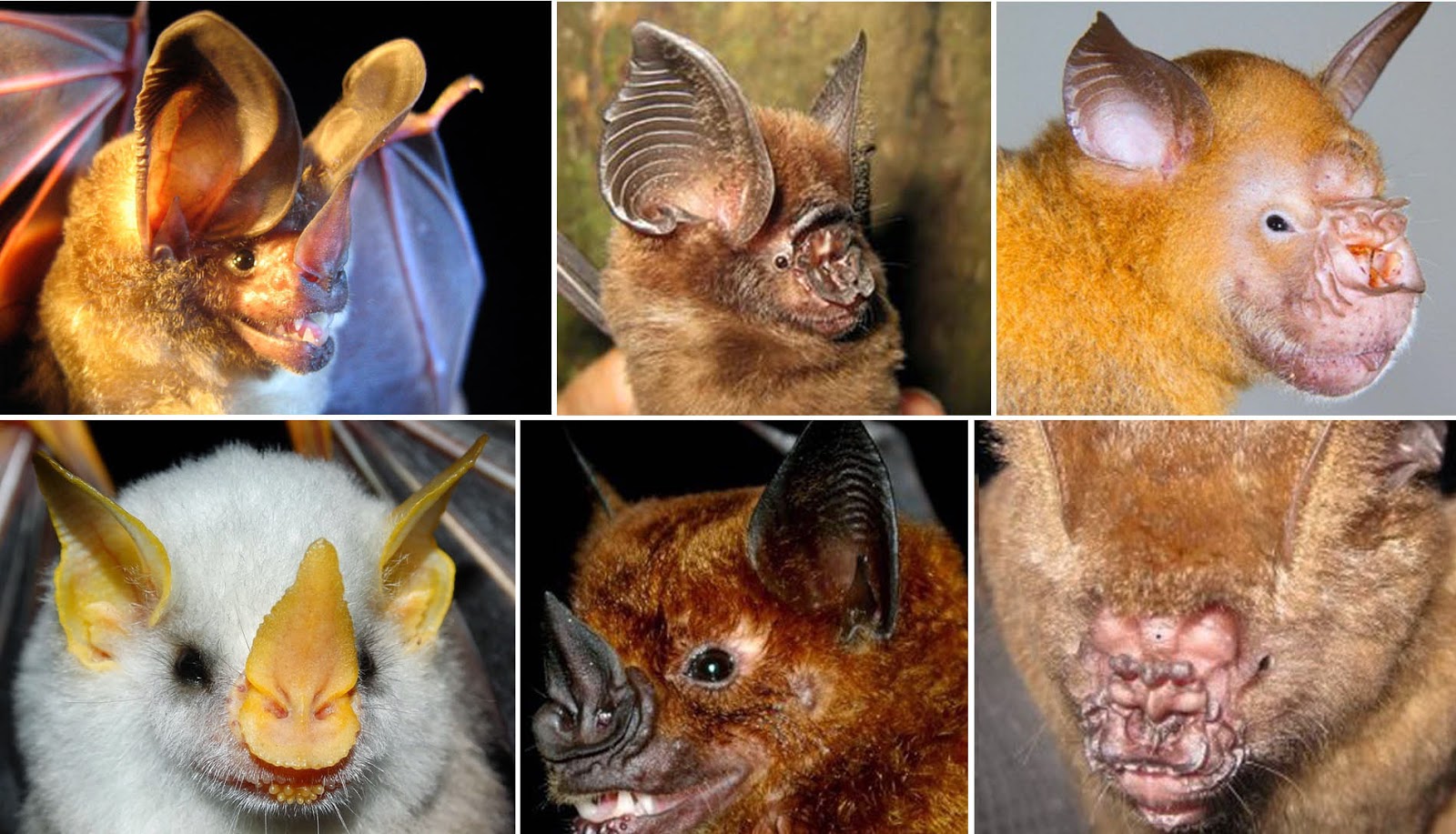
Leaf nosed bats come in some very odd varieties. The picture on the below and right will give you some idea of the shapes and sizes possible. The question is – what’s the reason for these bizarre growths and why isn’t one odd shape enough? The answer will best be found if we know what their function is, because in biology – form follows function (except for proteins, see this post).

Here are some different leaf nosed bats. Top middle is the Ridley’s leaf
nose bat; bottom left is the Honduran white bat. Top right is the
Commerson’s leaf nose bat and the middle bottom is the greater
spear-nosed bat. The bottom right image is of the cleaf nosed bat of
Vietnam, a more newly discovered variety. It was first described in
2008, but it took 4 years to determine if it was a new species or just
a variant of another species.

Two basic needs of the bat are to find food and find its way. Whether it's a fruit bat, an insectivorous bat, or a vampire bat, a bat must be able to negotiate obstacles within its environment and find a source of nutrition.

To accomplish these tasks, especially given that most bats are nocturnal, they use echolocation. They send out a high-pitched sound, and it bounces off objects and returns to their ears. This is very much like the radar used in airplanes. But this isn’t all they use. Bats can see just about as well as humans; the phrase “blind as a bat” might as well be “blind as a Bob.”


We said most bats are nocturnal. This is Livingstone’s fruit bat
or Comoro flying fox. It is a fruit eating bat of the Comoros
Islands in the western Indian Ocean (just northwest of Madagascar)
and is at least partially diurnal. Other bats may be seen during
the day, but it almost always because they have been disturbed
in their hiding place or they were disturbed in their
feeding the night before.
Bats can also smell their way to food, especially fruit bats. But to answer the question about the noseleaves we have to return to echolocation. Vampire bat sounds emitted for echolocation come through their nose, not their mouth! According to a 2010 study, the leaves aren’t used to gather the returning sound, but to focus the outgoing sound so that the “pictures” formed by the returning echos will be most accurate.

Different shapes help to increase the difference in the reflectivity of objects in the area of focus as opposed to those in the periphery. This allows the various species to hone in what they need to discern and dismiss those things that are uninteresting. Different backgrounds and different needs require different nose leaf shapes.

This answers the question about the wild shapes of noses, but it brings up another question. If vampire bats find their food by echolocation, sight, and smell, then why do they have heat sensors?

To answer this new question, consider the sizes of the vampire bat and its intended prey. The bat weighs about 2.5 oz (71 g), but it needs blood for food (mammalian blood for common vampire bats, bird blood for hairy legged and white-winged species). In fact, vampire bats are the only mammals that completely depend on hematophagy (blood meals). Because of this, they often feed on animals that are over 1000x their size.


Pigs are a favorite source of blood for vampire bats. Here, a
sleeping pig has been bitten on the snout. Why the snout – read
on. Notice the bat can hold its weight with its wings, and that
there seems to be more blood than you would expect from
such a small bite. Again, read on to know why.
To get to the blood of say a cow or horse, vampire bats would have to have teeth so large that they couldn’t lift themselves for flight. No, they have to be very careful about where they bite a victim; somewhere that will bring enough blood to feed on, but won’t cause the huge animal to kill them. Vampire bat teeth are so sharp that prey animals rarely feel the bite, and since the bats are nocturnal, the victims are most often asleep at the time and stay asleep during the feed.

The bats need to locate a place on the sleeping animals where blood vessels are near the surface. This is where the heat sensing comes into play. Vessels close to the surface will give off the most heat to the environment, and vampire bats can “see” these vessels from up to 20 cm away!

The vessels in question need to be covered with less hair, so the bat almost always goes for the lower leg or snout. They will land on the ground, and walk or run up to the prey from behind the animal to make the bite. Vampire bats wings are much stronger than most other bats, so they have an easier time moving along the ground, supporting some of their weight on their wings.

On the left you can see the incisors of the vampire bat. The cheek
teeth and canines are used to shave off any hair from the site, but
the incisors do the cutting. The lack enamel, so they are always
razor sharp. On the right, the tongue is being used to take in the
blood. The tongue is deeply grooved, so the anticoagulant saliva
runs down into the wound and more blood can easily be lapped up.
Their teeth then cut a 5 mm x 5 mm gouge in the victim and they lap up the blood that comes out. It isn’t too common, but vampire bats do feed on humans. This leads us to another amazing skill.

Instinct tells the vampire that a good feeding once will probably mean a good feeding again – if they can find the same animal. So how do they find the same animal several night is a row? They hear them.

A 2006 study showed that vampire bats do tend to feed on the same individual (be it human or cow) for several nights in a row. They can distinguish their previous victim by the sounds of their breathing! Every animal has a unique breathing pattern and sound profile, and the vampire bat can distinguish between individuals to find the one that matched a previous good meal. Imagine if we could find our favorite meal again by listening for the clinking of the right pans!

Returning to a good feeding spot each night, the vampire bat searches for a surface vessel to drink about 1-2 teaspoons of blood (4-5 ml). This isn’t enough to harm the animals, and is what allows them to go back several nights in a row.


Rabies can be spread by bats, and they don’t have to bite you.
When a bat bites an infected animal, it takes in the virus. The
virus grows in the animal and gets distributed to the saliva as
well. Startled bats sometimes spit, and if this gets into your
eyes, mouth, nose, or an open wound, you could contract the
infection. It’s rare overall, but rabies kills about 60,000
people a year.
This doesn’t mean that feeding by vampire bats is without negative consequences. One, the idea of being fed on gives me the heebie jeebies. Two, the vampire bat is a common vector for rabies virus. And three, in the cattle of Latin America, repeated feeding by vampire bats is associated with reduced milk production in dairy cattle and reduced mass gain in beef cattle. So if you wake to find a vampire bat licking your ankle, best to shoo him away and try to breathe differently tomorrow night.

How do vampire bats locate that ankle vessel they need to feed on? Back we go to that amazing nose. The heat sensors of bats are called pit organs, just like in the pit vipers we talked about last week. There are three to four of these organs in the noseleaves of the bat, and a couple across the upper lip as well.

As opposed to the pit vipers, vampire bats have adapted a heat sensor, not a cold sensor to use as their infrared detector for blood vessels. TRPV1, the same receptor that is used for the capsaicin burn and heat regulation in mammals, is present in very high numbers in the neurons of the pit organs.

But this is no ordinary TRPV1. Mammals can’t detect heat from 20 cm away with a regular TRPV1 – this is a modified TRPV1.  A 2011 study found that this version of the protein is missing the last three amino acids on the carboxy terminus (the end produced last). This small change increases the sensitivity of the receptor from 43˚C all the way down to 30˚C, so that small differences in heat can be noted from almost a foot away.

One more amazing fact - the bats have regular TRPV1 too. The two version of the protein come from the same gene and the normal one is used throughout the bat’s body for all the things we use TRPV1 for: heat regulation, reproduction, cancer inhibition, etc. Only in the neurons of the pit organs is the mRNA altered after it is transcribed from the gene (alternately spliced) to make the slightly shorter, more sensitive protein.


Here is a cartoon of how blood clots. On the bottom flow chart,
the first anti-co line is where desmolaris and draculin work.
The third line is where desmoteplase acts.
Now our bat friend has located a victim, found a surface vessel and taken a bite to let the blood flow. There’s yet another problem. Mammalian blood clots to prevent loss. The bats must either keep biting, which might wake their prey, or have a way to keep the blood flowing.

Their mouths have specialized salivary glands that make anticoagulants so no clot is formed. There is one anticoagulant that someone with a sense of humor named draculin. It acts to prevent blood clot formation. We have mentioned a second anticoagulant before, called desmoteplase. One of our Halloween posts talked about how it may be good for people that have had strokes. It dissolves any clots that may form.

A 2014 clinical trial is showing that desmoteplase is better than the tissue plasminogen activator clot busters now being used (rtPA), since they have a half-life of four hours (as opposed to 5 minutes for rtPA) and it’s breakdown products aren’t as toxic to nerves and the blood brain barrier as compared to rtPA.

A newer anticoagulant is called desmolaris. A 2013 study showed that it works on yet another part of the clotting system to prevent clot formation. And this isn’t all of them. A 2014 protein survey suggests that there may be dozens more anticoagulant proteins in vampire bat saliva.
Which flying machine is more complex and cool?

Lets add up the vampire bat’s technologies and compare them to an F16. The bat can fly and turn better. The bat has radar and infrared heat detection. It has high powered listening devices that can discriminate between two individuals. Finally, it has biological weapons that allow it to do its work without alarming the target.

All that in a “machine” that can fit into the palm of your hand. Defense aeronautical engineers must feel so embarrassed.

Next week, let’s take it just a bit further. Female mosquitoes aren’t just looking for you, they’re tasting and feeling for you. They use CO2 gradients as well as my prodigious heat to find me on a warm picnicking evening.


Vanderelst D, De Mey F, Peremans H, Geipel I, Kalko E, & Firzlaff U (2010). What noseleaves do for FM bats depends on their degree of sensorial specialization. PloS one, 5 (8) PMID: 20808438

Patel R, Ispoglou S, & Apostolakis S (2014). Desmoteplase as a potential treatment for cerebral ischaemia. Expert opinion on investigational drugs, 23 (6), 865-73 PMID: 24766516

Ma D, Mizurini DM, Assumpção TC, Li Y, Qi Y, Kotsyfakis M, Ribeiro JM, Monteiro RQ, & Francischetti IM (2013). Desmolaris, a novel factor XIa anticoagulant from the salivary gland of the vampire bat (Desmodus rotundus) inhibits inflammation and thrombosis in vivo. Blood, 122 (25), 4094-106 PMID: 24159172

Gröger U, & Wiegrebe L (2006). Classification of human breathing sounds by the common vampire bat, Desmodus rotundus. BMC biology, 4 PMID: 16780579

Gracheva EO, Cordero-Morales JF, González-Carcacía JA, Ingolia NT, Manno C, Aranguren CI, Weissman JS, & Julius D (2011). Ganglion-specific splicing of TRPV1 underlies infrared sensation in vampire bats. Nature, 476 (7358), 88-91 PMID: 21814281


For more information or classroom activities, see:

Leaf-nosed bats –

Echolocation –

Alternate splicing –

Anticoagulants -

Wednesday, May 28, 2014

Cold Receptors Come In From The Cold

Biology concepts – thermosensing, cool sensing, allergy, cross-reactivity, cold allergy, sperm maturation, acrosome reaction, opiate withdrawal


You can be allergic to things that touch your skin – like poison ivy,
things injected, like bee venom, things eaten – like foods, or things
inhaled – like perfumes. But now we need to add something else
to this list – cold? On the right you see a common way to test for
allergy. Anything that produces a wheal and flare reaction
(blanched and raised surrounded by red) is considered positive.
But what if they’re just allergic to the metal needle? 
Allergies can result when your immune system, specifically your mast cells, have an exaggerated response to something that should be innocuous. We have talked about the different kinds of immune hypersensitivity reactions before, but in general, allergy (or atopy, from Greek for out of place) occurs when your body produces a type of antibody (IgE) that recognizes foreign substances and causes your mast cells to release histamine.

Histamine release can lead to itching, watery eyes, runny nose, and even hives (urticaria, from Latin for nettle, see the post on nettle toxins). The IgE is good for helping you learn to avoid poisons and such, but what if your body makes and IgE to something that isn’t dangerous, like peanuts or latex?

Sometimes it isn’t even a case of building an antibody to something that is normally not deemed foreign. Sometimes a peanut molecule just looks enough like some other antigen that an IgE is tricked into binding to the peanut molecule or the banana molecule.

The fruit-latex syndrome is a good example of this. In many cases of people being allergic to latex (Hevea brasiliensis), they also have an allergy to avocados, kiwi fruit, bananas, or chestnuts. The IgE that recognizes the latex hevein protein cross reacts with a beta-glucanase enzyme protein from the fruits.

In the cases of cross-reacting antibodies, there are antibodies to innocuous antigens, your body reacts to them just like they were something dangerous. Histamine release results from IgEs grouping around an allergen and then attaching to a mast cell. If you have encountered this allergen before and have ramped up the number of IgEs that recognize this antigen, the mechanisms can lead to anaphylaxis. This life threatening condition is marked by inflammation that can cut off airways and a lowering of blood pressure that could kill the brain.


Spina bifida patients often develop latex and tropical fruit allergies.
Spina bifida is an incomplete closing of the spinal cord in the fetus
and can lead to severe difficulties in leg movement. It can range from
undetectable to very evident, like in the right image above. Lots of
treatment means lots of chances to develop latex hypersensitivity,
and almost 2/3 of spina bifida patients develop a latex allergy. A 2011
study says that they first develop allergy to latex, and then this cross-
reacts with the fruit. So patients without latex allergy don’t have
to avoid the fruits.
People allergic to nuts or bee stings are forced to carry around injectors of epinephrine just in case their allergies are triggered. The epinephrine constricts blood vessels, increases the heart rate and the amount of blood moved, so your blood pressure won’t drop too far if you take it soon enough. It also dilates the airways and stops inflammation so you can keep breathing. These are all good things.

Like we said, this is how allergies can and sometimes do work. But there are exceptions. Did you know that you can be allergic to cold weather? Yes, I hear you out there, chuckling that you’ve been allergic to shoveling snow for years. But what I’m talking about is a physical allergy – hives, breathing problems, itching, and cough – just because your skin and airways are exposed to cold air.

No – you can’t make an antibody to an environmental condition like cold – at least not as far as I know. But remember that TRPM8 is a cool sensor, stimulated by cold temperatures. What if your body skipped the antibody part and the cold temperature itself stimulated mast cell degranulation (release of histamine granules)? Maybe it does, but whether the cold acts via TRPM8 is another question.


Mast cells (in red) degranulate in response to allergens.
The allergen (1) is recognized and bound by the
appropriate IgE antibodies (2). The end of the antibody
opposite the allergen binding site has a receptor on the
mast cell surface (3). Crosslinking of more than one
surface recpeotr with Ab causes degranulation and
release of inflammatory mediators, like histamine (4)
from the granules usually stored in the cytoplasm (5).
There are only a couple of studies that have looked at TRPM8 and cold-induced urticaria. In 2010, a study using rat mast cells showed that they do express YRPM8 ion channels and that they do release histamine when exposed to cold or methanol (a TRPM8 agonist). The histamine release could be blocked, even at cold temperatures, by treating the cells with a TRPM8 antagonist. Pretty convincing, eh?

But the very next year, another study said it was unlikely that TRPM8 was responsible for cold-induced urticaria. This study used human mast cells and mice. Although they did find TRPM8 channels on the mouse mast cells, they didn’t release histamine in the presence of cold in their experimental model. And the researchers didn’t even find TRPM8 expressed on the human cells. This is a bit unusual, since mice are usually a great model for human physiology.

In mast cells from mice with no TRPM8 channels (TRPM8 knockout mice), the mast cell response to cold was normal, so this study concluded that TRPM8 is not involved in cold urticaria. Confusing, but a good opportunity to cheer the relentlessness of science. Study will continue until something is repeatable and can’t be proved wrong. Maybe it will be you – curing cold allergy might not make you rich, but cold-triggered asthma follows a similar stimulation – and solving that little problem will get you a Nobel Prize and a big fat check.

How about another exception? One important difference between TRPV1 warm/hot sensor and TRPM8 cool/cold sensor is that TRPV1 is often located on pain neurons, while TRPM8 is located on other types of neurons and other cell types. TRPM8 activation is not associated with pain sensation directly, since they don’t help depolarize pain neurons. But there is an exception – your teeth.


The left cartoon shows the dentinal pores and how they have
odontoblast processes in them. If the dentin is expose by
receding gums or by decay, the pores are then exposed. On
the right, different stimuli can cause the fluid in the pores to
move, which then puts strain or stretch on the processes, this
causes shifts in ions and that can cause the neurons to fire. These
neurons only carry one message – pain.
Inside the middle of each tooth is the pulp (in the pulp chamber), made up of a few layers of cells that can make more tooth material (odontoblasts), some blood vessels, and a set of nerves. Odontoblasts make a product called dentin, which is hard, but not as hard as enamel. The enamel on your teeth is not very thick, most of the structure is dentin. As you age, insults to the tooth (like decay), can stimulate the laying down of additional layers of dentin inside the pulp chamber.

The dentin has minute pores that travel out from the middle to the base of the enamel layer. If decay or some other stimulus reaches the pore, processes (like fingers) of the odontoblasts in the pores can react to the stimuli. These then signal the neurons in the pulp. However, the pulp has only pain sensing neurons. So every stimulus that reaches the pulp will be interpreted as pain.

The odontoblasts have TRPV1 channels, TRPM8 channels and TRPA1 channels (we will talk more about these next week). The hydrodynamic theory of tooth pain says that the changes in temperature that reach the odontoblast processes result in pressure changes and this puts mechanical stress (stretch or shear) on the membranes. These then trigger the channels and the signal is passed to the pain neuron.

A 2013 PLoS study says this is partially true. Their results seem to indicate that very cold and very hot stimuli do produce mechanical pressure on the membrane, so TRPV1 and TRPA1 are responsible for mechano-sensitive pain. But they suggest that in the case of TRPM8, cool/cold temperatures trigger the odontoblasts and neuron. The neuron only has one thing to say - pain – so when triggered by TRPM8 signals in the neighboring odontoblast, it responds the only way it knows how. Too bad, but it has spawned a million dollar industry in toothpastes for people with sensitive teeth.


This is a cartoon of the head of a sea urchin sperm, but many
of the concepts apply in humans as well. See all the red
arrows? Those represent the places where calcium flux is
important in maturation and function. And what do TRPV1
and TRPM8 move the best – calcium. The acrosome reaction
actually dissolved the membrane around the acrosome so that
it can more easily enter the ova. This has to be done at a proper
time; TRPM8 activation prevents it from happening too early.
Here’s another TRPM8 function that we will touch on only briefly. We talked about TRPV1 being important in sperm maturation and in entry into the egg. Well, it looks like TRPM8 is involved as well, only in the opposite direction. TRPM8 signaling, according to a 2011 study, TRPM8 activation prevents sperm maturation. This is also important, you need the capacitation and the acrosome reaction to occur at the proper point because they shorten the sperm survival time.

TRPM8 signaling prevents the acrosome reaction, but when the egg is near, a chemical called CRISP4 is released from the egg or parts near there. CRISP4 is a TRPM8 inhibitor. When TRPM8 is inhibited, now TRPV1 can be stimulated to trigger the acrosome reaction.

The interesting part here is that up to the point of CRISP4 release, something is constantly stimulating TRPM8 activity in the sperm cell. I really doubt that there's a cold stimulus way up inside the uterus, so just what is activating TRPM8? We know about lots of endogenous activators of TRPV1, but there has only been one study saying that TRPM8 might have a body-produced agonist, a type of lipid called lysophopholipids. But I think we are missing a bunch of other agonists – maybe you could look for those someday.

OK, here’s the last weird function for TRPM8 today. Would you believe it works in morphine action and withdrawal (when addicted)? Opiates like morphine are analgesic and cold antinociceptive. You take morphine and you don’t sense cold – of course, you won’t sense much of anything else either. For cold, we know how it acts. Opiates cause the internalization of TRPM8 channels on neurons. If there are no exposed channels, they can’t be triggered to allow ions into the neuron.

It goes even further; this isn’t some byproduct or side effect. Menthol is known to create analgesia (one of the reasons they use it in cigarettes). But according to a 2013 paper, if you give naloxone (an opiate blocker) at the same time as menthol – no analgesia. TRPM8 internalization is required for morphine to work.


The term, “cold turkey” is fairly old, first appearing in print
around 1910. It means “without preparation,” but just where
it came from is a matter of question. It might refer to the fact
that cold turkey after Thanksgiving doesn’t need preparation.
It might also be related to “talk turkey, which means to get
down to business. But the way that drug addicts feel cold,
sweat, are pale and have goose bumps – the visual aspect is
not wasted. By the way – who would smoke a cold turkey?
This is important when you are trying to kick a morphine habit. As you stop taking the opiates, TRPM8 quickly relocates to the membrane of the cell and is very easily activated. This causes a cold hypersensitivity and hyperalgesia. People going through withdrawal feel cold because their TRPM8 channels are firing. This is one explanation for calling it, “going cold turkey.” It is uncomfortable and painful, and is one of the main reasons that patients fail detox.

The naloxone that is used to treat morphine addiction binds to the opioid receptor, but doesn’t produce the analgesia. It also allows the TRPM8 to remain externalized, so they don’t have the rebound feeling of cold and pain. Pretty impressive – and now you know how it works.


Next week – TRPM8 is for cold, then there’s the cold that hurts. That is a different receptor, called TRPA1. It makes cold hurt, abut it also saves you from the cold.


Gibbs GM, Orta G, Reddy T, Koppers AJ, Martínez-López P, de la Vega-Beltràn JL, Lo JC, Veldhuis N, Jamsai D, McIntyre P, Darszon A, & O'Bryan MK (2011). Cysteine-rich secretory protein 4 is an inhibitor of transient receptor potential M8 with a role in establishing sperm function. Proceedings of the National Academy of Sciences of the United States of America, 108 (17), 7034-9 PMID: 21482758

Shapovalov G, Gkika D, Devilliers M, Kondratskyi A, Gordienko D, Busserolles J, Bokhobza A, Eschalier A, Skryma R, & Prevarskaya N (2013). Opiates modulate thermosensation by internalizing cold receptor TRPM8. Cell reports, 4 (3), 504-15 PMID: 23911290

Medic N, Desai A, Komarow H, Burch LH, Bandara G, Beaven MA, Metcalfe DD, & Gilfillan AM (2011). Examination of the role of TRPM8 in human mast cell activation and its relevance to the etiology of cold-induced urticaria. Cell calcium, 50 (5), 473-80 PMID: 21906810

Cho Y, Jang Y, Yang YD, Lee CH, Lee Y, & Oh U (2010). TRPM8 mediates cold and menthol allergies associated with mast cell activation. Cell calcium, 48 (4), 202-8 PMID: 20934218


For more information or classroom activities, see:

Cold allergy –

Hydrodynamic theory of tooth pain –

Sperm maturation –

Drug withdrawal –