Showing posts with label evolution. Show all posts

Thursday, December 7, 2017

Many Paths To The Top Of The Mountain

Biology concepts – hydrogenosome, FeS cluster protein, loricifera, erythrocyte


More than one way to skin a cat seems to
be a newer version of the old British saying,
“there are more ways to kill a cat than by
choking it with cream.” Mark Twain was one
of the first to use the cat skinning version, in his
classic A Connecticut Yankee in King Arthur’s
Court.
The old Chinese proverb says, “There are many paths to the top of the mountain, but the view is always the same.” Put somewhat less delicately, “There’s more than one way to skin a cat.” Who wants to skin a cat? I think there is something to be said for the wisdom gained in 4000 years of culture, to say nothing of the ability to say it better.

In biology, this is particularly relevant; organisms have found different ways to do the same things, and different ways to do different things, but the end goal is always the same – live long enough to reproduce and the more offspring the better.

Last week we talked about how some organisms have degraded their mitochondria into mitosomes, and how they get along fine just using glycolysis and fermentation for energy (and maybe some arginine dihydrolase action). But there is another mitochondrial remnant in some other species of anaerobic eukaryotes called the hydrogenosome, and it works more like a mitochondrion than does the mitosome.


Here is the T. vaginalis protist. The blue probe
binds to DNA (just one nucleus for this guy) and
the yellow probe binds to a hydrogenosome
protein. The strands at the top are the flagella it
uses to move, not its hair.

Trichonomas vaginalis is a eukaryotic amitochondriate, and therefore is an anaerobic (without oxygen) protozoan. Unlike many protozoans, T. vaginalis does not have an environmentally resistant form (something that can live outside the host for a prolonged time – often called a cyst). It is transmitted directly from host to host, in this case sexually. Trichomoniasis is the most common curable sexually transmitted disease, but 70% of cases have no symptoms (asymptomatic). This is unfortunate because T. vaginalis infection can predispose to HIV infection and even cervical cancer. Having symptoms initially might prevent some of the later tragedies.

Unlike the mitosome containing protists, T. vaginalis does use its mitochondrial remnant (hydrogenosome) to make ATP. The hydrogenosome was discovered much earlier than the mitosome, although they have the same origin and general morphology. Because of this difference in timing, amitochondrial organisms with hydrogenosomes are called type II amitochondriates. Type I’s were the organisms that presumably didn’t have any mitochondrial-like organelle (and were seen first), like the Giardia and E. histolytica that we now know have mitosomes.

Pyruvate generated by glycolysis enters the hydrogenosomes just like it does in mitochondria. The Krebs cycle would be next for aerobic organisms, but in the hydrogenosome, iron-containing enzymes convert the pyruvate into an intermediate that has CoA (coenzyme A) bound to it. When this CoA is removed, energy is released, and this energy is used to convert ADP to ATP.

Because ATP production occurs at the level of substrate (a molecule being chemically changed, in this case by an enzyme), it is called substrate level phosphorylation. This is in contrast to the use of oxygen and the electron transport chain of proteins to produce ATP through the proton gradient (oxidative phosphorylation). One of the byproducts of the pathway is hydrogen, hence the name of the organelle.

In terms of energy production, the pyruvate:ferredoxin oxido-reductase (the iron/sulfate-containing enzyme in hydrogenosomes, often abbreviated as FeS cluster enzymes) pathway is about as efficient as the arginine dihydrolase pathway (ADH) in some mitosome-containing organisms. However, T. vaginalis also contains the ADH pathway, so it comes out ahead of Giardia in terms of energy production.

While the hydrogenosome has some activity in energy production via the FeS-protein mediated metabolism of pyruvate with production of ATP, the mitosome seems to be limited to the assembly of the FeS clusters only. A study of the proteins of the mitosome show the parts are there to make the FeS clusters, but that there are not the enzymes needed to break down pyruvate and produce ATP.


A study trying to quantify the amount of methane
gas produced by cows was carried out recently
in Argentina. The method involved a big backpack
and a delicately placed rubber hose. At some point,
scientist A approached scientist B and said, I’ve
got a great idea….”
Other hydrogenosome-containing organisms include the anaerobic unicellular fungus, Neocallimastix frontalis (it lives in the guts of rumen animals like cows). N. frontalis byproducts are used by gut methanogens (methane-producing bacteria) and therefore contributes to the generous amount of gas produced by cows. Many estimates name dairy and beef cattle flatulence as a bigger source of greenhouse gases than automobiles!

Another hydrogenosome-containing protozoan is Nyctotherus ovalis. It lives in the GI tract of cockroaches, and efficiently works with an archaeal bacterium that uses the hydrogen that the hydrogenosomes release. Just one more reason that cockroaches will outlast us all. The fact that some fungi and some protozoans have hydrogenosomes indicates that this organelle has evolved independently from mitochondria at least three different times in history – they must be a good idea.

Even with the exception of anaerobic protists and fungi, it was believed until just recently that at least all multicellular eukaryotic (metazoan) organisms depended aerobic respiration for energy production. However, there are even metazoan exceptions. A 2010 study of the bottom of the Mediterranean Sea found three different animals that survive without using oxygen and therefore don’t have mitochondria.

The deepest basin of the Med, near Greece, is nearly anoxic (an environment without oxygen).  In the muds of this basin were found three loriciferan (lorici = corsette and fera = bearing, so organisms with a sort of girdle) species that live in this area all the time. Other animals can survive in an anoxic environment for a while, but they don’t call it home.
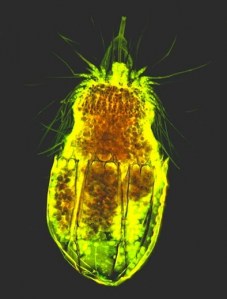

Loriciferans weren’t even discovered until 1983.
Now we have some that live as anaerobes. Most
species of this phylum live in the deep waters,
but only a few are obligate anaerobes, meaning
they can only perform anaerobic respiration.
Oxygen can be damaging, it likes to scavenge
electrons, I wonder if it is toxic to the loriciferans.
These new loriciferans have hydrogenosomes instead of mitochondria, and produce ATP in the same ways as T. vaginalis and the other anaerobic eukaryotes. This is a completely new door being opened in biology, because the multicellular animals evolved after Earth turned from an anoxic environment to a place where oxygen was plentiful. It seems that even some of the more advanced organisms don’t have a problem reverting to more ancient systems if they find themselves in a place where they need it.

Would you believe that some of your cells might not have mitochondria? Well, about 26 trillion of your cells (if you’re an adult male) are amitochondrial – your red blood cells. That’s right; the erythrocytes that deliver oxygen to your cells in order so they can make ATP in their mitochondria don’t have any mitochondria of their own! In an attempt to carry as much oxygen as possible (bound to a big molecule called hemoglobin) your red blood cells have evicted their mitochondria.

This is probably a good idea, since making energy in the erythrocytes would use up the oxygen they are supposed to deliver to other cells. Instead, they act more like prokaryotes, and carry out glycolysis and lactic acid fermentation in their cytoplasm for the energy they need. To gain more room for hemoglobin, the RBCs have also done away with their nucleus.  They have no way to produce more proteins or repair themselves, so they work as long as they can and then they are replaced.

Old erythrocytes are phagocytosed (eaten) by macrophages in the spleen and liver and are destroyed. New RBCs (about 2 million per second) are produced in your bone marrow. The spleen also acts as a reservoir for blood cells, a ready supply for when you need them, but you can get along without it, you are just more susceptible to infections, since the spleen houses many white blood cells just waiting to recognize a pathogen that needs to be taught a lesson.


Human red blood cells (left) are round and biconcave,
but the camel RBCs are oval. You can see why so many
people believe they have a nucleus, but what you are seeing
is their biconcave side staining darker. The large cell in the
middle is an immune cell.
Anucleate (a = without, and nucleate = pertaining to a nucleus) erythrocytes are the norm for mammals. Many people think that camels are the exception, that they have nucleated RBCs, but this is not so. But they do have ovoid RBCs. When they run low on water, camels can remove water from their blood and use it in their cells. This leaves their blood thicker and harder to push through the small capillaries. Round RBCs would be impossible to squeeze through when the blood is viscous, so the camel has evolved RBCs that are longer in one direction and smaller in the other, to help blood flow in times of dehydration.

On the other hand, almost all non-mammalian vertebrates do have erythrocytes that do have nuclei. The only exceptions are a few salamander species that have some anucleate erythrocytes. For example, 95% of the Batrachoseps attenuatus salamander’s RBCs are anucleate. There is also the pearlside fish which is known to have non-nucleated red blood cells.

However, the crocodile icefish is even a bigger exception; it is the only vertebrate animal that has gotten rid of its RBCs altogether. This species lives in cold, highly oxygenated waters. The oxygen it needs just travels in the blood as a dissolved gas and is carried to every cell. These fish have even lost the DNA for making hemoglobin – now that is efficiency!


Given our apparent complexity, it is amazing
just how few genes humans have; the grape
has almost 30% more. The chicken doesn’t have
many fewer than us, and we don’t have to worry
about laying eggs. What is more amazing is that nine
years after the completion of the human genome
project, we still aren't exactly sure how many
genes we have.
Or is it? We have recently discovered that the majority of proteins have more than one function. Scientists gave this idea more thought when the results of the human genome project started to role in and we discovered far fewer genes than we expected. It is now accepted that humans have about 22,000 genes, not even as many as the grape, which has 31,000. Even the lowly fruit fly has 15,000 genes! How do we get so many functions out of so few gene products? Multitasking!

Take hemoglobin for example, it doesn’t just carry oxygen in the blood. It also acts as an antioxidant in several types of immune cells, and in certain neurons. It is a regulator of iron uptake and metabolism, since it carries iron at its core. It destroys nitric oxide, which is one reason why the little blue pill doesn’t work forever. You have to wonder what else the crocodile icefish has lost by giving up its hemoglobin and how it has made up for these losses. One change probably requires many more to be made as well.

We have seen how some organisms get along without mitochondria. What about the other end of the energy equation? Plants can make their own carbohydrate in the chloroplast – but is that what makes it a plant? Let’s look at this next time.


Roberto Danovaro, Antonio Dell'Anno1, Antonio Pusceddu, Cristina Gambi1, Iben Heiner and Reinhardt Møbjerg, & Kristensen (2010). The first metazoa living in permanently anoxic conditions. BMC Biology DOI: 10.1186/1741-7007-8-30

For more information or classroom activities on hydrogenosome, FeS cluster protein, loricifera, erythrocyte, see:


Hydrogenosome –

FeS cluster protein –

Loricifera –

Erythrocytes –

Thursday, November 2, 2017

Extremophiles Are Key, Or Archaea

Biology concepts – archaea, bacteria, domains of life, hydrothermal vent ecosystem, chemosynthesis

What is a bigger mistake – to overestimate or to underestimate? If you overestimate someone, you may be disappointed with the result. If you underestimate, you may never realize what they are capable of accomplishing. What is more, your underestimation may cause you to miss incredible things already taking place.


Underestimate the power and importance of
wee small things at your peril. The atom holds
extreme amounts of energy, and we depend on
the tiniest of prokaryotes for our survival on Earth.
It would be a mistake to underestimate the grit and power of some of nature’s smallest organisms. We could talk about this for months, but why don’t we stick to the discussion of prokaryotes and their ability to get along without conventional organelles that we began last week.

We can go farther in praise of the prokaryote by looking at how some of them manage to live in the most inhospitable environments; places that would kill us in seconds, or at least we hope they would. These are the “extremophiles;” the name makes them sound like Saturday morning cartoon superheroes.  For example, Thermococcus gammatolerans is the most radiation tolerant organism on Earth. It can laugh at gamma radiation levels 100x higher than other resistant organisms, even though it lives at the bottom of the sea.

As a result of the molecular biology revolution, many of the extremophiles are now called Archaea (Greek for “ancient”) or archaeabacteria, a completely group of organisms. Archaea are older than bacteria, and but they have some similarities to bacteria. Archaea are generally smaller than bacteria, but the cell wall of most archaea looks just like that of Gram+ bacteria. This is a thicker cell wall than that of Gram- bacteria, and takes up the Gram stain, hence the name Gram+.


The archaea cell wall is thick, and is contiguous with the cell membrane, 
like that of Gram+ bacteria. Gram- bacteria have thinner walls and 
they have a periplasmic space between the wall and the membrane.
Just looking at archaea and bacteria through a microscope makes it hard to tell the difference between these two distant relatives. It is at the molecular level that most of their differences become apparent. The way that archaea make RNAs is more eukaryotic than bacterial and while they both have cell walls, the lipids that make up archaeal membranes are quite different. Archaea lipids are hydrocarbon based, not fatty acid based like those of eukaryotes and bacteria. Also, archaeal cell walls lack the peptidoglycan that is characteristic of bacterial cell walls. Peptidoglycan synthesis is a common target of antibiotics, like penicillins, cephalosporines, and vancomycin.

This last difference might work out O.K. for us as humans. Not a single disease can be attributed to an archaea – yet. This is a big exception. Every other group of organisms on Earth has at least some members that can do humans harm, even if only inadvertently. Fungi, protozoa, bacteria, even plants can all cause us harm. One study says it is unlikely that we have just missed disease-causing archaea. About 0.38% of bacterial species cause disease, so if diversity in archaea is similar to that in bacteria, we should have found about 20 disease causing archaea by now.

Gum disease (periodontitis) has an outside chance of having an archaeal cause, but the evidence is sketchy. In a couple of studies, the presence of archaea in the mouth has correlated with gum disease; if archaea were present, then there was disease. Also, higher archaea number correlated to more severe disease. But archaea were only present in 1/3 of all cases of periodontitis – this is not good evidence to say archaea are the cause of periodontitis. This is the closest we have come to finding an archaeon with an anti-human bent.

Some archaea are thermophiles (heat loving); they don’t just like it hot, some require it really hot. Many thermophiles live in near undersea hydrothermal vents, where heat from the Earth’s mantle and core escapes into the ocean; basically ocean volcanoes.


The hydrothermal vent is an ecosystem that one
would be hard pressed to call home. Varies from 700˚C
to 4˚C, it is acidic, toxic, and radioactive. Yet many unique
prokaryotic and eukaryotic organisms live nowhere else.
To each his own.
Near a thermal vent, the temperature can reach 400-410˚C (700-720˚F) . The water doesn’t boil because of the great pressure exerted on it by all the water above it. No eukaryotic organism can survive at these temperatures, but thermophiles like T. gammatolerans do just fine. The hydrothermal vents pour out high levels of gamma type ionizing radiation from deep in the Earth, so it is handy that this archaeon is a multi-extremophile.

Only a few feet away from the vent the temperature of the ocean bottom will remain near freezing, about 4.5˚C. Other archaea (and some true bacteria) thrive in this cold environment. Called psychrophiles, cold tolerant archaea have cell walls that resist stiffening in water that is even below freezing temperature, and can fill there cytoplasm with anti-freeze proteins (AFPs; they create a difference between a solution melting point and its freezing point, called thermal hysteresis).

Between these two extreme environments, you can find quasi-conventional animals. As the hydrothermal vent water gives up its heat to the surrounding ocean, it creates an area that holds a temperature of about 10-15˚C. Many interesting animals have been found in this area, including the yeti crab and tube worms. Data from January 2012 describes a pure white octopus found at a depth of 2,394 meters. At this depth there is no light, so the octopus has no need for the elaborate camouflage mechanisms of color and texture. This octopod may represent a new species, but other white, vent-dwelling octopuses have been described previously, just not this far south.


This is the yeti crab (Kiwa hirsute). It is white because it lives
in the dark. It is furry because……..well, it makes the name
appropriate. Actually, the setae (hairs) contain bacteria that
may act to detoxify the water from the hydrothermal vents
where it lives. And it isn’t really a crab either, but I’m not
going to tell it so.
Ultimately, even these animals depend on the archaea for survival. No photosynthetic producers can survive at these depths, so the food chain starts with the chemosynthesizing prokaryotes, particularly those that use hydrogen sulfide to produce energy. Hydrogen sulfide is a major constituent in the hydrothermal vent output…. and would kill us quickly by binding to the enzymes in our mitochondria that perform ATP synthesis.

Some animals, like snails, eat the chemosynthesizing prokaryotes directly, while others predate the snails, etc. On the other hand, tube worms (Riftia pachyptila) get their energy directly from thermophilic proteobacterium that live inside the worm in a symbiotic relationship.

Other archaea live in high salt environments, like in the Dead Sea or the Great Salt Lake. They must be lonely, because given the high salinity, they are the only things living there (Water, Water Everywhere, But….). On the grosser end of the scale, some archaea thrive in human sewage plants, working well in environments without oxygen and high nitrogen contents.

Archaea have also been found in natural asphalt lakes, like near the La Brea region of Trinidad and Tobago. With toxic gases, high temperature, and practically no water at all, it was surprising that scientists found so many different kinds of prokaryotes, including several types of archaea. These 2010 findings suggest that life on other planets might not necessarily depend on water – that would be one heck of an exception!

But not all archaea are extremophiles, and they turn out to be much more common than we had thought. This isn’t just a numbers game, it turns out that we have been underestimating their effects on our lives all along. For instance, nitrogen fixation is crucial for crop production. A 2006 study by Schleper et al. in Norway suggests that there are many more ammonia oxidizing archaea in the soil than there are nitrogen fixing bacteria.


Archaea are responsible for much of the primary production that 
occurs in the soil and in the water. Just the methanogenic 
archaea alone are responsible for nearly 2% of all the carbohydrates
produced on Earth. Archaea contribute to the primary production 
of every ecosytem.
Further, current evidence suggests that archaea may represent 25-84% of all primary production (creation of carbohydrates and other organic compounds from inorganic carbon sources, whether by photosynthesis or chemosynthesis) in the upper layers of seawater. Primary production is the beginning of every food chain, so ultimately all of our food depends on archaea as well. To bad that we have been underestimating our dependence on these oldest of life forms. Who knows what our effects our life choices have been having on them all these years.

On the other hand, not all extremophiles are archaea either. Thermus aquaticus is a bacterium that lives in hot sulfur springs and geysers. It is a chemosynthesizing bacterium that has become important in molecular biology. Since its enzymes can tolerate high temperatures, it is useful for replicating DNA sequences in the lab using the polymerase chain reaction. One step in this reaction requires high temperature and would kill most other enzymes. 

Amazingly, this PCR technology and T. aquaticus polymerase has been crucial for helping us see how important the archaea have been in our evolution. In 1977, scientists Carl Woese and George Fox began DNA sequencing of some the extremophiles. They recognized that archaea were very different from eubacteria. The two groups must have diverged long long ago.


The three domains of life are shown here. The length of line shows 
the evolutionary distance between domains. You can see that 
Archaea are more like us than are the bacteria. You can’t tell from 
this chart, but Archaea are older too. They are the roots
of our family tree.
It turns out that Archaea are as closely related to eukaryotes as they are to eubacteria. This stood science on its ear. Up to this point, scientists had been arguing as to whether there were four, or five, or six kingdoms. Now they had to impose a higher classification which superseded all the kingdoms.

Woese’s evidence has led us define to the three domains of life. One domain is the eukaroytes, all the cells with a nucleus (with exceptions, but we can talk about those later), with linear chromosomes instead of one circular piece of DNA (again with exceptions), and with organelles. The second domain is the archaea and the third domain is the bacteria. Six kingdoms follow from these domains; archaea, bacteria, protista, fungi, plantae, and animalia.

Archaea, bacteria, and eukaryotes; we have shown that they are all different, and yet they all developed from some single precursor cell. Next time we will see if our discussion to this point gives us a roadmap to get from that ancient first cell to us.


Rogers, A., Tyler, P., Connelly, D., Copley, J., James, R., Larter, R., Linse, K., Mills, R., Garabato, A., Pancost, R., Pearce, D., Polunin, N., German, C., Shank, T., Boersch-Supan, P., Alker, B., Aquilina, A., Bennett, S., Clarke, A., Dinley, R., Graham, A., Green, D., Hawkes, J., Hepburn, L., Hilario, A., Huvenne, V., Marsh, L., Ramirez-Llodra, E., Reid, W., Roterman, C., Sweeting, C., Thatje, S., & Zwirglmaier, K. (2012). The Discovery of New Deep-Sea Hydrothermal Vent Communities in the Southern Ocean and Implications for Biogeography PLoS Biology, 10 (1) DOI: 10.1371/journal.pbio.1001234

For more information and classroom activities on archaea, hydrothermal vents, chemosynthesis, and domain/kingdoms, see:

Archaea and extremophile bacteria –

Hydrothermal vents –

Chemosynthesis –

Domains/kingdoms -

Wednesday, July 20, 2016

Take Off Your Coat And Stay Awhile

Biology concepts – thermoregulation, ectothermy, endothermy, genetic mutation 

Let me introduce you to the most wondrous animal on the surface of the Earth, or under the surface of the Earth – the naked mole rat, Heterocephalus glaber (hetero  = different and cephalus = headed, refers to the fact that it lives in a colony where different members have different jobs; glaber = smooth skin).

Why, you ask, is this pruny thumb with two eyes the most incredible animal? Its odd looks and cutsie pink color belie the fact that this rodent is the most heinous rule breaker in all the biological world. It hasn’t meant a convention it wouldn't defy or a norm at which it wouldn’t thumb its nose.


Meet H. glaber, the naked mole rat. He has teeth, pink skin, and a probable
inferiority complex. The right image shows that H. glaber is not much bigger
than the thumb he resembles.
Take for instance, its name – NAKED mole rat. It is a mammal, but it’s naked. Mammals are always covered with hair or fur, but not his guy. Even we humans, the most hairless of all the apes (except for Robin Williams, he looks like he wears a sweater into the pool), look like we’re covered in fur compared to this rodent.

Look at yourself in a mirror. There’s hair on top of your head (well at least most of you). There is fine, unpigmented vellus hair (vellus = fleece in latin) that we know as peach fuzz, on your arms and legs when young and more coarse hair when older. You see eyebrows, and nose hairs as well. There is hardly a spot on us that isn’t hairy, save the palms of our hands to increase friction for gripping, and the soles of our feet, probably to keep it from tickling when we walk.

H. glaber eschews all this hair, but even he isn’t completely naked. From the picture, you can see the several sets of whiskers protruding from the wrinkly pink face that only a very devoted mother could love. The whiskers are crucial to helping the mole rat make its way in its surroundings, and therefore have not been lost, but why on Earth is it nearly naked?


The horn of Africa, a great place not to be noticed, and hot enough
to make underground living a plus.
The reason lies in how and where the naked mole rat lives. Found only in the desert of the horn of Africa (Ethiopia, Kenya, Somalia, Eritrea), this rodent that is neither a mole nor a rat lives underground its entire life. It burrows to find roots to nibble on, and they can be few and far between – it’s a desert for crying out loud!

In its tunnels, body hair imparts no advantage, and can contribute to negative outcomes, such as carriage of parasites (this is why scientists believe humans lost most of their hair), overheating, or getting stuck in narrow spaces. The mole rat’s skin helps with this last problem, although it seems counter-intuitive. Defensive lineman in football like to wear very tight uniforms so that the offense has nothing to grab a hold of, and it would follow that a tight skin on the naked mole rat would also help it slide around and not get caught on anything.

But the advantage to big skin is that the rat can turn around almost completely in its uniform, and dig from any direction to move itself along. Like the owl that can turn its head 270˚, the naked mole rat can rotate its whole body to get out of a jam. That loose skin is also helpful in traffic jams; mole rats can slip past one another in a tunnel without even slowing down.

The whiskers serve to guide the mole rat around in its dark environment. It feels its way, it feels for its food, and it feels other mole rats that it may meet in the tunnels. Therefore, the hairs it has kept serve a definite purpose, and one can see why there are whiskers along its entire body, as opposed to just around its nose (see photograph above).

Other mammals might appear to hairless, some even have it in their name, but they don’t match H. glaber for nakedness on an overall basis. Rhinoceroses, elephants, pigs, they all have coarse hair on many parts of their bodies, so they can’t compete for the world hairlessness title. Even marine mammals like whales and dolphins have some hair (mostly when they are younger) and have nose hairs as well (so I’m told – I never looked up a dolphin’s nose). The Sphynx cat is supposedly hairless, but its entire body is covered in vellus hair.

Dolphins have whisker as infants, and the whisker pits help sense electrical fields. The Sphynx cat was revered by the ancient Egyptians, which was fine, because the Egyptians shaved off most of their own hair. On the right, the Xoloitzcuintli was said by the Aztecs to guard human souls in the underworld. It looks intimidating enough to be good at that.

Finally, there is the Mexican hairless breed of dog, properly called the Xoloitzcuintli or Xoloitzcuintle. While some of these dogs are completely hairless, it is a mutation rather than normally occurring. Hairlessness is the dominant form of the mutation, but even most of these animals have hair on their heads and tails. It is less common that the dog is completely hairless.


Powder was a 1995 movie about a young man with alopecia
universalis amidst other issues, like psychokinesis and a lack
of sun exposure.
Humans can also be hairless, called Alopecia universalis (alopecia is Greek for “fox mange” and universalis means everywhere). The condition is an autoimmune disorder, meaning that our own immune system has decided that our hair follicles are no longer part of us and are attacked as being foreign. Many human diseases can be autoimmune in origin, including diabetes and muscular dystrophy.

But of all the animals mentioned, H. glaber takes the crown as hairlessiest! And it serves a good purpose. Along with living underground, living in a community, having smooth skin, living in a desert, and having a limited food source – these features have contributed to another decision nature has thrust on H. glaber, it is ectothermic! It doesn’t warm itself, rather it assumes the temperature of its surroundings. Is that any way for a self-respecting mammal to behave?

In the cold, hair traps air and keeps it close to the body to act as thermal insulation. However, H. glaber is communal, and they have larger chambers in which they all huddle together during sleep. Over the course of the cold desert night, the mole rats will rotate positions, so no one animal is on the outside for too long, much like penguins do in Antarctica. This keeps them warm and negates the need for hair as an insulator.

The communal sleeping is just one aspect of the social life of H. glaber. There are one of only two eusocial mammals. The have a queen and a caste system, like many bees and ants. A recent study shows that the queen is very important to the building of the tunnels, as well as all aspects of H. glaber life. 

The tunnels of each worker may be widened to form sleeping chambers or pup rearing chambers, but which. The 2012 study indicates that the presence of the queen will increase the dirt moving by all castes, while workers will work more than the others if she is not present. What is more, the odor of the queen is enough to increase the dirt moving in a particular area, so her movements do influence the geometry of the nest.


An arrector pili muscle is attached to every hair on your body. You can
see that if it contracts (shortens), the hair will stand up. Thank you,
black cat for the Halloweenish demonstration.
Hair can also act to dissipate heat. In most mammals, each hair is attached to a small muscle (arrector pilori; pili is the plural) that can stand the hair on end and release the trapped warm next to the body, cooler air will then carry the heat away from the skin and the hairs, thereby reducing the temperature of the animal. Interestingly, this same action is seen when we get scared. The fright or flight release of adrenaline causes the arrector pili muscles to contract; think of how a cat’s tail gets bushy and the hair on its back stands up when scared. The arrector pilli muscles will also spasm in an effort to produce added heat when the skin gets cold (goose bumps).

Being underground all the time means that H. glaber is protected from the most intense heat of the desert day and therefore needs fewer thermoregulatory mechanisms.  So, the naked mole rat doesn’t need to dissipate heat via the arrector pilli action.

Finally, by practicing ectothermy, the naked mole rats reduce the amount of food they have to consume; they don’t need all that energy to produce heat and maintain a constant temperature. This works out well for them, since they live in the desert where there isn’t a heck of a lot food for them anyway. Could H. glaber have ended up as anything other than ectothermic? Its design just makes too much sense for its environment. We could learn a thing or three from how nature has tweaked its design.

And we have only scratched the surface of the ways that this rodent refuses to conform to established biological norms. Future posts will introduce more aspects of this amazing animal’s physiology, including longevity, pathology (or lack thereof), social structure, senses, immunity, biochemistry, and reproduction.

But you’ll have to wait for those stories. Next time we will turn our attention to a necessity of all life, sleep. But aren’t we learning that no single characteristic applies to ALL life – there’s always an exception.


Kutsukake, N., Inada, M., Sakamoto, S., & Okanoya, K. (2012). A Distinct Role of the Queen in Coordinated Workload and Soil Distribution in Eusocial Naked Mole-Rats PLoS ONE, 7 (9) DOI: 10.1371/journal.pone.0044584

For additional information, classroom activities or laboratories on H. glaber, animal hair, alopecia universalis, arrector pili:

H. glaber

animal hair –

alopecia universalis –

arrector pili –

Wednesday, July 13, 2016

The Perils of Plant Monogamy

Biology concepts – pollination, single pollinator, co-evolution, co-divergence


What’s bugging her, it’s supposed to be a party!
Imagine the best party of the year – it’s cold outside, but hot inside. The food is great, all your friends are there, everyone is receptive to flirtations by the opposite sex, it lasts for two nights in a row where it is, and then picks up in a new location again and again. Where is it and how do I get invited?

Last week we learned that the Philodendron selloum flower becomes endothermic for a 2 day period each year in order to facilitate its pollination. In this state, it attracts a single species of beetle, which parties down inside the flower and then takes the pollen to the next party - sort of BYOP.

The heating of the P. selloum spadix evaporates and spreads a pheromone that attracts male Cyclocephala beetles. Pollination by beetles (cantharophily) is not one of the most common mechanisms for the spread of pollen to ovules; pollination by bees (melittophily), butterflies (psychophily), or even the wind (anemophily) is more common. In most cases of cantharophily, the flowers are big, white, strong-smelling, and the male flowers are usually eaten but the ovaries are protected. This is exactly the scenario in P. selloum.


When the male beetles enter the flower, the angle of the spadix makes the male flowers available to be eaten, while the covering of the spathe discourages the beetles from leaving the pit. The nectar, pheromone, and flowers help draw the beetles in, but it is really the atmosphere and the company that keep them there.

Female beetles are drawn to the warm temperatures as well, as this affords the beetles the ability to feed and mate through the night, when the ambient temperature outside the flower would require them to slow down their activity (being ectotherms).


The Cyclocephala beetles, but there are other examples.
Orchids are famous for finicky polli beetles follow the
pheromone back to the flower, and after partying, the
flower closes down and kicks them out.
As the party winds down in this first P. selloum, the temperature is reduced and the spathe starts to close down on the spadix, forcing the beetles out – it’s closing time, you don’t have to go home, but you can’t stay here (lyrics by Third Eye Blind). As the beetles leave the flower two things happen, first they pass the viscidium, which coats the beetles with a sticky substance, and then they pass by the pollinia, which covers them with pollen grains.

The next night, a new P. selloum is ready to open its doors for the party. When the previous night’s revelers show up with their coating of pollen, they head directly to the nectar bar at the bottom of the pit, right where the female flowers are located. While getting their first drink of the night, they deposit the pollen on female flowers that reside there and pollinate the plant. The beetles do the work, but their rewards (increased mating time, increased food) are as important to them as the pollen is to P. selloum.

Pollinators can various animals.Non-animal 
pollinators work in some cases too,
such as wind and water.
This is one type of pollination party, but not the only one. Most plants invite a variety of different pollinators, or a plant might self-pollinate. In some orchids of colder regions where pollinators are particularly rare, self-pollination can be a last resort. If the flower is not visited by any pollinator, the caudicle (the stalk on which the pollen resides) will shrivel up in a particular shape, dropping the pollen directly on the stigma (containing the eggs).

Most plants invite pollinators of different species.  One bee may be a particularly effective pollinator of a particular plant, but that plant is probably also visited by a fly, a butterfly, a bird, a beetle, etc.  Few plants have a single pollinator, but P. selloum is one exception. While Cyclocephala beetle may pollinate other plants as well, it is the only species that pollinates P. selloum.

Single pollinators provide advantages to the plant. The need to attract only one species reduces the energy a plant must expend to attract multiple pollinators. Some pollinators are attracted to color, some to different scents, some to different UV patterns, some to different nectars. To draw different pollinators the plant will have to have many attractants, and this costs energy. 


The more pollinators a flower depends on, the more energy the plant must spend on attractants. For instance, some flowers use color and UV patterns, as on the left. Some flowers use nectar and visible light patterns, as with the pitcher plant. The red flower is rafflesia, the largest flower in the world. It smells like rotting flesh to attract flies. Some flowers use mimicry, like the bee orchid on the right, it looks like a female bee and attracts males that will try to mate with it.
Another advantage is seen after the pollen is gathered on the pollinator. In order for a pollination to be successful, the pollen must be delivered to the female organs of a plant of the same species. If a pollinator species has developed a relationship with a certain plant (attracted by a specific odor or color, etc.) then the chances are higher that it will visit another plant of the same species after gathering pollen. This increases the chances of cross-pollination.

The dependence of a plant on a specific pollinator amplifies the plant’s vulnerability if there is a decrease in the pollinator numbers. It has no second option for pollination. This is one reason why cross-pollination is preferred to self-pollination. Evolution does not anticipate the future; it proceeds as if the pollinators are present in good numbers. The plant needs the greatest diversity of gene mutations and rearrangements in order to adapt to unanticipated changes in pollinator number, behavior, or preference. This diversity is provided by cross-pollination with another plant, not by reiteration of existing gene patterns by pollination with the plant’s own genome.

The disadvantage of employing a single pollinator is becoming more obvious. Recent years have seen large decreases in wild pollinator populations. Honeybees have experienced colony collapse disorder, and 2011 figures indicate that 10% of American bumblebee species are near extinction. More than 40 species of pollinating insects in the US are endangered, and even more shocking, 1200 vertebrate species of pollinators are termed “at risk.” If this many pollinator species are in decline, even plants pollinated by multiple species might feel the pinch. Can you imagine how many plants that rely on a single species of pollinator might be in danger of extinction?


Many orchids use a single pollinator. Orchids are the most 
diverse flower group, as show by the Dracula orchid, 
the spectacle orchid, and the small tongue orchid, left to right.
P. selloum is an interesting exception to the rule of multiple pollinators, but there are other examples. For instance, orchids are famous for finicky pollination. There are >25,000 species of orchids, the largest group of plants (in contrast, all birds represent only ~10,000 species), and single pollinators are responsible for the propagation of thousands of them. In South America and South Africa, the number of single pollinator species is quite high, including many orchid species. (Why? I have no idea.)

The specific interactions between the single pollinator and the plant it pollinates are often a result of co-evolution. In technical terms, this means describes the reciprocal natural selection and evolutionary change that occurs between two species by exertion of selective pressure on each other. The two species could be trying to outfox one another, like a parasite and its host, or could be working together, like the pollinator and pollinated.

As the two interacting species interact, they may evolve so that they rely solely on each other for that particular interaction. This could also lead to each species diverging from its closest relatives. This particular type of co-evolution is called co-divergence.

Co-divergent speciation can be seen in the host parasite relationship between the malaria parasite, Plasmodium falciparum, and humans. When humans and chimps diverged (about 4-7 million years ago), some P. falciparum evolved to infect only chimps, while others followed human evolution and became specific for humans.


The Darwin hawk moth wasn’t known when the star orchid
was first described. Charles Darwin just predicted it must exist.
Predicting the existence of a moth with 35 cm tongue didn’t win   
Darwin many fans, but he was right.

In similar fashion, there are numerous plants that have co-evolved with a pollinator. The Angraecum sesquipedale orchid (star orchid) is a classic example. Charles Darwin was sent several examples of this flower and described them in an 1862 publication. Darwin noted that the nectar of this flower was located deep within a hollow spur. To reach the nectar, a pollinator would bump into the pollen and it would stick.


However, the tube was so narrow, that no known insect could have been considered a pollinator of this plant. Darwin predicted that an insect with a 30-35 cm proboscis (tongue-like appendage) would be found pollinating A. sesquipedale. He was ridiculed for such a bold proposition, but 40 years later, just such an insect was discovered, the Xanthopan morganii praedicta moth (named for Darwin’s prediction).


Nature is full of exceptions to the rule of multiple pollinators, including snapdragons that need a bee of specific weight to trip the opening mechanism of the flower. Several orchids that use the same single pollinator place the pollen on different parts of the pollinator’s body, so that female flowers of the same species will come into contact with the correct pollen. These are still exceptions, as the vast majority of plants use multiple pollinators – they just aren’t as interesting.

We have seen a plant that can become endothermic in order to pollinate. Next time we will look at a mammal that has gone the other direction, but for the same reason - survival.


Chupp AD, Battaglia LL, Schauber EM, & Sipes SD (2015). Orchid-pollinator interactions and potential vulnerability to biological invasion. AoB PLANTS, 7 PMID: 26286221 Whitehead MR, & Peakall R (2014). 

Pollinator specificity drives strong prepollination reproductive isolation in sympatric sexually deceptive orchids. Evolution; international journal of organic evolution, 68 (6), 1561-75 PMID: 24527666


For more information, classroom activities and laboratories on P. selloum, pollinators and co-evolution, see:

P. selloum

pollinators –

co-evolution –
http://www.teachersdomain.org/resource/tdc02.sci.life.evo.lp_speciation/