Showing posts with label platyhelminth. Show all posts

Wednesday, March 4, 2015

Looking Sideways In The Mirror

Biology Concepts – platyhelminthes, asymmetry, bilateral symmetry, evolution, cephalization, natural selection, fish, lepidophagy

What is the largest living structure on Earth? No, it’s not the 2200 acre Armillaria ostoyae fungus in Oregon that we talked about previously. That is the largest single organism, but there is something bigger.

The Great Barrier Reef houses more species of
coral than any other place on earth, more than 600
species call the reef home. You see how many shapes
they can take. Does this mean they are
asymmetric animals?
The Great Barrier Reef off the northeast coast of Australia is alive. Reefs are made of the exoskeletons of coral polyps, with the new corals growing next to and on top of the older ones. With all the nooks and crannies available, coral reefs are some of the most diverse ecosystems on Earth, with thousands of species per square mile.

This can add up quickly, because the Great Barrier Reef is more than 132,973 sq. miles (344,400 sq. km) in area. And if you still don’t believe it is a living structure, get this; it’s moving south! Climate change is warming the waters off the coast, and corals and tropical fish are moving south with the warmer temperature. Meanwhile, the northern edge recedes as the waters get too hot for corals.

Corals take all sorts of shapes (see picture above), and despite what we talked about last week, they don’t seem to be either bilaterally or radial symmetric. Sure, brain corals look radial, but most corals don’t have a repetitive shape. Are these asymmetric animals?

Nope - remember that the coral you see is the exoskeleton of the polyp, not the animal itself. Just because the apartment building isn’t symmetric, it doesn’t mean the animal is as well. Coral polyps are definitely radially symmetric, so our discussion of last week still holds.

Corals and other radial animals are exceptions, since 99% of animals are actually bilaterally symmetric. But there are exceptions with the bilateral animals as well. Some species that have been bilateral for millions of years then evolved a tweak to the system. Some part them became asymmetric in order to give them an advantage. Their stories are exceptional and we should explore some of them.

Coral polyps are cnidarian animals. They live inside
the calcium shells they produce, and it is the shells
that seem asymmetric in many cases. But the polyps
show radial symmetry. Each stalk and white “flower”
is an individual polyp.
But we begin with a challenge –as we discuss the different animals that break symmetry in the next few posts, see if you can find something else that is common to many of them.

Let’s start with the first animals that became bilaterally symmetric– the platyhelminthes, or flatworms. Most flatworms are small, just barely visible with the human eye, and most swim in the water. There are free-living versions and parasitic species and it is in the parasites that we find our first animal that has decided that completely bilateral isn’t necessary.

Polyopsithocotylea monogenea is a group of flatworms that live on and feed on fish gills. About 0.05-1 mm long, these platyhelminthes attach themselves to one of the gill ridges and take up residence there for life. The attachment they use is called a haptor, and they come in different shapes and sizes.

The oncomiracidium stage of the worm is directly after the egg stage and before it becomes an adult. This stage is completely bilaterally symmetric. But when the adult stage is reached and it’s time to settle down and starting feeding on some fish’s gills, they become asymmetric via their haptor attachment.

Opisthaptors, or just haptors, are the attachment
organs for many parasites, including parasitic
flatworms. They can use suckers or clamps and hooks
in order to anchor the worm in its preferred habitat.
You can see that these haptors maintain animal
symmetry, but not all do.
Different host species fish have different gill anatomy, so the attachment point and position will be different. The haptor(s) have to be located where attachment is possible. This means that they may be on one side of the body or the other, or two on one side and one on the other, etc.

The initial haptor is usually located on the posterior end, on one side only. So much for bilateral symmetry. In some species this haptor has suckers, in others it has hard clamps, and yet other species have both.

As the adult grows, more haptors may develop, just where the animal touches the gill. Some may have 50 or more haptors arranged around their posterior, becoming more and more asymmetric. But there is a plan, they only grow where attachment is possible; some signal is generated by contact and this stimulates growth of more attachments.

Here we have a family of parasitic worms that aren’t symmetric living within a phylum of worms that were the first to be bilaterally symmetric - exceptional. But, take one step up the chain and you see the fish they live on. It just so happens that at least one group of fish parasitized by P. monogean worms are asymmetric themselves.

These are the profiles of some monogean flatworms. The
haptors of these parasites grown in odd places and
destroy the bilateral symmetry of the animal. But it is
necessary for the worm to attach to the gills of their
prey fish.
Cichlid fish are one of the most diverse family of animals known, with more than 1700 known species. They are found in the Old World and the New. They exhibit some amazing adaptations, especially when many are found in one place, Lake Tanganyika on the border of Tanzania and the Democratic Republic of the Congo.

The cichlids are successful because different species have developed different feeding niches, and this is where we meet our asymmetric cichlids – they eat the scales off other fish! One genus, Perissodus, has at least six species that eat scales, all endemic to Lake Tangayiki (although there are also other scale eaters in other locations).

Scale ripping and eating is called lepidophagy (lepido = scale, and phagy = eat). Scales are an unexpectedly good source of nutrition. They chock full of protein and calcium phosphate, and their attachments are both cartilaginous, fatty, and come with some carbohydrate. Remember that the next time you order fish in a fancy restaurant. Tell the chef not to scale it – you’ll be quite the topic of conversation in the kitchen.

Fish scales have many uses. Some, especially from
herrings, are used to make the pearlescent cosmetics
that are sold today. Gals, your putting fish scales on your
eyes and lips. Fish scales can also be turned into artificial
bone, or they can be food for lepidophageous fish.
Mind you, this isn’t eating the scales of dead fish, or eating the scales that drop off live fish. Lepidophagy means eating the scales that are still attached to live fish. It’s a fish smorgasbord. This is both good and bad. Scales on live fish grow back fast, so there is always a ready supply of food.

But, you can imagine that the fish being unfrocked don’t appreciate it very much and fight back or swim away quickly. That doesn’t even take into account how hard it is to bite the scales off a swimming fish. Therefore, lepidophages must evolve anatomies and behaviors that give them a chance to succeed. Or perhaps it would be better to say, they acquired characteristics that made being a lepidophage an advantage.

Here are two P. microlepis scale eating fish. One is right
mouthed and the other is left mouthed. You can see how
the way their mouth develops breaks their bilateral
symmetry. The right-mouthed version (on the left) will
only eat scales from the left side of fish. How is it that both
versions can be maintained in a population?
The species P. microlepis has developed one particularly amazing way to help it eat the scales off of neighbor fish. It’s mouth and jaws have evolved so that they bend sideways. There are right-mouthed P. microlepis and left-mouthed individuals. The difference is obvious, right-mouthed individuals will feed only from the left side of their prey and vice versa. They have an asymmetry, or lateralization, of both anatomy and behavior

A 2012 video study showed that right-mouthed individuals almost always attack prey from the left, and their strikes are more powerful and successful when coming from the preferred side. One could ask, why are their both types? How did right- and left-mouthed individuals come to evolve and why are there still both types?

A different 2012 study shows that juveniles prefer one side or the other, even before their mouth bend has become pronounced, so it is a deeply penetrating characteristic, both heritable and perhaps partially acquired. There’s evolution and genetics at work here.

The prevailing model is that at any one time, right or left-mouthed individuals will predominate in a population. Let’s say that right now, right-mouthed feeders are the majority. The prey fish will learn to pay more attention to their left side, as this side is more vulnerable.

This makes it harder for right-mouthed individuals to feed, but easier for left-mouthed fish, because the prey fish ignore their right side relative to the left. In time, the right-mouthed individuals breed less well and the numbers in the population will shift. The left-mouthed feeders will become the majority. This is an example of negative frequency-dependent selection, where as a trait becomes more common it becomes less advantageous, and there is a balancing selection.

The flu virus comes with one of many hemagglutin proteins
and one of many neuraminidase proteins. If one genetic
version is too successful, most people will develop
immunity to it and it becomes less fit in the population of
hosts. Its success is its downfall and a more rare version
will rise up. This is negative frequency-dependent selection.
The cycle will begin again after left-mouthed individuals come to dominant in the population. Back and forth the population will go. If the population stayed 50/50, nobody would gain an advantage, and overall, they would all suffer. The system only works if a small number develop opposite to the majority. The gene regulatory complex that controls if an individual will be right- or left-mouthed must be very complex if it can take into account that a few need to be lateralized the other way.

However, a 2012 study throws this into question. They found equal distributions of right-and left mouthed individuals in five populations they studied. Also, left-mouthed and right-mouthed individuals mated with each other just as often as they mate with same-sided individuals (called disassortative mating). Perhaps the mouth bend is not a true dimorphism (di = two, and morph = shape).

Or, as a 2008 study suggests, negative frequency-dependent selection works best when there is disassortative mating. This may be necessary since a 2007 study showed that lefty:lefty matings give 2:1 lefty offspring, right:lefty mates give equal righty and lefty offspring, but righty:righty pairs ONLY give righty kids. Figure out the genetics of that. The authors proposed two possibilities – mendelian genetics with lefty being dominant and dominant homozygous being lethal, or cross-incompatibility that is predominant in lefty:lefty homozygotes, (meaning lefty homozygotes can’t mate successfully mate with the other types).

Today we have seen a swimming flatworm that feeds on some fish, and some fish that feed on the scales of other fish. And both of them achieve this only because they have adapted their bilateral symmetry to become just a bit asymmetric.

Next week, there are other animals that break symmetry to survive. Flatfish lay on their sides at the bottom of lakes and oceans, yet they still use binocular vision. How can that be?


Takeuchi, Y., Hori, M., & Oda, Y. (2012). Lateralized Kinematics of Predation Behavior in a Lake Tanganyika Scale-Eating Cichlid Fish PLoS ONE, 7 (1) DOI: 10.1371/journal.pone.0029272

Lee, H., Kusche, H., & Meyer, A. (2012). Handed Foraging Behavior in Scale-Eating Cichlid Fish: Its Potential Role in Shaping Morphological Asymmetry PLoS ONE, 7 (9) DOI: 10.1371/journal.pone.0044670

Kusche, H., Lee, H., & Meyer, A. (2012). Mouth asymmetry in the textbook example of scale-eating cichlid fish is not a discrete dimorphism after all Proceedings of the Royal Society B: Biological Sciences, 279 (1748), 4715-4723 DOI: 10.1098/rspb.2012.2082

Takahashi, T., & Hori, M. (2008). Evidence of disassortative mating in a Tanganyikan cichlid fish and its role in the maintenance of intrapopulation dimorphism Biology Letters, 4 (5), 497-499 DOI: 10.1098/rsbl.2008.0244

Hori, M., Ochi, H., & Kohda, M. (2007). Inheritance Pattern of Lateral Dimorphism in Two Cichlids (a Scale Eater, Perissodus microlepis, and an Herbivore, Neolamprologus moorii) in Lake Tanganyika Zoological Science, 24 (5), 486-492 DOI: 10.2108/zsj.24.486


For more information or classroom activities, see:

Great Barrier Reef –

Coral polyps –

Cichlids –

Wednesday, February 25, 2015

Mirroring Evolution


Biology concepts – bilateral symmetry, radial symmetry, planulozoa hypothesis, cephalization, last animal common ancestor, porifera, platyhelminth, cnidarian, echinodermata


Halloween was a classic slasher film. Jamie Lee
Curtis looks so young, decades before Freaky
Friday or yogurt commercials. Michael Myers
could cut a man in half with his machete, but
could he produce two mirror image halves?
Slasher movies have been around for years. The heyday of the knife-wielding madman was in the 1970’s-1980’s with films like Halloween and Texas Chainsaw Massacre. Even today we have examples, like American Horror Show, both the Asylum and the Freak Show seasons. The common theme to the movies is often someone getting something cut off or basically halved right in front of the audience.

But how many ways can you be cut in half? Top to bottom is one way, leaving you with your head attached to one half and your feet attached to the other. Or you could be cleaved through your ears and down through your body. Then you would have your nose attached to one half and your bum attached to the other.

However, there’s only one way to slice you that will give two mirror images, each with the same components. If Chucky happens to catch you through the top of your head, down through your nose and straight down to where your legs split, each half will have one eye, one arm, one leg, one ear. This can only occur because you are bilaterally symmetric. Most animals (about 99%) have bilaterally symmetric bodies, so we have to at least consider the possibility that this provides some sort of advantage.


Cnidarians like jellyfish have radial symmetry,
but not spherical. You still have to cut them in
half from top to bottom through the center. When
some move on their own, instead of floating, they
move like bilaterally symmetric animals – could
this have been the start of bilateral symmetry?
But not all animals are bilaterally symmetric, especially those that diverged earliest from the last animal common ancestor (LACA). Cnidarians (jellyfish, corals, sea anemones) are a phylum of organisms that diverged fairly early and show radial symmetry. This means that anywhere Michael Myers slashed them from top to bottom and through the center, he would always produce two mirror image halves.

If bilateral symmetry is advantageous, why are jellyfish still radial? Because it works for them; no pressure/ random mutation combination sent them on that path. Remember, evolution doesn’t have a plan, it is neither reactive nor proactive. Random mutations are always occurring, and sometimes a change in environment makes renders a random mutation advantageous. It’s simply hit or miss. If the mutation or the pressure occurred at some other time, they would miss each other.

Radially symmetric animals tend to be sessile (non-moving), free-floating, or very slow movers. They don’t chase prey down, so they don’t need to be fast. This is the advantage of bilateral symmetry; it coordinates movements so that an animal can move in a particular direction faster. In fact, one 2102 paper puts forth the idea that maneuverability is the main reason for the maintenance of bilateral symmetry in animals.

However, fast movement wouldn’t be much use if you didn’t know where you were going. This is why bilateral animals also have a head. A head is a place to store your sensory apparatus and your neural tissue to process those sensory inputs. You think its an accident that our brain is located the same place as our eyes, ears, nose, and mouth?

Slow or sessile animals (like cnidarians) that filter feed or catch what runs into them have no head. They have few sensory neurons, and only loosely associated ganglia of neural tissues spread throughout their bodies.


Humans decided to become bipedal (two footed)
and this made it hard for us to lead
the way with our head. Our foramen magnum
(hole where spine emerges) moved down and
below our skull to support the weight of our head
and keep our sensory organs pointed in
the right direction.
But if you’re going to have a head to sense the environment and help you move well in one direction – where should you put it? At the front of course. Bilateral animals also evolved to have an anterior and posterior end – the anterior end being the direction that they move. And this is where we find their head.

Bilateral animals have a head, and radial animals don’t have a head. This sounds like a fairly plain story – as animals diverged and evolved, some developed a head and became bilateral. Or..... did they become bilateral and then develop a head? Maybe the animals can tell us which way it was.

The flatworms (platyhelminthes) were the first divergence of animals to have their neural ganglia clustered in their anterior end. Going along with this, they have sensory systems located at that end too. They have eyespots, although they are really just patches that detect light or dark.


Platyhelminthes have a define head ganglion of
nerves and have started develop more senses at
the anterior end; see the sensors that stick up.
And they move faster and in a straight line. They
are headed, and headed in a particular direction.
Platyhelminthes have mechanosensors to know if they touch something, and they have chemical sensors to sample the water in front of them. That sounds a lot like our eyes, mouth, nose, and sense of touch. Since these are all at that anterior end, I call that a head. The worms are longer than they are wide, and they move primarily in one direction letting their head lead the way.

So we have gone from animals with no head and radial symmetry to animals with a head and bilateral symmetry. This doesn’t help answer the question of which came first. Aren't there any animals in between?

Yes, there are, and they give us a little bit of a clue as to which came first. The ctenophora (pronounced "ten", cteno = comb and phora = bearing) is a phylum of animals that lie between the cnidarians and the platyhelminthes. Ctenophoran animals are the comb jellies. Both cnidarians and comb jellies have been around for over 500 million years, so they’ve had time to settle in to a niche.

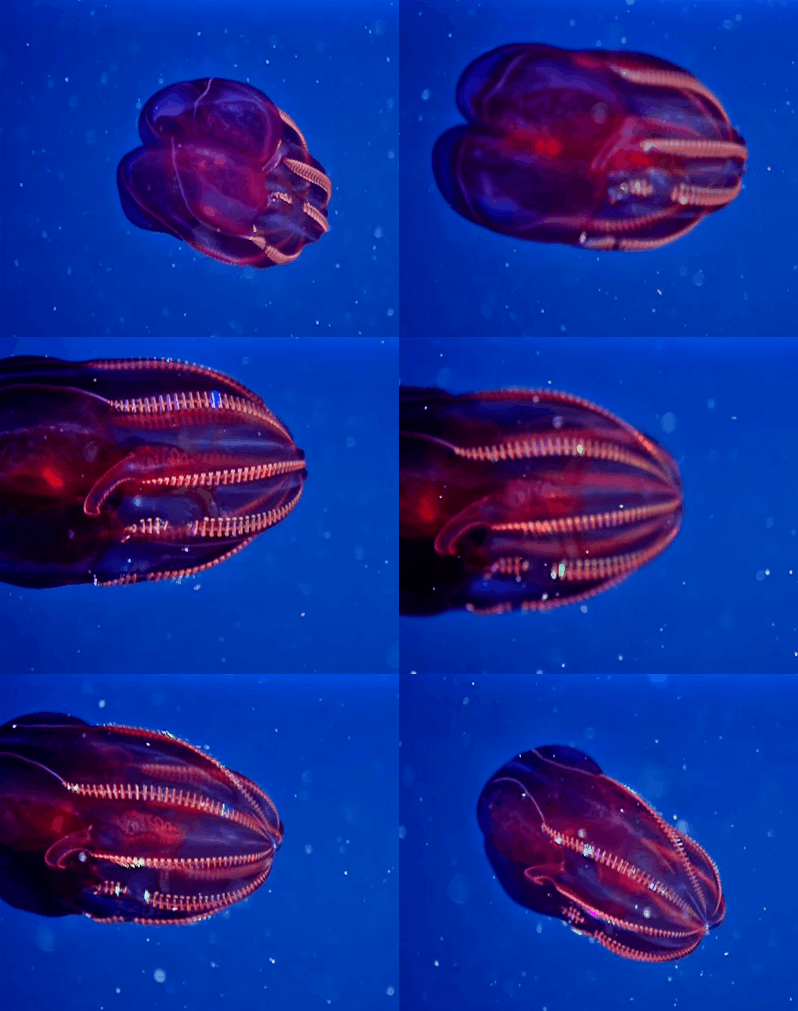
The comb jellies look round at first glance, but their architecture is a bit more complex than the cnidarian jellyfish. They have internal and external features that allow only for two planes of symmetry that give mirror images (see picture). These especially include the combs, rows of fused cilia that line their sides, and the fact that they don’t have stinging cells (cnidocytes). Remember that ONLY cnidarians have cnidocytes.


Here is a cladogram that shows the divergence of
each phylum of animal from their last common
ancestor. Ctenophores and cnidarians diverged from
each other recently (or did they, see article). Starfish
diverged after everyone else on that end was
bilateral, yet they are radial as adults. What gives?
Just as the ctenophora lie between the radial cnidarians and the bilateral flatworms, their symmetry lies in the middle as well. Two planes (bi) in an otherwise radial animal = biradial symmetry.

A 2004 study investigated the relationships between biradial and bilateral animals in evolution. If biradial is the link between radial and bilateral, then would seem to suggest that bilateralism occurred before cephalization.  Called the Planulozoa Hypothesis, the authors suggests that ctenophora are the sister clade of bilateralians, and that all three of the groups – cnidarians, ctenophora and bilaterals – are the descendents of a single bilateral ancestor.

Ctenophora larvae have bilateral features, so this supports the planulozoa hypothesis (the free swimming larvae of all three phyla are called planulae). This would then suggest that cnidarians were once bilateral and then returned to radial symmetry.

Additionally, the if the planulozoa hypothesis holds, then bilateralism would seem to predate cephalization (development of a head). The larvae of ctenophores and some ctenophore features show that a move to true bilateral symmetry came before platyhelminthes and the emergence of a head. The conclusion – the streamlined body came before the head. But that confuses me, one isn’t much good without the other.


Ctenophores – the comb jellies, often show
bioluminescence. They only have two perpendicular
planes of mirror image symmetry. You can see the
fused cilia that form the combs on each ridge.
Wait a minute, there’s a fly in the bouillabaisse. Ctenophores have a nervous system that is more complex than many other animals – it’s just not centralized to a head. Centralizing the nervous system, with the sensory processing and muscular control, is a crucial part of cephalization. They seem to developed a strong neural system without adding the head itself.

A 2014 study of the genome of several ctenophores showed that they do not have the same neuron-building gene regulation pathways as any other phylum of animals, and they only use one of the most common neurotransmitters; all their other neuron signalling molecules are unique to ctenophores alone. This suggests that they evolved radically differently than the phylums around them, cnidarians and flatworms. This does not support the planulozoa hypothesis at all. Ctenophores may have developed all on their own and therefore can't help us answer the question of which cam first the bilateral body or the head.

Other things about symmetry development make you say, “Huh?” as well. Look at that same cladogram of animals above – see the right side where the sea star is located? What’s a radially symmetric animal doing way over there after everyone else switched to bilateral symmetry?

The echinodermata (sea stars, brittle stars, sea cucumbers; echino = spiny, and derm = skin) also support the planulozoa hypothesis, since they seem to have undergone the same regression as the cnidarians. Echinoderms include the brittle stars, sea stars, sea cucumbers, barnacles and sea urchins. They have bilateral symmetry as larvae, but many of them become radial (pentaradial or such, depending on the number of arms) when they become adults.

Secondary radial symmetry is term for when a bilateral larva becomes a radial adult; but it is more interesting than that. The easy way for that transformation to occur would be for the arms to grow out of the larva, with the top (aboral) and mouth (oral) sides remaining the same. But that’s not how it happens.


The brittle star, an echinoderm, walks like bilateral
animal, even though it assumes pentaradial symmetry
as an adult. One arm acts as the head, and two arms
on each side work as mirror images. When it wants to
turn, it just assigns another arm to be the head.
The swimming larva becomes sessile by attaching itself to something on the sea floor. Then one mirror image side (right or left) becomes the oral side, while the other half become the aboral side of the adult. To do this, all the arms must grow from one half, and many tissues and organs are actually lost from the larva when it becomes an adult. This seems like a lot of work just to go backward in evolution.

But like I say, it works for them. The adult sea stars and other echinoderms are fairly slow. Their lifestyle doesn’t require a head or a bilateral body, so they went biologically simpler and energetically cheaper and returned to radial symmetry. All the mechanics were still in their genomes - it was really pretty smart.

However much they have tried to regress as adults, the brittle stars seemed to have retained at least a little bilateral activity. The way they move is a lot like a bilateral animal, according to a 2012 study. One arm points forward, the direction they are traveling. The arms on either side then push the animal along, like a crawling bilateral animal. I guess you can’t completely go home again.

Next week – Bilateral animals are simple - just two mirror images, right? Well no. You won’t believe the number of complex animals that break symmetry in order to give them a unique shape or function.


Moroz, L., Kocot, K., Citarella, M., Dosung, S., Norekian, T., Povolotskaya, I., Grigorenko, A., Dailey, C., Berezikov, E., Buckley, K., Ptitsyn, A., Reshetov, D., Mukherjee, K., Moroz, T., Bobkova, Y., Yu, F., Kapitonov, V., Jurka, J., Bobkov, Y., Swore, J., Girardo, D., Fodor, A., Gusev, F., Sanford, R., Bruders, R., Kittler, E., Mills, C., Rast, J., Derelle, R., Solovyev, V., Kondrashov, F., Swalla, B., Sweedler, J., Rogaev, E., Halanych, K., & Kohn, A. (2014). The ctenophore genome and the evolutionary origins of neural systems Nature, 510 (7503), 109-114 DOI: 10.1038/nature13400

Holló, G., & Novák, M. (2012). The manoeuvrability hypothesis to explain the maintenance of bilateral symmetry in animal evolution Biology Direct, 7 (1) DOI: 10.1186/1745-6150-7-22

Wallberg, A., Thollesson, M., Farris, J., & Jondelius, U. (2004). The phylogenetic position of the comb jellies (Ctenophora) and the importance of taxonomic sampling Cladistics, 20 (6), 558-578 DOI: 10.1111/j.1096-0031.2004.00041.x

Astley HC (2012). Getting around when you're round: quantitative analysis of the locomotion of the blunt-spined brittle star, Ophiocoma echinata. The Journal of experimental biology, 215 (Pt 11), 1923-9 PMID: 22573771


For more information or classroom activities, see:

Biologic symmetry –

Ctenophora vs .cnidarians –

Echinoderms -