Showing posts with label trace elements. Show all posts

Wednesday, December 16, 2015

A Gift Worth Its Weight In Gold

Biology concepts – toxicity, trace elements

Say hello to the Holterman nugget of New South
Wales, Australia, supposedly the largest gold
nugget ever found. Strictly speaking, it isn’t a nugget,
but rather a huge vein of gold in a piece of quartz.
And Bernhardt didn’t find by himself, but he was a
shameless media hound and built himself a legend.
In 2nd century Rome, practitioners of Mithraism, a popular pagan religion of the time, had a feast on December 25 to celebrate the god Mithras, the “Invincible Sun.” This also coincided with other feasts for Saturn and the winter solstice. People gave gifts to one another during these holiday celebrations. This practice of gift giving was adopted by Christians when the pagan and Christian traditions were merged, as they often were.

Today, Christmas presents are most often associated with the gifts of the three kings who came to see the baby wrapped in swaddling clothes (although by the time they arrived, Jesus was already a toddler – camels will never be confused with jet planes). Their gifts were gold – a gift for a king, frankincense – a gift for a priest, and myrrh – a gift for one who was to die (used in burial rights).

These three gifts are not exempt from our search for biologic exceptions and amazement. In terms of biology, they are indeed gifts.  This week we will talk about gold, with the others to follow on successive posts, like the ghosts of Christmas past, present, and future.

At December 2012 prices, a 150 lb (69 kg) person has about 37 cents worth of gold in his/her body, excluding any dental work. Hardly worth trying to harvest, but nice to know you’re worth more than you thought. How did the gold get there and is it doing anything?

Living organisms rely on small amounts of some metals and other elements in order to carry out their metabolic reactions. As such, these elements that are needed in small amounts are called trace elements. Examples of important trace elements include selenium, iron, copper, iodine, and zinc. Zinc is probably the king of the trace elements, as it is used in over 200 different reactions in mammalian physiology.

Copper is used in many biochemical pathways,
and it is showing promise as an anti-inflammatory
agent. But NO! people - you can’t get the anti-
inflammatory effects by wearing the copper
bracelets or copper-impregnated compression
wear! On the other hand, copper impregnated
clothes are antimicrobial.
Zinc works to control what genes are activated to make proteins (zinc finger transcription factors), as well as DNA and RNA production and destruction. It is stored in the brain to control just how active some neurons become when stimulated, and plays an important role in neural plasticity – the reordering of neuron connections after experiences and sleep, you may know it as learning and memory. Make sure you take your zinc before studying for that big test!

Because you need only a “trace” of these substances to maintain growth, development and health, they are also called micronutrients. Their functions can be quite diverse. Iron is the oxygen carrier in hemoglobin, but you only need a trace in your diet because you are so good at preserving what you already have. Selenium is contained in a non-traditional amino acid called selenocysteine, which is important for antioxidant proteins (selenium replaces sulphur in the traditional cysteine).

The biologic rule is that gold is not a trace element! Supposedly, no living organism uses gold in its physiology, but you know there has to be an exception. In 2002, Russian scientists investigating a membrane bound enzyme of the aurophilic (au = gold, and philic = loving) bacteria, Micrococcus luteus, showed that the enzyme contained gold in its active site (the area that binds the molecule to be chemical reacted). The gold was important for converting methane to methanol, giving the bacteria a way to produce energy when traditional food sources were scarce.

But we, and presumably ever other organism don’t have this system, so why is there gold in our body? It turns out that we have many things in our body that we don’t use, they just accumulate, things like lead, mercury, cobalt, arsenic. Some are toxic at low levels and some are useful unless we get too much of them. We have discussed the problems associated with having too much iron, and copper excess can be toxic as well. We said zinc is important for many reactions, but too much zinc can hinder copper absorption and you can end up with a copper deficiency. This is just as dangerous as copper excess.
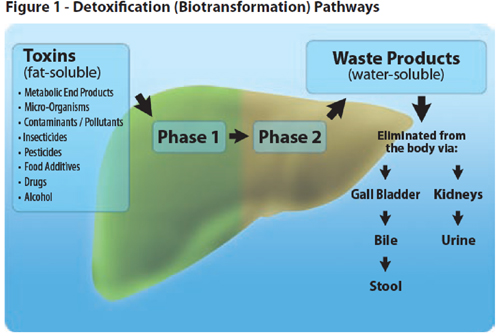
The liver is the site of much detoxification in the body.
Two systems are at work, one to break down or modify
fat soluble toxins, and the other to prepare them and
water soluble toxins for elimination in the bile or urine.
Toxic heavy metals often just get stored in the liver and
cause damage later.
If the element itself or amount of the element is toxic, then we have to get rid of some; this is the job of the liver. In some cases even gold can be toxic; as we accumulate more and more gold in the liver and kidney, it can disrupt their functions. Poor liver and/or kidney function – you die. The classic form of toxic gold found in nature is called gold chloride or “liquid gold,” which causes organ damage in humans and severe toxic effects in other organisms, but there is an exception.

A microbiologist and a professor of electronic art at Michigan State University have worked with a bacterium that can withstand gold chloride levels that would kill every other known organism. They found that Cupriavidus metallidurans was hundreds of time more resistant to gold chloride than any other organism.

C. metallidurans takes in the gold chloride and processes it to pure 24 karat gold, and then deposits it in a thin layer as part of the community of proteins and insoluble products that the bacteria builds around its colony. These organized layer of proteins, lipids and carbohydrates are called biofilms, and are being recognized as very important in bacteria ecology and pathology. In the case of C. metallidurans, the biofilm is intrinsically valuable to Wall Street.

Other organisms accumulate gold as well – bacteria, fungi, algae, fish, etc., but as does everything else in biology, it starts with the bacteria. It turns out that some bacteria excrete high levels of acidic amino acids – aspartate and glutamate (ate means acid). Yes, amino acids that are used to build proteins are organic acids, hence the name.

To dissolve gold out of powdered and broken rock,
many mines like this one in Brazil spray the ore with
sodium cyanide in water. They collect the runoff and
precipitate out the purer gold. I guess they don’t worry
about all the living things contaminated with the
cyanide.
The bacterium Chromobacterium violaceum actually makes and excretes cyanide. Cyanide binds stably to gold and silver, so it is used in gold mining to bind and concentrate very fine gold particles in rocks. Then the gold can be collected and precipitated. These examples show that if gold is in the immediate environment of these various organisms, it can be dissolved by the organic molecules and taken up by the bacteria when they feed.

Once gold is consumed and stored by the bacteria, it enters the food chain; millions of organisms feed on bacteria, and millions of organisms feed on the feeders, and so on. Eventually, we end up eating a little gold as well. This is similar to how fish that ingest food and swim in water contaminated by mercury runoff can end up increasing the human levels of mercury – the difference is that mercury is much more toxic than gold.

The accumulation of gold in sedentary organisms may provide someone with a gold rush. A 2010 study showed that the saprobic fungi (those that feed on decaying material) around an existing gold mine contain much higher levels of gold than ectomycorrhizal fungi (those that are parasitic) in the same area.  The accumulation of gold in soil bacteria and fungi may be able to provide scientifically astute miner with clues as to where they should dig the next mine!

The blue toadstool  (Entoloma hochstetteri) is an
example of a saprobic fungus. It gains all the
nutrients it needs from the soil and from decaying
organic material. Therefore, it picks up and
accumulates other things in the soil – like gold maybe.

 Bacteria may prove even more important to miners. December 2012 evidence indicates bacteria that dissolve and ingest gold in the rocks and soil purify it to some degree. When they form biofilms, the gold becomes insoluble again, and nuggets or flakes are formed. Veins of gold may be due to bacterial byproducts and corpses flowing into cracks in the rocks. Makes you look at your gold ring differently, doesn’t it.

We might be able to thank gold-loving bacteria for more than our jewelry – gold is finding its way into medical treatments and tests these days.  Because gold was rare, pure, inert, and costly, early physicians thought it just had to be good for you. Many remedies had gold incorporated into them, including a popular cure for alcoholism called the Keely cure.

The cure was so widely accepted (and patented by Dr. Keely) that even Theodore Roosevelt himself sent his brother, Elliott, to Dr Keely’s clinic in Dwight, IL to be cured of his addiction. It didn’t work, Elliott drank to the point of depression, and died from injuries that resulted from his jumping from a window.

More recent uses of gold include as an anti-inflammatory agent rheumatoid arthritis, including a compound called aurothiomalate. Just how this works remains a mystery, but a 2010 study in chondrocytes (the cells that make cartilage and are present in joints) showed that this drug down-regulates a signaling enzyme (MAP kinase phosphatase 1) that is important for expression of several inflammatory proteins, including cyclooxygenase, p38 MAP kinase, matrix metalloproteinase-3 and interleukin-6.

The aquatic or semi-aquatic plant Bacopa caroliniania can
be loaded with gold nanoparticles and made to give off
light.  Depending on the energy of the UV light shone on
it, it can glow from green to gold to red. Someday, maybe
our tree lined streets will have natural streetlights.
Gold is finding a home as a treatment in other conditions as well including in cancer, viral infections, and parasitic diseases. But gold is being used most often as a carrier. Because gold is practically inert, nanoparticles of gold can be used to carry drugs to specific targets or to be used as imaging agents to illuminate very small structures.

Most spectacularly, gold may help light a dark world. Plants can now be grown with gold nanoparticles that are small enough to be taken up into the leaf cells. When exposed to UV light, the gold releases energy at a wavelength that stimulates chlorophyll to bioluminesce. The plants actually give off light like natural street lights.

That’s a lot of biology for a hunk of metal used for wedding rings and retirement watches – a way cool gift for any biologist. Next week, the biology of frankincense.

  Nieminen, R., Korhonen, R., Moilanen, T., Clark, A., & Moilanen, E. (2010). Aurothiomalate inhibits cyclooxygenase 2, matrix metalloproteinase 3, and interleukin-6 expression in chondrocytes by increasing MAPK phosphatase 1 expression and decreasing p38 phosphorylation: MAPK phosphatase 1 as a novel target for antirheumatic drugs Arthritis & Rheumatism, 62 (6), 1650-1659 DOI: 10.1002/art.27409

 Levchenko, L., Sadkov, A., Lariontseva, N., Koldasheva, E., Shilova, A., & Shilov, A. (2002). Gold helps bacteria to oxidize methane Journal of Inorganic Biochemistry, 88 (3-4), 251-253 DOI: 10.1016/S0162-0134(01)00385-3
 

Wednesday, August 21, 2013

Life is Elemental

Biology concepts – elements, biomolecules, biochemistry, trace elements, selenocysteine, stop codon

The blue whale is the often 30 m (100 ft) long and can reach a
mass of more than 175 tons (160,000 kg). As such, it is the
largest animal ever to grace the face of Earth. Yet, it owes it
shares its intricate biochemistry with even the smallest
organisms on the planet. The commonality is due to the
chemical elements that make up the biomolecules of all living
things. A few elements are used in most biological compounds,
and many elements are used in just a few. This is today’s story.
A blue whale is the largest animal on the face of the Earth - ever. You could swing a tennis racquet while standing inside a chamber of its heart (left). Built very differently, the watermeal plant is the size of a grain of salt. Comparing the two organisms at the macrolevel is like comparing lug nuts and twinkies, or pink and Darth Vader. But looks are often deceiving.

At the genetic level, about 50% of the genes from whales and watermeal are exactly the same, coding for the same structural proteins or enzymes. At a biochemical level there's even more similarity; even if the gene products are different most of the processes that huge whales and tiny flowering plants carry out are exactly the same.

They are so similar for one overarching reason, and that reason points out an amazing commonality. Both the world’s largest animal and the world’s smallest flower come from a common ancestor. It may have been many moons since their family had that argument at the summer picnic that drove them apart forever, but they are still related nonetheless.

And since they have a common ancestor, they are going to harbor many of the same traits as that ancestor – including the ways they carry out the reactions and functions in their cells. The totality of the molecules that are present in an organism and how they interact to perform different jobs is termed an organism’s biochemistry.
Biochemistry is the chemical reactions that take place in living
organisms, like glycolysis and the citric acid cycle shown above.
Though different organisms may have subtle differences in the
proteins or even eliminate some of the steps, the overall
pathways are conserved across all life on earth. Look at the
molecules, the elements are common in availability and
common to all life. This is evidence of evolution and why
biochemistry is shared so completely.

Biochemistry refers to how information flows through organisms via biochemical signaling and how chemical energy flows through cells via metabolism. All life on Earth uses basically the same biochemistry since we all came from a common ancestor – to the best of our knowledge.

Organisms on Earth have similar biochemistry in part because they use the same types of macromolecules. Life as we know it is based on the interactions (biochemistry) of lipids, carbohydrates, proteins and nucleic acids. Each of these macromolecules is amazing and contains many exceptions, so we will deal with each in next few posts.

Whales and watermeal, all life for that matter, is organic (Greek, pertaining to an organ) since their biochemistry is based on carbon, but there many exceptions to our important molecules being organic. What is the most abundant molecule in living things? Water. Is water organic? No.

What creates the electrochemical gradient that fires our neurons? Sodium, chloride, and potassium. Are they organic? No. So the next time someone makes a joke about being a carbon-based life form, you can say you are just partly organic, and then let them ponder whether you are some kind of cyborg.

So what do the macromolecules have in common that is related to the biochemistry of life? They are made up of the same chemical elements. In fact, most all biomolecules are made up of just five or fewer different elements; carbon (C), hydrogen (H), oxygen (O), nitrogen (N), phosphorus (P), and sulfur (S).

Carbon’s importance lies in its ability to bond to many different elements, and because it can accept electrons in a bond or donate electrons to a bond. Carbon can bond to four different elements at the same time. This increases the possibility of complexity and is one reason our molecules are based on carbon. The situations are similar for oxygen, sulfur, nitrogen, and phosphorous.

One of the lesser abundant elements is sulfur since it is used in proteins as a structural element mostly, although it shows up in bone and other skeletal materials as well. Still, the average adult male (80 kg/175 lb) contains about 160 grams of sulfur; this would be about a salt shaker’s worth.

Carbon is the basis of life on Earth because of its ability to form single,
double, and triple bonds, and because it can bond with so many
different elements. On the left is the top right corner of the periodic
table, showing carbon and silicon in the same column (family).
Elements in the same family have similar chemical properties, so
scientists believe that life on other planets could be based on silicon.
This is how we got the look and feel of the alien in the Sigorney Weaver
movies of the same name. But, silicon is more abundant than carbon,
so why don’t we look like the alien?
Only two of the twenty common amino acids that make up proteins contains sulfur (methionine and cysteine). But don't minimize its importance just because it is present in only two of the protein building blocks. The sulfurs in proteins often interact with one another, determining the protein's three-dimensional structure. And for proteins, 3-D structure is everything  - their function follows their form.

Sulfur is important in other ways as well. Some bacteria substitute sulfur (in the form of hydrogen sulfide) for water in the process of photosynthesis. Other bacteria and archaea use sulfur instead of oxygen as electron acceptor in cellular metabolism. This is one way organisms can be anaerobic (live without oxygen).

In a more bizarre example, sea squirts use sulfuric acid (H2SO4) in their stomachs instead of hydrochloric acid – just how they don’t digest themselves is a mystery. Just about every element has some off label uses; we could find weird uses for C, H, O, N, and P as well. Heck, nitric oxide (NO) works in systems as diverse as immune functions and vasodilation (think Viagra).

So these are the “elements of life” – right? Well, yes and no, you can’t survive without them, but you also can’t survive with only them. There are at least 24 different elements that are required for some forms of life. Two dozen exceptions to the elements of life rule – sounds like an area ripe for amazing stories.

Some of these exceptions are called trace elements, needed in only small quantities in various organisms. It may be difficult to define “trace” since some elements are needed in only small quantities in some organisms, but in great quantities (or not at all) in others. Take copper (Cu) for instance. Humans use it for some enzymatic reactions and need little, but mollusks use copper as the oxygen-carrying molecule in their blood (like we use iron).

Let’s start with a list is of the exceptions; a list will allow you to do some investigating on your own to see how they are used in biologic systems.

Aluminum (Al)        0.0735 g
Arsenic (As)              0.00408 g
Tyrian Purple, or royal purple, is a dye made from the bodies of several
mollusks from the eastern Mediterranean. The spiny dye snail (left) is
one such mollusk that produces the purple dye from its hypobrancial
mucus glands. The dye is based on a bromine-containing compound that
the snails use to protect their eggs from microbial predators (right) and
for hunting. The dye was prized because instead of fading with time and
sun exposure, it actually became brighter. Used as early as 1500 BCE by the
Phoenicians, Tyrian Purple was worth its weight in silver for two
thousand years.
Boron (B)                   0.0572 g
Bromine (Br)            0.237 g
Cadmium (Cd)          0.0572 g
Calcium (Ca)             1142.4 g
Chlorine (Cl)             98.06 g
Chromium (Cr)        0.00245 g
Cobalt (Co)                 0.00163 g
Copper (Cu)               0.0817 g
Fluorine (F)               3.023 g
Gold (Ag)                     0.00817 g
Iodine (I)                     0.0163 g
Iron (Fe)                      4.9 g
Magnesium (Mg)      22.06 g
Manganese (Mn)       0.0163 g
Molybdenum (Mo)   0.00812 g
Nickel (Ni)                   0.00817 g
Potassium (K)           163.44 g
Selenium (Se)             0.00408g
Silicon (Si)                   21.24 g
Sodium (Na)               114.4 g
Tin (Sn)                        0.0163 g
Tungsten (W)            no level given for humans  
Vanadium (V)            0.00245 g
Zinc (Zn)                      2.696 g

You can see that for each element I gave a mass in grams. This corresponds to the amount that can be found in an 80 kg (175 lb) human male. But don’t confuse the mass found with the mass needed.

Barium (Ba) isn’t used in any known biologic system, yet you have some in your body. It is the 14th most abundant element in the Earth’s crust, so it can enter the food chain via herbivores or decomposers and then find its way up to us. You probably have a couple hundredths of a gram in you right now.

Bromine (Br) is a crucial element for algae and other marine creatures, but as far as we know, mammals don’t need any. In fact, this brings up an interesting thing about chemistry. Chlorine is integral for human life, just about anything that requires an electrochemical gradient will use chlorine, to say nothing of stomach acid (HCl).

However, chlorine gas is a chemical weapon that will burn out your lungs (and did in WWI). Bromine gas is very similar to chlorine gas - so elements that are useful as dissolved solids can be lethal as gasses.

How about something supposedly inert, like gold (Ag)? We use it for jewelry because it is rare and supposedly it doesn’t cause allergy (wrong - see this previous post). But some bacteria have an enzyme for which gold is placed in the active center. Gold is rare, so why would it be used for crucial biology? Most elements in biology are more common.

Finally, we should describe a couple of the uses of non-standard elements:

Selenium in proteins is important for stopping damage from
oxygen, but in case you don’t think that is important enough,
how about insulin function. From the cartoon above, you can
see that selenoprotin function affects insulin responsive
elements (IRS) that in turn control DNA function, cell survival
(Akt), and carbohydrate management.
Selenium is a rare element, being only the 60th most common element in the Earth’s crust. Yet, without 0.00408 grams of selenium on board, a human is only so much worm food. Selenium is only essential for mammals and some higher plants, but it performs a unique role in those organisms.

In a few proteins, particularly glutathione peroxidase, selenium will take the place of sulfur in certain cysteine amino acids. Selenocysteine is an amazing exception because it is not coded for by the genetic code! Instead, the stop codon, UGA, (a three nucleotide run which calls for protein production to stop), is modified to become a selenocysteine-coding codon.

The selenocysteine amino acid changes the shape of the protein, and is found to be the active site for proteins such as glutathione peroxidase and glutathione S-transferase. These enzymes are crucial for cellular neutralization of reactive oxygen molecules that do damage by reacting with just about any other cellular biomolecule.

So selenocysteine is an endogenous biomolecule that is important for protecting our bodies – as important as the antibiotics we use from other organisms. But a 2013 study shows that some antibiotics (doxycycline, chloramphenicol, G418) actually interfere with the production of selenocysteine proteins by inhibiting the modification of the UGA codon. In many cases, the amino acid arginine is inserted instead of selenocysteine, reducing the functionality of the enzymes. Yet another reason to not overprescribe antibiotics.

One last exceptions - silicon is important for many grasses. Remember, this is silicon, the element; not silicone the polymer used in breast implants and caulk; and not silica, the mineral SiO2. Silicon is taken up by grasses of many types; crops, weeds, and water plants (although silicon in grasses may take the form of silica).  

Silicon (top) is an element that is used in many ways, including
in computer chips. Silica is a combination of silicon and oxygen
(middle) which is part of many products as well, including the
lightest material on Earth, aerogel, used in NASA projects.
Silicone is a rubbery material (bottom) that is used in caulks and
in many other things, including creepy movie prosthetics.
In some grasses, the inclusion of silicon makes them less likely to be victims of herbivory (being grazed on by herbivores). Herbivores avoid high silica-containing grasses because they aren’t digested well. A 2008 study showed that this reduced digestibility is related to silicon-mediated reduction in leaf breakdown through chewing and chemical digestion.

Another protective function of silicon in grasses was illustrated by a 2013 study. In halophytic (salt-loving) grasses that live on seashores, increased silicon uptake resulted in increased nutrient mineral uptake, and increased transpiration, the crucial process for water movement through the plant.

In addition, these plants have better salt tolerance in the presence of increased silicon, even though they already have specific mechanisms for reducing the damage that could be induced by such high salt concentrations. Silicon reduced the amount of sodium element found in the saltwater grasses. Pretty important for an element that is considered non-essential.

Next week, let’s start to look at the biomolecules made from C, H, O, N, P, and S. Proteins are macromolecules made up of amino acids, and amino acids are exceptional.

Tobe R, Naranjo-Suarez S, Everley RA, Carlson BA, Turanov AA, Tsuji PA, Yoo MH, Gygi SP, Gladyshev VN, & Hatfield DL (2013). High error rates in selenocysteine insertion in mammalian cells treated with the antibiotic doxycycline, chloramphenicol, or geneticin. The Journal of biological chemistry, 288 (21), 14709-15 PMID: 23589299
 
Mateos-Naranjo E, Andrades-Moreno L, & Davy AJ (2013). Silicon alleviates deleterious effects of high salinity on the halophytic grass Spartina densiflora. Plant physiology and biochemistry : PPB / Societe francaise de physiologie vegetale, 63, 115-21 PMID: 23257076

For more information or classroom activities, see:

Elements of life - 

Trace elements in diet –

Trace elements in plants –

What is biochemistry –

Sulfur –

Bromine –

Selenium/selenocysteine –

Silicon based life –