Wednesday, December 16, 2015

A Gift Worth Its Weight In Gold

Biology concepts – toxicity, trace elements

Say hello to the Holterman nugget of New South
Wales, Australia, supposedly the largest gold
nugget ever found. Strictly speaking, it isn’t a nugget,
but rather a huge vein of gold in a piece of quartz.
And Bernhardt didn’t find by himself, but he was a
shameless media hound and built himself a legend.
In 2nd century Rome, practitioners of Mithraism, a popular pagan religion of the time, had a feast on December 25 to celebrate the god Mithras, the “Invincible Sun.” This also coincided with other feasts for Saturn and the winter solstice. People gave gifts to one another during these holiday celebrations. This practice of gift giving was adopted by Christians when the pagan and Christian traditions were merged, as they often were.

Today, Christmas presents are most often associated with the gifts of the three kings who came to see the baby wrapped in swaddling clothes (although by the time they arrived, Jesus was already a toddler – camels will never be confused with jet planes). Their gifts were gold – a gift for a king, frankincense – a gift for a priest, and myrrh – a gift for one who was to die (used in burial rights).

These three gifts are not exempt from our search for biologic exceptions and amazement. In terms of biology, they are indeed gifts.  This week we will talk about gold, with the others to follow on successive posts, like the ghosts of Christmas past, present, and future.

At December 2012 prices, a 150 lb (69 kg) person has about 37 cents worth of gold in his/her body, excluding any dental work. Hardly worth trying to harvest, but nice to know you’re worth more than you thought. How did the gold get there and is it doing anything?

Living organisms rely on small amounts of some metals and other elements in order to carry out their metabolic reactions. As such, these elements that are needed in small amounts are called trace elements. Examples of important trace elements include selenium, iron, copper, iodine, and zinc. Zinc is probably the king of the trace elements, as it is used in over 200 different reactions in mammalian physiology.

Copper is used in many biochemical pathways,
and it is showing promise as an anti-inflammatory
agent. But NO! people - you can’t get the anti-
inflammatory effects by wearing the copper
bracelets or copper-impregnated compression
wear! On the other hand, copper impregnated
clothes are antimicrobial.
Zinc works to control what genes are activated to make proteins (zinc finger transcription factors), as well as DNA and RNA production and destruction. It is stored in the brain to control just how active some neurons become when stimulated, and plays an important role in neural plasticity – the reordering of neuron connections after experiences and sleep, you may know it as learning and memory. Make sure you take your zinc before studying for that big test!

Because you need only a “trace” of these substances to maintain growth, development and health, they are also called micronutrients. Their functions can be quite diverse. Iron is the oxygen carrier in hemoglobin, but you only need a trace in your diet because you are so good at preserving what you already have. Selenium is contained in a non-traditional amino acid called selenocysteine, which is important for antioxidant proteins (selenium replaces sulphur in the traditional cysteine).

The biologic rule is that gold is not a trace element! Supposedly, no living organism uses gold in its physiology, but you know there has to be an exception. In 2002, Russian scientists investigating a membrane bound enzyme of the aurophilic (au = gold, and philic = loving) bacteria, Micrococcus luteus, showed that the enzyme contained gold in its active site (the area that binds the molecule to be chemical reacted). The gold was important for converting methane to methanol, giving the bacteria a way to produce energy when traditional food sources were scarce.

But we, and presumably ever other organism don’t have this system, so why is there gold in our body? It turns out that we have many things in our body that we don’t use, they just accumulate, things like lead, mercury, cobalt, arsenic. Some are toxic at low levels and some are useful unless we get too much of them. We have discussed the problems associated with having too much iron, and copper excess can be toxic as well. We said zinc is important for many reactions, but too much zinc can hinder copper absorption and you can end up with a copper deficiency. This is just as dangerous as copper excess.
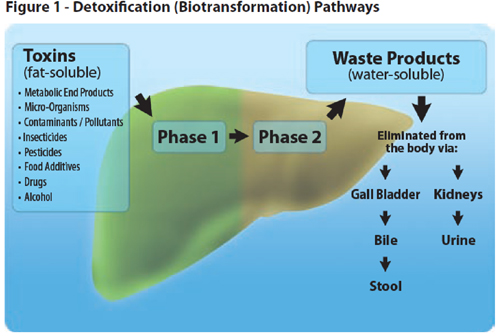
The liver is the site of much detoxification in the body.
Two systems are at work, one to break down or modify
fat soluble toxins, and the other to prepare them and
water soluble toxins for elimination in the bile or urine.
Toxic heavy metals often just get stored in the liver and
cause damage later.
If the element itself or amount of the element is toxic, then we have to get rid of some; this is the job of the liver. In some cases even gold can be toxic; as we accumulate more and more gold in the liver and kidney, it can disrupt their functions. Poor liver and/or kidney function – you die. The classic form of toxic gold found in nature is called gold chloride or “liquid gold,” which causes organ damage in humans and severe toxic effects in other organisms, but there is an exception.

A microbiologist and a professor of electronic art at Michigan State University have worked with a bacterium that can withstand gold chloride levels that would kill every other known organism. They found that Cupriavidus metallidurans was hundreds of time more resistant to gold chloride than any other organism.

C. metallidurans takes in the gold chloride and processes it to pure 24 karat gold, and then deposits it in a thin layer as part of the community of proteins and insoluble products that the bacteria builds around its colony. These organized layer of proteins, lipids and carbohydrates are called biofilms, and are being recognized as very important in bacteria ecology and pathology. In the case of C. metallidurans, the biofilm is intrinsically valuable to Wall Street.

Other organisms accumulate gold as well – bacteria, fungi, algae, fish, etc., but as does everything else in biology, it starts with the bacteria. It turns out that some bacteria excrete high levels of acidic amino acids – aspartate and glutamate (ate means acid). Yes, amino acids that are used to build proteins are organic acids, hence the name.

To dissolve gold out of powdered and broken rock,
many mines like this one in Brazil spray the ore with
sodium cyanide in water. They collect the runoff and
precipitate out the purer gold. I guess they don’t worry
about all the living things contaminated with the
cyanide.
The bacterium Chromobacterium violaceum actually makes and excretes cyanide. Cyanide binds stably to gold and silver, so it is used in gold mining to bind and concentrate very fine gold particles in rocks. Then the gold can be collected and precipitated. These examples show that if gold is in the immediate environment of these various organisms, it can be dissolved by the organic molecules and taken up by the bacteria when they feed.

Once gold is consumed and stored by the bacteria, it enters the food chain; millions of organisms feed on bacteria, and millions of organisms feed on the feeders, and so on. Eventually, we end up eating a little gold as well. This is similar to how fish that ingest food and swim in water contaminated by mercury runoff can end up increasing the human levels of mercury – the difference is that mercury is much more toxic than gold.

The accumulation of gold in sedentary organisms may provide someone with a gold rush. A 2010 study showed that the saprobic fungi (those that feed on decaying material) around an existing gold mine contain much higher levels of gold than ectomycorrhizal fungi (those that are parasitic) in the same area.  The accumulation of gold in soil bacteria and fungi may be able to provide scientifically astute miner with clues as to where they should dig the next mine!

The blue toadstool  (Entoloma hochstetteri) is an
example of a saprobic fungus. It gains all the
nutrients it needs from the soil and from decaying
organic material. Therefore, it picks up and
accumulates other things in the soil – like gold maybe.

 Bacteria may prove even more important to miners. December 2012 evidence indicates bacteria that dissolve and ingest gold in the rocks and soil purify it to some degree. When they form biofilms, the gold becomes insoluble again, and nuggets or flakes are formed. Veins of gold may be due to bacterial byproducts and corpses flowing into cracks in the rocks. Makes you look at your gold ring differently, doesn’t it.

We might be able to thank gold-loving bacteria for more than our jewelry – gold is finding its way into medical treatments and tests these days.  Because gold was rare, pure, inert, and costly, early physicians thought it just had to be good for you. Many remedies had gold incorporated into them, including a popular cure for alcoholism called the Keely cure.

The cure was so widely accepted (and patented by Dr. Keely) that even Theodore Roosevelt himself sent his brother, Elliott, to Dr Keely’s clinic in Dwight, IL to be cured of his addiction. It didn’t work, Elliott drank to the point of depression, and died from injuries that resulted from his jumping from a window.

More recent uses of gold include as an anti-inflammatory agent rheumatoid arthritis, including a compound called aurothiomalate. Just how this works remains a mystery, but a 2010 study in chondrocytes (the cells that make cartilage and are present in joints) showed that this drug down-regulates a signaling enzyme (MAP kinase phosphatase 1) that is important for expression of several inflammatory proteins, including cyclooxygenase, p38 MAP kinase, matrix metalloproteinase-3 and interleukin-6.

The aquatic or semi-aquatic plant Bacopa caroliniania can
be loaded with gold nanoparticles and made to give off
light.  Depending on the energy of the UV light shone on
it, it can glow from green to gold to red. Someday, maybe
our tree lined streets will have natural streetlights.
Gold is finding a home as a treatment in other conditions as well including in cancer, viral infections, and parasitic diseases. But gold is being used most often as a carrier. Because gold is practically inert, nanoparticles of gold can be used to carry drugs to specific targets or to be used as imaging agents to illuminate very small structures.

Most spectacularly, gold may help light a dark world. Plants can now be grown with gold nanoparticles that are small enough to be taken up into the leaf cells. When exposed to UV light, the gold releases energy at a wavelength that stimulates chlorophyll to bioluminesce. The plants actually give off light like natural street lights.

That’s a lot of biology for a hunk of metal used for wedding rings and retirement watches – a way cool gift for any biologist. Next week, the biology of frankincense.

  Nieminen, R., Korhonen, R., Moilanen, T., Clark, A., & Moilanen, E. (2010). Aurothiomalate inhibits cyclooxygenase 2, matrix metalloproteinase 3, and interleukin-6 expression in chondrocytes by increasing MAPK phosphatase 1 expression and decreasing p38 phosphorylation: MAPK phosphatase 1 as a novel target for antirheumatic drugs Arthritis & Rheumatism, 62 (6), 1650-1659 DOI: 10.1002/art.27409

 Levchenko, L., Sadkov, A., Lariontseva, N., Koldasheva, E., Shilova, A., & Shilov, A. (2002). Gold helps bacteria to oxidize methane Journal of Inorganic Biochemistry, 88 (3-4), 251-253 DOI: 10.1016/S0162-0134(01)00385-3
 

Wednesday, December 9, 2015

Snow Saves Lives

Biology concepts – subnivean zone, chionophiles, antifreeze proteins, UV vision, snow blindness, photokeratitis


Rudolph the red nosed reindeer didn’t start as a song or
even a Rankin and Bass stop motion special. It was a story
published by the Montgomery Ward Stores.  The author’s
brother-in-law was Johnny Marks, the king of Christmas
songs. He adapted the story into a song that was recorded
by Gene Autry in 1949. Then it went viral. The TV
special didn’t appear until 1964.
Rudolph with his nose so bright – only he could lead Santa’s sleigh through the snowstorm. What a great mutation, a beaming red nose – although that might be quite the draw for predators. In real life, reindeer have indeed evolved to overcome the snow, but also to rely on it. You could even speculate that Rudolph would die without the snow.

This leads a biologist to ask, "Just who and what is depending on the snow; how does snow affect the living world?" Many animals have snow in their name, but that isn’t always a good clue. The snowy egret and the snow crab are examples.

The snowy egret is called that only because of its white plumes, while the snow crab is so named because its hunting season is when the snow is the deepest. Mike Rowe, the hardest working man in show business since James Brown, taught watchers of The Deadliest Catch that the snow crab is better called the opilio crab (Chionoecetes opilio). Fisherman that go to sea to put them on your table are a breed unto themselves.

Egrets and crabs don’t help us to investigate the question of the effects of snow on life. The easy observation is that snowy winters are something that organisms have evolved to overcome or even use to their advantage. They have developed ways to survive the harsh conditions of the snowy season or to exploit the white stuff.


The snow leopard is unique amongst cats. It has blue-green or
gray eyes, while most other cats have yellow or black eyes. It
also can’t roar. It has a partially ossified (turned to bone)
hyoid cartilage, which was thought to be the key to cat roars,
but it just can’t manage more than a screech. Maybe it just
doesn’t feel like roaring – or maybe it fears an avalanche.
The snow leopard (Panthera uncia) is an animal that overcomes snow. It has evolved large paws to act as snowshoes. The snow leopard can easily stalk prey and run in snow as deep as 36 in (1 m). Their paws also have fur on all surfaces, to insulate their footpads from the cold and wet snow.

On the other hand, their markings are better suited for their preferred living and hunting grounds. They aren’t nearly as white as you would expect. They like to live on rocky ledges and they descend into the forests to hunt prey when the weather gets really cold (because that’s where the prey are), so their brown tints and spots help them blend in to both habitats.

The lemming is an example of a small mammal that exploits the snow for cover, others being mice, voles, and shrews. The Norway lemming (Lemmus lemmus) moves from the low mountainsides up to higher elevations (opposite of the snow leopard for obvious reasons) as the snow falls. They don’t live underground, although they may nest there, but they don’t live on top of the snow either.

The lemmings dig vast networks of tunnels in the snow where it meets the ground. This is called the subnivean environment (sub = below, and niveus is Latin for snow), and they race around looking for vegetation to eat and other lemmings with which to mate. The many openings in the snow may seem to be doors to the subnivean environment, but the lemmings rarely come out of the snow. They are more likely vents to release carbon dioxide from lemming breath and plant decomposition.

Lemmings don’t jump off cliffs in large numbers when they
get older. That is a myth. However, they may be a little
challenged when they run for new feeding grounds in great
numbers – some seem to find their way to cliffs and accidently
go over head first. They are solitary except for mating times,
as is seen here. He’s taking flowers to his girl.

Some animals, like some big cats and large owls have evolved a hearing sense that allows them to pinpoint lemmings under the snow, but the subnivean tunnels work well enough that lemming populations usually skyrocket every 3-4 years, and then plummet as resources become scarce. Their success is in some ways their downfall.

And speaking of falling, the lemmings are also responsible for some human tragedies. When the temperatures fluctuate and the tunnels remodel with ice and snow, the layers of snow can become unstable. The dense snow above the tunnel system will crush and slide off the subnivean layer and …. look out below, here comes the avalanche. And I thought skiers that flock to resorts in order to fall off the mountain repeatedly were the lemmings!

You wouldn’t expect it, but some small arthropods (insects and such) have found ways to live in the snow. When a warmer winter day pops up, so do the snow fleas (Hypogastrura nivicola). You will see them as black specks on the snow – appearing in the thousands at the bases of trees. They aren’t really fleas at all, but a species of springtail (see picture). The reason they come out is not known exactly, but I think that any snow melt due to warmth might drown them in their below ground hiding places.

On the left is a convention of snow fleas discussing the merits
of elm leaves as decaying foliage – or maybe that’s the buffet.
On the right is a single snow flea, called a springtail. The back
legs can apply a load and then are released. They spring from
place to place, but they aren’t “fleaing.”

Snow fleas have an antifreeze protein that keeps them alive over the winter. This isn’t an exception, many animals have chemical mechanisms to prevent freezing, but the protein in snow fleas is unlike any other. The snow flea anti-freeze protein (sfAFP) may serve humans as well. See the post here for more on anti-freezing mechanisms, and here to show that snow midges are the largest animals in many parts of cold Antarctica.

A 2008 project produced the protein in a laboratory and showed that it may be possible to use it to preserve organs for transplant a longer time. Storage at cooler temperatures would allow for longer shelf lives for organs, but they can become damaged by ice crystal formation. The researchers also made a version of the protein using D-amino acids. We have talked about these before – but here they work to our advantage, by making the protein less susceptible to enzymatic degradation, while still providing antifreeze function.           

Snow melt mosquitoes, on the other hand, are winged. Living from northern California up to the arctic tundra, snowpool Aedes mosquitoes (many species) lay their eggs and their larvae develop in the pools of melted snow as the weather warms. This gives them a head start on the rest of the mosquito world. It would seem many forms of life have found ways to exploit snow.

Watermelon snow is caused by an alga that grows in the
snow. Chlamydomonas nivalis is a green algae, but it also
produces a lot of anthocyanins (red) pigments. They
absorb the sunlight and generate heat. This melts some
of the snow and gives the algae the water it needs to grow.
The algae serves as a food source for other animals
during the winter, including the snow fleas.

Then there are the chionophiles (chioni is Greek for snow, and phile = lover). We have talked about the psychrophiles, organisms that prefer cold temperatures, but chionophiles need the snow to survive.

It may seem counterintuitive, but many organisms need the snow to keep them warm. It’s the wind that blows heat away from around the skin, so a layer of snow actually helps trap heat and protect form the wind. Lemmings give snow a big thumbs up (if they have thumbs) for snow as an insulator.

It isn’t just animals that need a “blanket” of snow to retain heat and protect from the wind. Winter wheat needs the snow, but for several reasons. Sure, the snow provides insulation for the young shoots that were planted in the late fall and go dormant until the spring. Nothing worse than frozen wheat.

But the snow also provides a source of water when it melts. This loosens the ground to give the wheat plants strength to push through the earth, and for early water for growth. Snow also gives stability to the young plants out on the plains. Lots of wind out there, enough to knock down and break the fragile plants when they are young. A cast of snow surrounding the stem helps keep them upright. The wise man says, “ Rain versus snow, the wheat doesn’t know the difference, but the farmer wants snow in the winter.”


Winter wheat is susceptible to grey snow mold, even though
it can produce antifungal compounds. This can decimate
entire crops of wheat, especially if the snow fall lasts deep
into the spring. The bottom image shows a close up of pink
snow mold on grass. This is a particular problem on golf
courses – I’m not going to cry over that.
Growing in the snow has also created a problem for wheat, a problem caused by another snow grower. Snow molds (gray or pink) remains dormant in the summer, and only start growing when covered by a layer of snow. As the snow melts in the spring, the damage is down, causing circular patches of gray or brown grass, including wheat, which is a grass.

Snow mold doesn’t attack plants on exposed soil – but they may be killed by the more extreme temperature. They do attack where there is snow, and there is more damage in the deeper snow banks – it seems they do their damage under cover of snow only – more snow, longer time for complete melt, more damage.

The snow mold excretes its antifreeze proteins, not to prevent itself from freezing, but to keep ice crystals from forming or altering around the fungus. Perhaps they are protecting their food to keep it growing and a good source of nutrients; often that food is wheat. But wheat also has tricks. A 2002 study shows that winter wheat produces several proteins that inhibit the growth of the mold.

Now back to Rudolph. To understand his exception with snow, we first need to talk about photokeratitis (photo = light, keratin = the protein found in cornea, and it is = inflammation), better known as snow blindness. For Eskimos and other humans, the 90% of the sunlight’s UV waves bouncing off the snow is enough to burn the cornea and lead to fuzzy vision or even blindness. The cornea is a protective structure, keeping the UV rays from injuring the retina.


This is part of the study that discovered UV vision in
reindeer. I get the part where they examine the retina,
but what I need to know is how they get them to read
the lines of letters on the eye chart.
Other animals are prone to snow blindness as well. Polar bears have a nictating membrane to protect the eye, but the reindeer have gone much further. Of all the mammals, only the reindeer actually sees in the UV range.

Their cornea doesn’t stop UV rays from entering the eye, yet they don’t suffer damage. The pigments of their retina absorb the energy and convert it into images, just like our eye does with visible light only. A good study would determine how they are protected – you work on that. It might be related to a new study that shows that reindeer eyes change color with the seasons, becoming blue in winter.

Being able to see in the UV range is what saves the reindeer. Predators that blend in with the snow still show up easily in UV, and well as urine stains in the snow that mark the territories of predators or other reindeer. Using his UV vision, the reindeer is better protected from predation. And it only works because of the snow – no snow, no reflected UV light. And thus we learn…. snow saved Christmas.

Next week, the biology of one of the original Christmas gifts.


Hogg C, Neveu M, Stokkan KA, Folkow L, Cottrill P, Douglas R, Hunt DM, & Jeffery G (2011). Arctic reindeer extend their visual range into the ultraviolet. The Journal of experimental biology, 214 (Pt 12), 2014-9 PMID: 21613517

Kondo H, Hanada Y, Sugimoto H, Hoshino T, Garnham CP, Davies PL, & Tsuda S (2012). Ice-binding site of snow mold fungus antifreeze protein deviates from structural regularity and high conservation. Proceedings of the National Academy of Sciences of the United States of America, 109 (24), 9360-5 PMID: 22645341

Pentelute BL, Gates ZP, Dashnau JL, Vanderkooi JM, & Kent SB (2008). Mirror image forms of snow flea antifreeze protein prepared by total chemical synthesis have identical antifreeze activities. Journal of the American Chemical Society, 130 (30), 9702-7 PMID: 18598026

Kuwabara C, Takezawa D, Shimada T, Hamada T, Fujikawa S, & Arakawa K (2002). Abscisic acid- and cold-induced thaumatin-like protein in winter wheat has an antifungal activity against snow mould, Microdochium nivale. Physiologia plantarum, 115 (1), 101-110 PMID: 12010473


For more information or classroom activities, see:

A great book on the mechanisms of survival in the winter and how cold and snow affect life is entitled
           Winter World, The Ingenuity of Animal Survival
           Bernd Heinrich
           2003
           ecco publishing, an imprint of Harper-Collins
           ISBN 0-06-019744-7

Snow blindness –

Reindeer –

Subnivean layer –

Winter wheat –

Snow mold –

Watermelon snow -


Wednesday, December 2, 2015

The Best Cure for Insomnia Is To Get A Lot Of Sleep

Biology concepts – theories of sleep, REM sleep, circadian rhythms, neural plasticity

You open the door to your house and find your roommate sprawled out on the couch. Is he sleeping, unconscious, or dead? Knowing your roommate, you figure it could be any of them – you stop yourself short of naming a preference.


You find your roommate passed out in his underwear,
and can’t decide if he is sleeping, unconscious or dead.
If you have chosen Homer as a roommate, you have
already clued us in to your decision-making abilities.
The live/dead question is easy; hold a mirror under his nose and see if it fogs up. If he’s not breathing, there’s only one thing to do – go through his pockets and look for loose change (with a nod to “The Princess Bride”). But if you do see condensation, how do you decide if he is passed out or just sleeping - or are you considered unconscious when sleeping?

Sleep is voluntary, at least most of the time. I try to stay awake at the ballet, but I don’t always succeed. But besides drinking yourself into a stupor, going unconscious is usually not voluntary. Unfortunately (or fortunately), you weren’t there to see what preceded the crease marks on your roommate’s face or his drooling on the couch pillow, so how can you identify his state?

Sleeping implies that one has a diminished ability to respond to external stimuli with reduced sensory perception. However, unconsciousness appears much the same. The difference lies in the degree of diminished capacity; you can be roused more easily from sleep and perhaps not at all from deeper unconsciousness. Some people I know must pass out every night, because they are tough to wake up. You might parse the difference and just say that sleep is more easily rousable unconsciousness.

Sleep has stages and these stages have cycles. If deprived
of a particular stage the night before, your body will
change your cycles so that you make up the lost time in
that stage on the next night. Source for image: http://xavier 
appsychology.wikispaces.com/Chapter+5,+ Period+6
A more profound difference between the two exists, but you won’t be able to detect it in your roommate without monitoring his brain waves. In sleep, you go through different phases, each with characteristic brain wave patterns. In 2007, a revised set of sleep stages was published, identifying 4 distinct phases, although stages 2 and 4 are repeated more than twice. Stage 4 is REM sleep, in which many many animals dream.

In general, the safer an animal is, the more it dreams. Predators dream more than prey and big species dream more than small species, though there are several exceptions to this rule. For example, ruminants (cows, deer, goats, and buffalo) dream very little (about 5 minutes/night), and cetaceans (whales, dolphins, porpoises) may not dream at all.

In contrast, animals that are born immature (not able to live on their own) tend to experience lots of REM sleep. These altricial (meaning “requiring nourishment") animals, including marsupials, cats, dogs, and most rodents, may have 6-8 hours of REM sleep a night. What is more, as adults they continue to dream heavily – about what, I have no idea.


Do you know the differences between dolphins and porpoises? Dolphins have longer bodies and snouts, and porpoises have a straight front edge on their dorsal fin. But, they are both cetaceans and have the same sleep patterns. Opposums, the only marsupials in North America, have immature young, and for some reason they dream much more. They are probably dreaming about the day their kids will get off their back.
 But even this exception has an exception. Many birds are born very immature. They have no feathers, they can’t fly, they usually have their huge eyes closed, so they are definitely altricial species. But, birds have extremely short cycles of non-REM and REM sleep. Avian REM cycles might total only 5 minutes in a night, and each episode might be only 9 seconds long. What can you get done in a 9 second dream?


Brain waves recorded on an electroencephalogram
(EEG) show that dolphins and birds have normal
activity in one hemisphere while the other is at rest.
The heartbeat is constant showing that there is
normal body rhythm. This is unihemispheric sleep.
Image is taken from: Ridgeway, S. et. al. J. Exp. Med.
209:2902-2910, 2006.
REM sleep is deeper and harder to be roused from compared to non-REM sleep, the short cycles might be related to birds’ sleep pattern, which is unihemispheric (one half of the brain) in non-REM sleep, and is probably related to their need to keep watch for predators. Birds don’t lose muscle tone when they sleep; often they have to remain on a perch while they sleep. How embarrassing it would be for a bird to fall asleep and then fall off their branch- they would deserve to be eaten.

Other species of bird can sleep while flying, the arctic tern for example, whose migration can be as long as 22,000 miles one way. During flight, the eye connected the active half of the brain will remain open to navigate, but the bird will not dream, since both hemispheres are required in all animals for REM sleep.

Dreaming less doesn’t necessarily correlate with sleeping less. Animals that dream little may still sleep a considerable amount. For prey animals, sleep may represent a dicey time when they must be on the lookout. But it might also represent a way to stay motionless, blend in, and avoid predators. Either theory is practical, since predators seem to take the old, young, and diseased, whether sleeping or not.

Indisputably, every animal needs to sleep to survive, but why? It is interesting that science hasn’t quite figured this out yet. It is known that many beneficial events occur during sleep, but just being good for you doesn’t make them vital. But it must be vital, since even hibernating animals will cycle from hibernation to sleep in order to reap the benefits. Several theories exist for the necessity of sleep:

Energy conservation theory of sleep. Smaller animals carry less fat than large animals, which means they have a smaller margin of error in energy usage – they must conserve energy or feed more often. By sleeping longer, smaller animals keep their metabolic rate low and conserve more energy for when they need it, like for finding more food.

Related to this, animals with fewer predators seem to sleep longer than animals who may be hunted by many other species (as discussed above). However, since resting saves 90% as much energy as sleeping and that animals could watch for predators while resting, there clearly must be additional reasons to sleep instead of just rest.

Repair theory of sleep. This theory contends that non-REM sleep is important for repairing the physical body. Indeed, cell division and protein synthesis increase during non-REM sleep. On the other hand, REM sleep is necessary for restoring mental function, but we will leave the reasons for why we dream for another discussion.

Information packaging theory of sleep. You may sleep in order to provide the brain with time to process all that occurred the previous day, and be ready to take in more the next day. This relates to something called neural plasticity (new connections, ie. learning) and memory consolidation. Recent evidence shows that sleep deprivation harms recall, so sleep may help move information from short-term to long-term memory.


One theory of sleep is that your brain returns to a set
point so you can learn things the next day. Learning
means making new connections between neurons;
these connections are reinforced by neurotransmitters
being released to stimulate the next neuron in series. If
the neuron isn’t fired, it will not release neurotransmitters
to stimulate the next neuron in the path. If they are not
repeatedly fired, the pathway will no longer exist, and
new connections can be made.
In terms of plasticity, a 2007 study indicated that the slow brain waves in non-REM sleep are linked to our ability to learn new information. Dr. Guioli Tononi stated that neural connections become progressively weaker during slow wave sleep, so that by morning, the connections are ready to record new information, but still strong enough to hold the old memories. 


An extension of this study, published in 2011 by the same group showed that in some groups of neurons, synapse size and number was affected by the amount of sleep that fly and the amount of experience that the fly had. More experience required more sleep in order to prune the connections and strengthen those that were used repeatedly. After a few hours of wake, synapse size and number increased, and sleep was required to reduce those that are weak and strengthen the remaining circuits.

If sleep provides all these benefits, and higher animals can’t survive without it (even insects and worms have periods of inactivity that look a lot like sleep), then how is it that the giraffe sleeps only 2-4 hours per day? As prey, nature may have deemed it more important to stay alert; or maybe they just can’t find a long enough blanket.

Cetaceans, like birds, only let half their brain sleep at a time, so they probably don’t dream either. Being mammals, they still have to be able to surface to inhale and exhale while sleeping, called conscious breathing. This might require that some part of their brain be active at all times.

I say might because most cetacean sleep studies have been done in captive animals (the smaller species). But in 2008, the boat of a cetacean research team accidentally floated into the middle of a pod of inactive sperm whales. The whales were unresponsive to the researchers and had both eyes closed. This agreed with another observation that electronically tagged sperm whales spent about 7% (1.68 hr/day) of their drifting with the tide. If this is true sleep (not unihemispheric), it would be a new finding in cetaceans and would indicate that that sperm whales sleep less than any other mammal.


The American bullfrog is fully alert when inactive, so is it
asleep? Scientists think that the bullfrog is so territorial and
is such a good parent that it will not let its guard down until
it dies.
An even more amazing exception to the sleep rule is the American bullfrog (Rana catesbeiana). Brain wave studies (electroencephalography) of the nocturnally active bullfrog did show signs of rest during the day, but bullfrogs had no loss of sensory perception. They could react to stimuli just as if awake. Other frogs show similar brain waves, but are much harder to arouse. The bullfrog might be the only animal to pull a lifetime all-nighter. He should really be ready for that math test.

Nobody yet knows exactly how sleep restores the brain or why bullfrogs and giraffes need so little, but we do know that people who are deprived of sleep suffer physically, emotionally, and intellectually – or worse. How would you like to be condemned to death for not taking a nap? We’ll talk about this in a few weeks. But we've got winter and Christmas things to discuss first.

Daniel Bushey, Giulio Tononi, Chiara Cirelli (2011). Sleep and Synaptic Homeostasis: Structural Evidence in Drosophila Science DOI: 10.1126/science.1202839

For more information, classroom activities, and laboratories on theories of sleep, and sleep in animals, see:
sleep –


stages of sleep and REM sleep –

sleep in animals –
http://thebrain.mcgill.ca/flash/capsules/outil_jaune07.html