Showing posts with label allergy. Show all posts

Wednesday, June 1, 2016

The Dirt On Staying Healthy

Biology concepts - hygiene hypothesis, immune regulation, bacterial drug resistance

Christian Slater starred in a 2008 American TV
series called, “My Own Worst Enemy.” Slater was
a secret agent with a chip in his brain that allowed
his employers to turn him from a mild mannered
family man to a super spy without each knowing
of the other’s existence. The showed last only nine
episodes; apparently the drama was its own
worst enemy.
Is everyone their own worst enemy? Google it---- apparently scientists are their own worst enemy; Christians are too. Chad Johnson is, and so was Whitney Houston. Someone out there even thinks bassists are their own worst enemies! I think that if this is true, everyone must be leading pretty lucky lives; the only thing stopping us appears to be us.

So it comes as no surprise that some scientists believe that people are their own worst enemies when it comes to protecting their health. Good intentions can have bad results. How might this relate to our topic of the past few weeks, the benefits of disease and infection?

Some diseases have had a positive effect on survival in specific conditions (like hemochromatosis and plague) and even how malarial fever can kill bacteria. This goes against the popular idea that less disease is better, and that whatever we do to kill infectious organisms is good. We try to be as sterile as possible; just look at what surgeons do before entering the operating room. The health industry has given us antibacterial soaps, cleaning products, plastics, cosmetics, toothpastes, pencils, and even antibacterial computer keyboards!

The majority of these products use triclosan as the active ingredient. First introduced as a pesticide in 1972, triclosan (chemical name: 2,4,4’-trichloro-2’-hydroxydiphenyl ether) is an antibacterial and antifungal agent. Triclosan’s mechanism of action at low concentrations is to disrupt fatty acid synthesis as a bacteriostatic agent (slows bacterial growth and reproduction); at high levels it can disrupt membranes and act as a biocidal agent (kills organisms).

Just because something is an antibiotic, it doesn’t mean it kills 
bacteria. Many of the common antibiotics we use are bacteriostatic, 
meaning that they inhibit the growth. This allows our immune 
system time to overcome the intruder on its own. 
Bactericidal agents do actually kill the bug, but they still need 
help from the immune system. If you took enough to 
kill all the bacteria, you’d need a capsule the size of a bus!
Triclosan can control bacterial contamination on hands and skin; hospital staff are encouraged to bathe or shower in triclosan solutions to prevent the spread of MRSA (pronounced “mersa” – methicillin resistant Staphylococcus aureus) in hospital wards. However, this is for control of contamination, not necessarily infection.

Triclosan has been proven effective in reducing infections rates only in cases of gingivitis (inflammation of the gums). However, a 2009 study stated that 75% of Americans over the age of six years have detectable levels of triclosan in their urine. This is significant since there is emerging data that suggests that triclosan might be harmful to people’s health.

High triclosan levels in urine and the environment mean high levels around microorganisms as well. But this shouldn’t be bad – it is supposed to kill germs, isn’t it? Many scientists worry that high triclosan levels also promotes bacterial evolution, selecting for the mutants that are resistant to the chemical. We all have good reason to worry about this because it’s happened before. Many bacteria, from MRSA to Mycobacterium tuberculosis, to vancomycin-resistant enterococcus, are wreaking havoc because we have fewer drugs that are effective against them.

In the laboratory, triclosan exposure has resulted in resistant strains of E. coli, salmonella, and rhodospirillium, and other organisms. Industry scientists argue that there is no data that triclosan causes resistance to develop in the wild, but a 2011 EU report suggests that this very well may be taking place; the levels of triclosan seen in people and the environment are similar to the levels used to drive resistance in the laboratory.

The bacterial resistance mechanism at work might be more dangerous than the resistance to triclosan itself. Several studies have deduced that triclosan interacts with proteins in the bacterial multidrug efflux pump. Many prokaryotes have this system; it works to pump non-bacterial small molecules, including antibiotics and toxins, out of the cell.

This cartoon represents a model of the E. coli
multidrug efflux pump. Protons pumped out are
allowed back in, and this produces the force needed
to pump out the drugs. This is another reason that
you need your immune system to overcome a
bacterial infection – the little buggers are working
against you!
In a situation where an organism is exposed to low or medium levels of triclosan, the multidrug efflux pump actually becomes more active because the triclosan binds to, and suppresses, the pump’s off switch. Think about that - you’re taking an antibiotic for a respiratory infection. But your household products are contaminating your body with triclosan. As a result, the respiratory organism is very efficiently expelling the antibiotics you are taking! Now the bacteria are being exposed to lower levels of antibiotic and will have a better shot at developing resistance! Perhaps anti-bacterials aren’t such a great idea.

Want more evidence? An August 2012 study showed that triclosan has an immediate and dangerous affect on muscle activity. You remember your heart?- it’s a muscle. In mice, triclosan exposure caused a 25% reduction in cardiac muscle function, and an 18% reduction in mouse grip strength. An idea for your next arm wrestling contest – wear a glove and slather it with liquid hand soap. You now have an 18% better chance at winning….if you are competing against a mouse.

Triclosan also affects endocrine function. A new study indicates that triclosan exposure in pregnant rats lowers mother, fetal, and neonatal levels of thyroid hormone. Triclosan has a structure similar to a thyroid hormone; it may trick the body into believing it has enough hormone. The thyroid would then reduce the production of the hormone, leaving the system starved of thyroid hormone. Most of this work has been done in amphibians, fish and rats, but a similar affect on human thyroid function is predicted.

Your body is exposed to many antigens from many sources.
If you are an only child or have parents that microwave
your toys, you are exposed to many fewer antigens. Many
scientists hypothesize that your immune system needs
these exposures to balance your developing system
between the Th1 responses and Th2 responses. Too much
Th2 and you will start to overreact to innocuous antigens –
allergies, asthma, and autoimmunity can result.
Antibacterial agents might be harmful through their actions on us and on bacteria. But does being too clean have other effects? Consider the hygiene hypothesis; mounting evidence indicates that efforts to produce near-sterile living environment, or even the movement from a rural to an urban environment, can negatively affect our health.

Case in point - most everyone has an idea that food allergies and asthma seem to be on the rise. The CDC stated in 2008 that there had been a 20% increase in food allergies in the years between 1997 and 2007. In a large number of these cases, children with food allergies also had eczema or skin allergies (27%) or respiratory allergies (30%), compared to only 8-9% of kids without food allergies. Basically, allergies are significantly on the rise, and if you have one, you are much more likely to have more than one.

Importantly, the rise isn’t occurring everywhere. Rural Africa - no increase in allergies or asthma. The arctic inuit peoples – very little allergy or asthma despite high levels of childhood smoking. Farm kids in just about every country – far lower levels of respiratory allergies, food allergies, asthma, and autoimmune diseases.

The hygiene hypothesis states that a lack of immune stimulation when young leads to exuberant responses to antigens that would normally be innocuous. Isn’t it interesting that the increase in allergies and asthma also correlates with the onset of antimicrobial agents being added to everything?

Different ideas abound as to how being clean might lead to increased immune hypersensitivities. One hypothesis is that a lack of antigen exposure in urban kids leads to a loss of balance between different T lymphocyte responses (see picture above). Infections tend to stimulate Th1 responses. A too clean, urban environment results in less stimulation of Th1 and therefore a relative over stimulation of the Th2 response. Increased Th2 leads to the kinds of responses seen in asthma and allergies. Indeed, atopic (allergy) patients do show an increase in Th2-driven cytokines.

Are we too clean as a society? Maybe we can back off
on the antimicrobial agents and spend more time in
the woods and the park. A brisk hike is as good for
your health as a spotless bathtub – and its more fun.
Then again, increased immune hypersensitivity in at risk populations might be due to an imbalance between the innate and adaptive immune systems. Many of the microbiologic antigens to which neonates and children need exposure stimulate innate immune receptors. The innate immune system then stimulates the adaptive immune system and balances the Th1 and Th2 responses. An absence of innate immune stimulation leaves the adaptive system to its own devices, and Th2 will often win this battle.

Additionally, the exposure to bacteria, viruses and parasites stimulates the immune regulatory system as well. Antigen presentation can be stimulatory or suppressive; suppressive presentation leads to regulatory (suppressive) lymphocyte production. It is hypothesized that regulatory lymphocytes help to balance the Th1 and Th2 responses and reduce the incidence of allergy.

We see that several portions of the immune system could be involved in helping the natural environment fine tune our immune responses. But what is it that induces this wonderful balance and state of good health?

A 2010 study suggested that the important molecule is something called arabinogalactan. This is a ubiquitous polysaccharide made of arabinose and galactose monomers. It is a component of many cell walls – bacterial, parasite, worm, grasses and other plants, and is in farm (unprocessed) milk.

Arabinogalactan is present in cow’s milk, in the grasses
that cows are fed, and in the dung patties that they leave
behind. And they last as well – there is a cowshed in
Wales that dates to 1402, making it the oldest building
in Wales. Cowshed – uninterrupted immune stimulation
for six centuries!
The hygiene hypothesis can be expanded to test the idea that farm kids' exposure to farm milk and cowshed dust (big sources of arabinogalactan) stems allergy and asthma development. However, there are studies that do not support the hygiene hypothesis, such as influenza virus actually promoting the development of asthma and the fact that daycare children have more respiratory infections, but do not have lower incidence of allergy. More needs to be known before we start shipping our infants to the country for the summer.

Two final notes to bring this full circle. Triclosan use has now been linked to higher rates of allergy. In particular, urinary triclosan levels correlate with development of food allergy. Correlation does not equal cause and effect, but it does ask a question that needs to be answered.

Lastly, increases in autism parallel increases in asthma and allergy, and a recent study shows that kids with autism and behavioral fluctuations have less stimulation of regulatory immune response after infection. Like allergy and asthma, autism definitely has a genetic component, but could the hygiene hypothesis and autism be linked as well?      


Gennady Cherednichenkoa, Rui Zhanga, Roger A. Bannisterb,Valeriy Timofeyevc, Ning Lic, Erika B. Fritscha, Wei Fenga, Genaro C. Barrientosa, Nils H. Schebbd, Bruce D. Hammockd, Kurt G. Beame, Nipavan Chiamvimonvatc, and Isaac N. Pessaha (2012). Triclosan impairs excitation–contraction coupling and Ca2+ dynamics in striated muscle PNAS DOI: 10.1073/pnas.1211314109

For more information or classroom activities, see:

Anti-microbial products –

Triclosan and health –

Hygiene hypothesis –

Wednesday, December 17, 2014

Christmas Greenery - Friend Or Foe?


Biology concepts – toxin, botany, cancer chemotherapies, pregnancy, evergreen


Noche de Rábanos (Night of the Radishes) is celebrated in
Oaxaca, Mexico on December 23. The townspeople carve
radishes into shapes, characters or scenes and then they are
judged.  It began as a suggestion by a couple of monks to
bring people in to the market to buy the produce that the
farmers had raised, so it’s a Christmas plant tradition that
really has little to do with Christmas.
In the middle of Northern hemisphere’s winter we use plants to help celebrate Christmas, but the practice is much older than Christmas. Decorating houses with evergreen boughs was related to the pagan tradition of the circle of the seasons, a guarantee that life would again return to the land.

Different regions used different evergreens, based on their folklore and what was locally grown. The poinsettia (Euphorbia pulcherrima) wasn’t considered a winter flower at first. It is native to southern Mexico and Central America, where it carried no real significance in holiday traditions, but was used by the Aztecs for making red dye and for treating fevers (using just the sap).

The first US ambassador to Mexico, Joel Poinsett, brought them back to the states and distributed them to botanical gardens. In the 1950’s, the Tonight Show was one of the first shows to be broadcast in color, and growers offered them free poinsettia plants as set decoration near Christmas. This, with additional donations for magazine layouts and Bob Hope specials created a huge market for the flower, which is now the most popular potted plant in America.

No matter what plants your corner of the world has chosen to include in their winter holiday tradition, they bring joy and warmth and yes, a sense of returning spring. ….. And many of them can kill you. To be fair, science is finding ways that they can save us as well. Let’s look at the major Christmas evergreens and how they can ruin or save your holiday.

Christmas trees – Several species of pines are used in the United States and Europe as Christmas trees. While not lethal, my pet peeve is the itchy rash I get on my arms while putting the tree in its stand and decorating it.


Many types of firs, pines, and spruces are used for Christmas,
but I think the bonsai Christmas has been severely underused.
Think of the budget savings, not many presents will fit under
that tree. And if it catches on fire, it might not even set off
your smoke detector.
It’s called irritant contact dermatitis (ICD) and can come from the wood or needles. Many people have trouble with the sawdust from cutting pine trees. I know it won’t kill me, but since I have few allergies and therefore am not used to being itchy, this bugs me.

Many people tout the health benefits of drinking tea made from pine needles, but this could get you into trouble. Many evergreen tree species (Ponderosa pine, Lodgepole pine, the cypresses, junipers) have high levels of a chemical called isocupressic acid (ICA).

ICA causes spontaneous abortions in cattle, and perhaps humans. A 2002 study showed that progesterone levels were affected by ICA. Progesterone is important for maintaining a pregnancy through the third trimester, ie. stopping premature labor. Progesterone relaxes the uterine muscles to prevent contractions; giving high risk women progesterone gel has been show to reduce premature delivery by 45%. You can see why ICA might be a problem.

A very recent study showed that ICA inhibits the transcription of two enzymes called StAR and P450scc. And a 2005 study links these two enzymes progesterone production. This is compelling evidence that eating pine needles that contain ICA suppresses the body’s work to prevent early labor.

On the other hand, pine needle tea might just save your life. A 2014 study showed that extracts from the Taiwan white pine (Pinus morrisonicola) needle can affect some cancer cells, specifically glioblastoma cells (cancer of the support cells of the brain).


Not all Christmas trees are evergreens. The New Zealand
Christmas tree (Metrosideros excelsa, or pohutukawa) turns
red around Christmas. A 2010 study indicated that extracts
from this tree were lethal to tuberculosis organisms as well
as Staph. aureus….. you know, that bacteria that is becoming
resistant to so many antibiotics.
One chemical in the pine needles, chrysin, could not only kill cancer cells on its own, but also prevented and reversed the molecular events in glioblastoma cells that had become insensitive to the cancer drugs used to treat gliobastoma. And lucky for us, Taiwan white pine needles are very low in ICA , so we can use it to treat cattle that are pregnant and have brain cancer…. and people too.

Speaking of cancer drugs, a different kind of evergreen tree is the source of one of the most powerful cancer chemotherapeutics we have. In many parts of Britain and Europe, yew trees were used as Christmas trees instead of pines or firs. Taxol itself is found in greatest quantity in bark of the slow growing Pacific Yew.

As you have probably guessed, some people like to make tea from the bark of the Pacific Yew, so it care needs to be taken here as well. Remember that cancer drugs kill cells that are reproducing. In the case of taxol, the chemical binds to parts of the cell that help line up and pull apart the chromosomes during mitosis (called microtubules).

Since normal cells use microtubules in exactly the same way as cancer cells do for cell division, taxol inhibits their function as well. This is why people lose their hair during many cancer treatments. Cancer drug therapy is balanced on a knife edge; hopefully it kills the fast dividing cancer cells just a little bit better and faster than it kills the cells that we need, like stomach lining cells, bone marrow cells, and hair follicles.

Mistletoe – prior to the advent of the Christmas tradition in Britain, kissing bunches were popular. An evergreen would be hung in a circular hoop and couple would kiss beneath it. In some traditions, the white berries of the mistletoe (Viscum album) also were used. Each time a kiss was taken, a berry had to be pulled; when the berries were gone, the kissing was over.


On the left is the older kissing hoop, or kissing bough. The
purpose of the apples eludes me, but they may be there to keep
the hot wax from dripping on your head. The right side is our
more modern mistletoe bough. It still has the white berries, but
we don’t pick them off with each kiss anymore.
The berries of mistletoe are poisonous to humans, so I hope that the young men who had to pick the berry after a kiss didn’t just pop it in their mouth in an attempt to impress the girl or make her laugh. Both the leaves and the berries contain toxins that would require a call to Poison Control if ingested.

Different species have different cocktails of toxins, but most, including phoratoxin and tyramine, will bring you (before they kill you) nausea, vomiting, blurred vision, and dangerously low blood pressure. Some companies tout European mistletoe extract as a natural antihypertensive treatment, but safe dosages have not been worked out, so I would caution against it as an herbal medicine not taken under a doctor’s supervision.

ON THE OTHER HAND, some extracts from some species of mistletoe might save your life. A chemical called viscothionin from a Korean species of mistletoe has been shown in a 2014 series of experiments to improve liver function in people that have fatty buildups in their liver tissue. Another 2014 study showed similar benefits to the liver and other tissues in rats that had low levels of estrogen, implying that it could be of benefit to post-menopausal women.


Pancreatic cancer is staged from 1 to 4, with 1 being the least
aggressive or least progressed. Notice that the survival
timess are in MONTHS, not years. No wonder we need to
find additional drugs for this cancer and why people are looking
for drugs to make people’s live easier while they suffer with
this cancer.
In a more philosophically complicated study, mistletoe extract was given to patients with advanced, terminal pancreatic cancer. Only patients who had refused further treatment were included in the study, to see if the mistletoe extract could improve their quality of life in the time they had remaining.

It did, as witnessed by increased body weight, increased appetite, less pain, better sleep, and less fatigue during the day. Great you say, but it also prolonged their life. Again you say great….. but I wonder if is this what all the patients wanted? Improved quality of life is amazing, but if they live longer, it just means living a little longer with a horribly painful cancer. A study of the ethics of this treatment should be warranted as well.

IvyHedera helix is scientific name for English ivy, used for centuries in Christmas decorations and symbols. One of the most popular Christmas carols remains, The Holy and the Ivy, but we will focus on just the ivy here.

As an evergreen, ivy was used as a symbol of everlasting life, but there was a time when Christians in England outlawed the use of ivy as a Christmas decoration. Some thought that since it grows in the shade, it could represent the sin that takes place outside of the light of day; secrecy and debauchery must have been on their minds.


English churches used to decorate the outside with 
ivy for Christmas, but only the outside. And of, 
course this during the period when they believe
that ivy was the houseplant of the devil.
I’m not sure why they would decorate with ivy, 
most of them are covered with it anyway.
In keeping with the evil associated with ivy, all parts of the plant are toxic. Cats and horses are especially susceptible to the toxins ivy contains, including facarinol. Ingestion can lead to convulsions, breathing problems, paralysis and coma. At least in humans it takes a pretty large dose to bring on big trouble.

However, many people develop a contact dermatitis reaction to ivy. Weeping blisters are common and severe itching accompany even the slightest contact. Heaven forbid the kind of itching that might accompany the eating of ivy! A 2010 review concluded that ivy should be one of the standard botanical allergens to be tested for.

ON THE OTHER HAND, ivy extracts might save your life. The same toxin that makes you sick, falcarinol, inhibits breast cancer cells from becoming resistant to cancer drugs (2014 study). Falcarinol stops the action of proteins in the cancer cell that work to pump cancer drugs back out. Called efflux pumps, cancer cells with increased pump activity keep pumping the cancer drugs out of the cell. Ivy extract stops the efflux pump from being produced so the cancer drug can do its job.


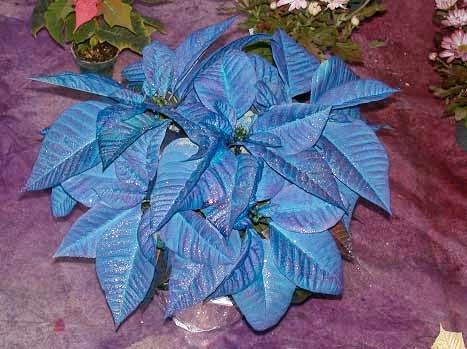
The poinsettia has undergone many hybridizations over the years
and has been selectively bred to keep its colored bracts (leaves)
for much longer. But the purpose of the blue poinsettia escapes
me. Is it supposed to look cold? My wife says it doesn’t have to
have a purpose, it’s just pretty.
According to another recent study, a toxin from ivy leaves, hederagenin, induces colon cancer cells to kill themselves (apoptosis). I think the take home message here is that Christmas evergreens are pretty and can be meaningful, but don’t add them to the holiday meal unless instructed by a doctor.

And as for poinsettia, they have a bad reputation for being poisonous, but a child would have to eat about 500 leaves for them to be in big trouble. And they taste so bad, that no kid would eat more than one. It’s strange how some have the reputation and other that are more dangerous are not thought of as toxic.

Next week, myrrh was one of the original Christmas gifts. It had many functions in ancient times, but now we know WHY it's such a great gift.


Liu, B., Zhou, J., Li, Y., Zou, X., Wu, J., Gu, J., Yuan, J., Zhao, B., Feng, L., Jia, X., & Wang, R. (2014). Hederagenin from the leaves of ivy (Hedera helix L.) induces apoptosis in human LoVo colon cells through the mitochondrial pathway BMC Complementary and Alternative Medicine, 14 (1) DOI: 10.1186/1472-6882-14-412

Tröger W, Galun D, Reif M, Schumann A, Stanković N, & Milićević M (2014). Quality of life of patients with advanced pancreatic cancer during treatment with mistletoe: a randomized controlled trial. Deutsches Arzteblatt international, 111 (29-30) PMID: 25142075

Tsui, K., Wang, J., Wu, L., & Chiu, C. (2012). Molecular Mechanism of Isocupressic Acid Supresses MA-10 Cell Steroidogenesis Evidence-Based Complementary and Alternative Medicine, 2012, 1-12 DOI: 10.1155/2012/190107

Earl, E., Altaf, M., Murikoli, R., Swift, S., & O'Toole, R. (2010). Native New Zealand plants with inhibitory activity towards Mycobacterium tuberculosis BMC Complementary and Alternative Medicine, 10 (1) DOI: 10.1186/1472-6882-10-25


Since most of this post is about how certain plants can be poisonous, I have decided not to include links for more information on how these things can kill you. If you must know, you’ll have to look them up yourself.


Wednesday, May 28, 2014

Cold Receptors Come In From The Cold

Biology concepts – thermosensing, cool sensing, allergy, cross-reactivity, cold allergy, sperm maturation, acrosome reaction, opiate withdrawal


You can be allergic to things that touch your skin – like poison ivy,
things injected, like bee venom, things eaten – like foods, or things
inhaled – like perfumes. But now we need to add something else
to this list – cold? On the right you see a common way to test for
allergy. Anything that produces a wheal and flare reaction
(blanched and raised surrounded by red) is considered positive.
But what if they’re just allergic to the metal needle? 
Allergies can result when your immune system, specifically your mast cells, have an exaggerated response to something that should be innocuous. We have talked about the different kinds of immune hypersensitivity reactions before, but in general, allergy (or atopy, from Greek for out of place) occurs when your body produces a type of antibody (IgE) that recognizes foreign substances and causes your mast cells to release histamine.

Histamine release can lead to itching, watery eyes, runny nose, and even hives (urticaria, from Latin for nettle, see the post on nettle toxins). The IgE is good for helping you learn to avoid poisons and such, but what if your body makes and IgE to something that isn’t dangerous, like peanuts or latex?

Sometimes it isn’t even a case of building an antibody to something that is normally not deemed foreign. Sometimes a peanut molecule just looks enough like some other antigen that an IgE is tricked into binding to the peanut molecule or the banana molecule.

The fruit-latex syndrome is a good example of this. In many cases of people being allergic to latex (Hevea brasiliensis), they also have an allergy to avocados, kiwi fruit, bananas, or chestnuts. The IgE that recognizes the latex hevein protein cross reacts with a beta-glucanase enzyme protein from the fruits.

In the cases of cross-reacting antibodies, there are antibodies to innocuous antigens, your body reacts to them just like they were something dangerous. Histamine release results from IgEs grouping around an allergen and then attaching to a mast cell. If you have encountered this allergen before and have ramped up the number of IgEs that recognize this antigen, the mechanisms can lead to anaphylaxis. This life threatening condition is marked by inflammation that can cut off airways and a lowering of blood pressure that could kill the brain.


Spina bifida patients often develop latex and tropical fruit allergies.
Spina bifida is an incomplete closing of the spinal cord in the fetus
and can lead to severe difficulties in leg movement. It can range from
undetectable to very evident, like in the right image above. Lots of
treatment means lots of chances to develop latex hypersensitivity,
and almost 2/3 of spina bifida patients develop a latex allergy. A 2011
study says that they first develop allergy to latex, and then this cross-
reacts with the fruit. So patients without latex allergy don’t have
to avoid the fruits.
People allergic to nuts or bee stings are forced to carry around injectors of epinephrine just in case their allergies are triggered. The epinephrine constricts blood vessels, increases the heart rate and the amount of blood moved, so your blood pressure won’t drop too far if you take it soon enough. It also dilates the airways and stops inflammation so you can keep breathing. These are all good things.

Like we said, this is how allergies can and sometimes do work. But there are exceptions. Did you know that you can be allergic to cold weather? Yes, I hear you out there, chuckling that you’ve been allergic to shoveling snow for years. But what I’m talking about is a physical allergy – hives, breathing problems, itching, and cough – just because your skin and airways are exposed to cold air.

No – you can’t make an antibody to an environmental condition like cold – at least not as far as I know. But remember that TRPM8 is a cool sensor, stimulated by cold temperatures. What if your body skipped the antibody part and the cold temperature itself stimulated mast cell degranulation (release of histamine granules)? Maybe it does, but whether the cold acts via TRPM8 is another question.


Mast cells (in red) degranulate in response to allergens.
The allergen (1) is recognized and bound by the
appropriate IgE antibodies (2). The end of the antibody
opposite the allergen binding site has a receptor on the
mast cell surface (3). Crosslinking of more than one
surface recpeotr with Ab causes degranulation and
release of inflammatory mediators, like histamine (4)
from the granules usually stored in the cytoplasm (5).
There are only a couple of studies that have looked at TRPM8 and cold-induced urticaria. In 2010, a study using rat mast cells showed that they do express YRPM8 ion channels and that they do release histamine when exposed to cold or methanol (a TRPM8 agonist). The histamine release could be blocked, even at cold temperatures, by treating the cells with a TRPM8 antagonist. Pretty convincing, eh?

But the very next year, another study said it was unlikely that TRPM8 was responsible for cold-induced urticaria. This study used human mast cells and mice. Although they did find TRPM8 channels on the mouse mast cells, they didn’t release histamine in the presence of cold in their experimental model. And the researchers didn’t even find TRPM8 expressed on the human cells. This is a bit unusual, since mice are usually a great model for human physiology.

In mast cells from mice with no TRPM8 channels (TRPM8 knockout mice), the mast cell response to cold was normal, so this study concluded that TRPM8 is not involved in cold urticaria. Confusing, but a good opportunity to cheer the relentlessness of science. Study will continue until something is repeatable and can’t be proved wrong. Maybe it will be you – curing cold allergy might not make you rich, but cold-triggered asthma follows a similar stimulation – and solving that little problem will get you a Nobel Prize and a big fat check.

How about another exception? One important difference between TRPV1 warm/hot sensor and TRPM8 cool/cold sensor is that TRPV1 is often located on pain neurons, while TRPM8 is located on other types of neurons and other cell types. TRPM8 activation is not associated with pain sensation directly, since they don’t help depolarize pain neurons. But there is an exception – your teeth.


The left cartoon shows the dentinal pores and how they have
odontoblast processes in them. If the dentin is expose by
receding gums or by decay, the pores are then exposed. On
the right, different stimuli can cause the fluid in the pores to
move, which then puts strain or stretch on the processes, this
causes shifts in ions and that can cause the neurons to fire. These
neurons only carry one message – pain.
Inside the middle of each tooth is the pulp (in the pulp chamber), made up of a few layers of cells that can make more tooth material (odontoblasts), some blood vessels, and a set of nerves. Odontoblasts make a product called dentin, which is hard, but not as hard as enamel. The enamel on your teeth is not very thick, most of the structure is dentin. As you age, insults to the tooth (like decay), can stimulate the laying down of additional layers of dentin inside the pulp chamber.

The dentin has minute pores that travel out from the middle to the base of the enamel layer. If decay or some other stimulus reaches the pore, processes (like fingers) of the odontoblasts in the pores can react to the stimuli. These then signal the neurons in the pulp. However, the pulp has only pain sensing neurons. So every stimulus that reaches the pulp will be interpreted as pain.

The odontoblasts have TRPV1 channels, TRPM8 channels and TRPA1 channels (we will talk more about these next week). The hydrodynamic theory of tooth pain says that the changes in temperature that reach the odontoblast processes result in pressure changes and this puts mechanical stress (stretch or shear) on the membranes. These then trigger the channels and the signal is passed to the pain neuron.

A 2013 PLoS study says this is partially true. Their results seem to indicate that very cold and very hot stimuli do produce mechanical pressure on the membrane, so TRPV1 and TRPA1 are responsible for mechano-sensitive pain. But they suggest that in the case of TRPM8, cool/cold temperatures trigger the odontoblasts and neuron. The neuron only has one thing to say - pain – so when triggered by TRPM8 signals in the neighboring odontoblast, it responds the only way it knows how. Too bad, but it has spawned a million dollar industry in toothpastes for people with sensitive teeth.


This is a cartoon of the head of a sea urchin sperm, but many
of the concepts apply in humans as well. See all the red
arrows? Those represent the places where calcium flux is
important in maturation and function. And what do TRPV1
and TRPM8 move the best – calcium. The acrosome reaction
actually dissolved the membrane around the acrosome so that
it can more easily enter the ova. This has to be done at a proper
time; TRPM8 activation prevents it from happening too early.
Here’s another TRPM8 function that we will touch on only briefly. We talked about TRPV1 being important in sperm maturation and in entry into the egg. Well, it looks like TRPM8 is involved as well, only in the opposite direction. TRPM8 signaling, according to a 2011 study, TRPM8 activation prevents sperm maturation. This is also important, you need the capacitation and the acrosome reaction to occur at the proper point because they shorten the sperm survival time.

TRPM8 signaling prevents the acrosome reaction, but when the egg is near, a chemical called CRISP4 is released from the egg or parts near there. CRISP4 is a TRPM8 inhibitor. When TRPM8 is inhibited, now TRPV1 can be stimulated to trigger the acrosome reaction.

The interesting part here is that up to the point of CRISP4 release, something is constantly stimulating TRPM8 activity in the sperm cell. I really doubt that there's a cold stimulus way up inside the uterus, so just what is activating TRPM8? We know about lots of endogenous activators of TRPV1, but there has only been one study saying that TRPM8 might have a body-produced agonist, a type of lipid called lysophopholipids. But I think we are missing a bunch of other agonists – maybe you could look for those someday.

OK, here’s the last weird function for TRPM8 today. Would you believe it works in morphine action and withdrawal (when addicted)? Opiates like morphine are analgesic and cold antinociceptive. You take morphine and you don’t sense cold – of course, you won’t sense much of anything else either. For cold, we know how it acts. Opiates cause the internalization of TRPM8 channels on neurons. If there are no exposed channels, they can’t be triggered to allow ions into the neuron.

It goes even further; this isn’t some byproduct or side effect. Menthol is known to create analgesia (one of the reasons they use it in cigarettes). But according to a 2013 paper, if you give naloxone (an opiate blocker) at the same time as menthol – no analgesia. TRPM8 internalization is required for morphine to work.


The term, “cold turkey” is fairly old, first appearing in print
around 1910. It means “without preparation,” but just where
it came from is a matter of question. It might refer to the fact
that cold turkey after Thanksgiving doesn’t need preparation.
It might also be related to “talk turkey, which means to get
down to business. But the way that drug addicts feel cold,
sweat, are pale and have goose bumps – the visual aspect is
not wasted. By the way – who would smoke a cold turkey?
This is important when you are trying to kick a morphine habit. As you stop taking the opiates, TRPM8 quickly relocates to the membrane of the cell and is very easily activated. This causes a cold hypersensitivity and hyperalgesia. People going through withdrawal feel cold because their TRPM8 channels are firing. This is one explanation for calling it, “going cold turkey.” It is uncomfortable and painful, and is one of the main reasons that patients fail detox.

The naloxone that is used to treat morphine addiction binds to the opioid receptor, but doesn’t produce the analgesia. It also allows the TRPM8 to remain externalized, so they don’t have the rebound feeling of cold and pain. Pretty impressive – and now you know how it works.


Next week – TRPM8 is for cold, then there’s the cold that hurts. That is a different receptor, called TRPA1. It makes cold hurt, abut it also saves you from the cold.


Gibbs GM, Orta G, Reddy T, Koppers AJ, Martínez-López P, de la Vega-Beltràn JL, Lo JC, Veldhuis N, Jamsai D, McIntyre P, Darszon A, & O'Bryan MK (2011). Cysteine-rich secretory protein 4 is an inhibitor of transient receptor potential M8 with a role in establishing sperm function. Proceedings of the National Academy of Sciences of the United States of America, 108 (17), 7034-9 PMID: 21482758

Shapovalov G, Gkika D, Devilliers M, Kondratskyi A, Gordienko D, Busserolles J, Bokhobza A, Eschalier A, Skryma R, & Prevarskaya N (2013). Opiates modulate thermosensation by internalizing cold receptor TRPM8. Cell reports, 4 (3), 504-15 PMID: 23911290

Medic N, Desai A, Komarow H, Burch LH, Bandara G, Beaven MA, Metcalfe DD, & Gilfillan AM (2011). Examination of the role of TRPM8 in human mast cell activation and its relevance to the etiology of cold-induced urticaria. Cell calcium, 50 (5), 473-80 PMID: 21906810

Cho Y, Jang Y, Yang YD, Lee CH, Lee Y, & Oh U (2010). TRPM8 mediates cold and menthol allergies associated with mast cell activation. Cell calcium, 48 (4), 202-8 PMID: 20934218


For more information or classroom activities, see:

Cold allergy –

Hydrodynamic theory of tooth pain –

Sperm maturation –

Drug withdrawal –