Showing posts with label TRPA1. Show all posts

Wednesday, July 9, 2014

What’s So Repelling About Repellents?

Biology concepts – thermosensing, repellent, odor receptors, gustatory receptors, semiochemcials


Science explains our world, and then technology and engineering
build a model of that for our use. The better we know how our
universe works, the better we can make use of it. In the 1985
film Real Genius, this difference is stated when the scientist
students ask what a 6 megawatt laser might be for, one student
says, “Let the engineers figure out a use for it.” In this case, they
used it to fill a house with popcorn.
Science exists to describe our universe in terms of rules and mechanisms; what is and how it comes to be. Knowing that something exists is only half the equation. Science seeks to explain how something exists in terms of the rules of the universe. Observation is good, but it only shows us the question – mechanisms of action and interactions show us the answers.

As an example – we know that certain naturally occurring oils and well as some man made chemicals keep mosquitoes from feeding on us. This is the observation. But the question is – how do mosquito repellents work? The answer is more interesting and more complicated than you would initially think. Repellents rarely repel.

Investigating how chemicals keep us from getting bitten will teach us about how the living systems work, will give us a better understanding of our universe, and then give us better insect repellents. Don’t think that’s important? Consider the hundreds of millions of people who are infected every year (several million die) with mosquito-borne diseases (malaria, encephalitis, dengue fever, yellow fever, filiariasis). So yes, we need more repellents.


Mosquito borne diseases can be unpleasant at best. Top left is
filariasis, a worm is transmitted via mosquito and it clogs up
your lymphatic vessels, so that body parts swell from excess
fluid. Top right – malaria can result in so much red blood cell
lysis that your spleen (the guy who cleans them up) can
rupture. Bottom left – Dengue fever is often called breakbone
fever, the pain is not something an image can express. But the
hemorrhagic form of the disease can produce some bleeding
in weird places. Oh, and it can kill you too. Bottom right –
yellow fever is caused by a virus transmitted by mosquito. Your
liver breaks down and causes your whole body to turn yellow
and you bleed into your skin.
We should start with the repellents for which we have good ideas of their mechanism of action. But there aren’t any. We have some hypotheses and working ideas of the modes of action of mosquito repellents, but nothing is definitive yet. Let’s look at two of them and see if we can find some common pathways.

Citronella oil
Citronella is a combination of many different natural oils produced in lemongrass plants (Cymbopogon nardus and Cymbopogon winteratu). As a natural oil and a flavoring in Asian cooking, one would think that citronella oil would be considered just about the safest insect repellent this side of a slap with an open palm.

But no, Canada says that one small component of citronella oil called methyleugenol, can increase the likelihood of tumor formation in rats. Of course this was when methyleugenol was distilled from the oil, given by itself in large doses, and introduced directly into the stomach. But Canada is still in the process of banning citronella oil as an insect repellent. Of course, you can still eat thai food in Canada, which is often flavored with lemongrass.

The EU, on the other hand, said that the repelling function of citronella oil hadn’t been proven and it was deemed illegal to use in the EU in 2006. Oh, you could eat it, and use it soap or perfumes, you just couldn’t use it to keep mosquitoes away. They reconsidered in 2014 and some restricted uses of citronella oil as a repellent are now allowed.


Citronella oil comes from the lemongrass plant (Cymbopogon
nardus or Cymbopogon winteratu). There are two major species
for acquiring the oil, and the oil from each is a little different in
the percentage of each chemical. Lemon grass is also used in
cooking, the woody stalks are used with extra long cook times.
The torches that burn citronella oil work pretty well, but you
have to stay in the volatilized cloud of oil for them to be efficient.
Despite these issues, the U.S. Environmental Protection Agency (EPA) says citronella is safe and effective as an insect repellent. One weird side issue – you can take all the lemongrass you want from the US to Canada, where its oil is under attack, but you can’t bring any lemongrass from Canada to the US, where it is considered safe. Hmmmm.

Citronella oil probably works in a couple of ways. It's strong and sweet smelling, so it covers up and dilutes the odors that mosquitoes use to find you. If they’re detecting all the citronella in the air, then they aren’t smelling you. But research also shows that citronella oil activates TRPA1 ion channels. In us, they detect cold and noxious chemicals and are interpreted as pain. It is very possible that the detected signals in mosquitoes just come through as something unpleasant and to be avoided.

In this way, citronella would be an actual repellent. It repels on contact as well, as the taste is thought to activate bitter taste receptors and contact greatly reduces feeding time.

But citronella only seems to work when you are in the cloud produced by burning the candles or torches, or within the area of the spray. And if you’re using an oil or cream with citronella, it should really be reapplied every 30-45 minutes - not the most user-friendly method for discouraging pests.

DEET
World War II in the Pacific was an insect nightmare for the US Army. In response to the plethora of insect-borne disease that ran through the allied forces, defense scientists starting looking for better insect repellents. In 1946, their efforts produced N,N-Diethyl-meta-toluamide, or DEET.

Just how they came up with DEET is a mystery to me, it must have been a massive exercise in trial and error. Why? Because we know less about how DEET works than we do about citronella oil. And that’s with the benefit of 40 years of research. They didn’t have a clue how it worked or even what systems it was targeting when developed in the 40’s.


Guess which hand has been treated with DEET. The
mosquitoes come very close to the hand that was treated,
but don’t land on it. This argues that DEET is less repelling,
than it is disguising. On the right, the structure of DEET is
similar to several human semiochemicals, it fits into the lock
and key system of several odor receptors and activates or
inhibits them.
Originally it was believed that DEET disrupted the mosquito’s ability to detect semiochemicals (octenol) produced by mammals, especially humans, so mosquitoes couldn’t find a mammalian host to feed on. Then they played around with the idea that it blocked detection of CO2.

More recent studies have been more rigorous, but haven’t helped solve the puzzle. A 2008 study suggested that DEET was actually repellent; the mosquitoes didn’t like the smell and would avoid it. But other studies have shown different mechanisms of action.

A study in the journal Nature in 2011 found that mosquito odor receptors could be confused by DEET. The receptors for octenol were less responsive in the presence of DEET, but other receptors more more responsive.  The conclusion of the study was that odorants from humans could be detected, but their pattern was confused, so the mosquito didn’t recognize the target as a target. It’s as if we disappear from the mosquitoes radar when we wear DEET.

A 2010 study showed similar results. DEET activated certain odor receptors but not others when given alone, but the opposite effects were seen when DEET was given in the presence of things from human sweat that would normally attract a mosquito. Once again, the signals were confused. This is really more of a chemical disguise for us, not a repellent. Next time your kids go outside, you should insist that they apply their mosquito confusant.

However, a 2013 study in the Journal of Vector Ecology found that heat and moisture were critical elements for recognition of targets by female mosquitoes, and that DEET messed not with odor, but with detection of heat and/or moisture. Different from the other studies, but still more of a masking than a repellent.


Something a little disturbing. Mosquitoes can learn to ignore
DEET. Most mosquitoes will be confused by DEET and never
find you. But if they do and then are repelled by the taste, they
learn from that and the second taste is not repellent. Hopefully
they just don’t find you a second time.
There was an interesting study from 2013 that showed that if you mutate or knock out Orco, one of the co-receptors (a protein that works with many different odor receptors so that they can function properly), then two things happened. One, DEET didn’t have any effect on the mosquitoes, and two, mosquitoes that normally preferred humans greatly would then settle for any mammal.

Weird - Orco is needed for both DEET to work and for mosquitoes to find humans more attractive. I haven’t figured that one out yet. The researchers showed that DEET only maintained an effect on the Orco mutant mosquitoes when they landed on a DEET covered surface, and then they didn’t like it at all.

This suggested that DEET might have more than one mechanism, confusion in the air and repellent taste on contact. Older studies supported this idea, as a couple of studies in 2005 and 2006 showed that contact with DEET would reduce feeding behavior in mosquitoes and one in 2010 showed that fruit fly bitter taste receptors are activated by DEET.

So, we have studies that say DEET is a confusant rather than a repellent, others that say it is a true obnoxious smell that they can’t stand, and yet others that say DEET is confusing to the smell and repellent to the taste. But there are more. Other studies suggest that DEET actually inhibits the smelling of anything, while others say that it inhibits an important protein called cytochrome p450.

Used commercially since the 1950’s, DEET has been the gold standard for efficiency for many years. Although it has to be used at fairly high concentrations, it can keep mosquitoes away for 4-6 hours at concentrations where citronella oil might work for less than an hour. At 100% concentration, DEET is active for more than 12 hours. What’s more, if you combine DEET with 5% vanillin, it works two hours longer!


A lime with cloves stuck in it as a mosquito repellent – really?
Well, lime is kind of like citronella oil, and clove has eugenol,
which acts on TRPV1 ion channels. But how many would you
have to have, or do you wear them like earrings? Penny royal
contains menthol and mosquitoes stay away from it. But it
also has toxins that will kill you.
As good as DEET is, people still question whether it’s safe. The EPA in a 2014 review said that DEET is safe for human use and poses no identifiable risks for human health, even in children. But this doesn’t keep people from suspecting chemical usage of carrying negative effects.

On the other hand, DEET dissolves plastic, foam rubber, spandex, gore-tex, and nylon. I can see where this might make people leery about slathering it on their skin for hours at a time. And a few people are allergic to DEET, so the best current repellent isn’t without some negatives.

One last point – a newer repellent called picaridin is almost as effective as DEET and doesn’t eat your back packing equipment and clothes. The interesting point is that picaridin is a synthetic version of piperine, the spicy chemical in black peppercorns. Add to this that menthol is also a fairly decent mosquito repellent, and we have some good arguments that TRP receptors might be involved in repelling activity – as with citronella oil. Piperine is a TRPV1 agonist, and menthol activates TRPM8 and TRPV1. All our talk about spicy food and heat/cold receptors has an impact even in the spread of malaria and other deadly diseases!

Next week, another question to answer - do sunflowers really turn with the sun?


DeGennaro M, McBride CS, Seeholzer L, Nakagawa T, Dennis EJ, Goldman C, Jasinskiene N, James AA, & Vosshall LB (2013). orco mutant mosquitoes lose strong preference for humans and are not repelled by volatile DEET. Nature, 498 (7455), 487-91 PMID: 23719379

Stanczyk NM, Brookfield JF, Field LM, & Logan JG (2013). Aedes aegypti mosquitoes exhibit decreased repellency by DEET following previous exposure. PloS one, 8 (2) PMID: 23437043

Klun JA, Kramer M, & Debboun M (2013). Four simple stimuli that induce host-seeking and blood-feeding behaviors in two mosquito species, with a clue to DEET's mode of action. Journal of vector ecology : journal of the Society for Vector Ecology, 38 (1), 143-53 PMID: 23701619


Wednesday, July 2, 2014

How Do Mosquitoes Find You?

Biology concepts – semiochemicals, hematophagy, proboscis, thermosensing, TRPA1


Sure, mosquitoes suck blood and pass along malaria
that kill more humans than any other infectious disease.
But would it be good to get rid of them. They provide
food for birds – one scientist suggests that elimination
of Arctic mosquitoes could reduce northern bird
populations by 50%. And mosquitoes pollinate flowers
too, like blueberries and cranberries. See, they’re
not all bad.
We can start our summer series of biology questions by continuing our discussion of taste and thermosensing. It seems that some people are bitten by mosquitoes if they peak out the front door, while other people can sit outside next to tall grass or ponds for hours with suffering a single bite. Unfortunately, I happen to be in the former category.

How do mosquitoes find some people and not others? Are some people just tastier than others?

First let’s get some common misconceptions and basic information out of the way. Do mosquitoes bite you (or any other animal)? No, they have no teeth, so they don’t bite in the traditional sense. What they do have is an elongated set of mouthparts called a proboscis. The sheath on the outside retracts as the longer parts inside pierce the skin like a hypodermic needle. Only this is a flexible hypodermic needle, small enough to go around individual cells and look for a small vein or venule.


On the left is a drawing of the mosquito proboscis parts. Most sit
in a groove of the labium, which retracts as the rest is injected
into the skin. The maxillae and mandibles are like our upper and
lower jaws. They are the sharp parts. The hypopharynx is what
delivers the anticoagulant saliva. On the right is the parts put
together. The fuzzy part is the labium and the sharp tips are
from the maxillae.
Take a look at these videos taken from a 2012 PLoS One study of a mosquito biting a mouse. The squarish objects are skin cells, and the red streaks are blood vessels. The second video in the sequence shows what happens when the proboscis finds a vessel and starts to suck out the blood. Makes you respect the mosquito a bit more – these are some determined females.

Of course it’s only the females that feed on blood. This suggests that feeding on blood is related to having babies. And it is – just not in a “gotta get the baby some food” sort of way. Most mosquito species require a blood meal in order to develop viable eggs. Females get energy from drinking nectar (full of carbohydrates), but they need protein to produce yolk for the eggs. They get the protein from feeding on blood. If the female doesn’t feed on blood, the eggs will be produced, but they won’t be able to hatch and become larva.

But here is one of our exceptions – some mosquitoes have gotten around the need for blood meals. All 92 species of mosquito in the genus Toxorhynchites (elephant mosquito) don’t need to feed on blood. Instead, their larvae feed on the larva of other mosquitoes, and the gather the proteins they need to lay viable eggs from their larval meals. They store the amino acids in their larval and pupal bodies, until they become adults and need them to lay eggs of their own.

Compare the sizes of the elephant mosquito (left) and
A. aegypti.  I’m very glad that the females of the
Toxorhynchites genus don’t suck blood. They could drain
people dry! Even though their size is small, species like the
one on the right can consume 300 ml a day from every
caribou in a herd when they are swarming.


This suggests that the elephant mosquitoes could be used to combat disease spreading mosquitoes, like the Aedes aegypti mosquitoes that spread dengue fever, yellow fever and the current disease of interest, chikungunya fever. And the elephant mosquito has been used as a natural biocontrol agent. What's weird is that A. aegypti females actually help the situation.


A. aegypti, and many other mosquitoes that lay eggs in water, have larvae that eat bacteria. So they want to lay eggs where there are a lot of bacteria. Well, the eating of larvae by Toxorhynchites species leaves lots of little pieces of mosquito larva in the water, and this provides bacteria with a lot of food. A June 2014 study showed that A. aegypti females actually prefer to lay eggs in water that contain predators for their larva, because it increases the bacterial numbers so much. Thos that survive have lots of bacteria to feed on. It’s a calculated behavior – risk being eaten or risk starving.


So some mosquitoes will go a long way and risk death in order to get a good meal for their potential offspring. They’re looking for mammals usually, but even here there are exceptions. Some mosquito species, like Culiseta melanura, feed almost exclusively on bird blood – they say it tastes like chicken.


The picture represents the transmission cycle for
eastern equine encephalitis virus (EEEV). It can’t be
transmitted from mammals to other animals, so they are
called dead-end hosts. But it can produce disease in
them. Humans most often will present with a limiting or
subclinical disease, but horses have a hard time with it.
The major source is in birds, and the transmission from
bird to bird is by mosquitoes that rarely bite humans. The
way into dead-end hosts is by a mosquito that normally
bites mammals occasionally biting a bird, or the rare
occasion that a bird specific mosquito will bit a mammal.
But just because they feed mostly from birds doesn’t mean they aren’t important disease transmission. They are – for horses. Eastern equine encephalitis virus is passed from bird to bird by C. melanura, so the birds, especially cardinals, are a reservoir of virus. Then, when another species of mosquito that is less particular about its host species bite a bird then bites a horse or person, the disease can be spread. There are even cases where a C. melanura will occasionally feed on a human and spread the disease directly.

With this background, we still need to answer our question of the day – how do mosquitoes find a blood meal. Believe it or not, your socks help answer the question. For many years it was assumed that mosquitoes followed the heat of warm-blooded animals in order to find a meal, but this was an assumption that was not tested rigorously.

Then it was discovered that carbon dioxide (CO2) is a strong cue for mosquitoes seeking sustenance. CO2 means respiration, and respiration possibly means mammals. The mosquitoes have taste receptors in their antennae and mouths that will sense changes in CO2 and they will follow the path of more carbon dioxide right to your nose and mouth (see this post).

Large people and pregnant women tend to exhale more CO2, so they will be more attractive to mosquitoes. But there are large individuals who never get bothered by mosquitoes. Maybe there’s more to it.

Semiochemicals are part of the answer. Semio- comes from the Greek meaning signal, like in semaphore flags. So semiochemicals are molecules emitted by organisms for communication. Pheromones are the most famous of the semiochemicals – and we know that these are used in many animals, from helping to guide ants to follow the path of their predecessors, to influencing mate choices in many animals.

Semiochemicals might be attractants or repellants. In some cases, they can be both. Take human body odor – it contains dozens of semiochemicals, people find body odor repulsive, but mosquitoes enjoy it like the smell of fresh apple pie. Of course, body odor is only offensive nowadays; before the advent of deodorant, daily or three times daily baths and showers, perfume, aftershave, and of course Axe products – everybody smelled like that guy that lives under the bridge.


On the top of this image is a general idea of semiochemicals.
If they work on members of the same species (like mating
signals), then they are called pheromones. If they work on
other species, they are called alleochemicals. Each can be
either attractive or repellant. On the bottom is a homemade
mosquito trap. You might be able to see that it has been
baited with old shoes and grimy socks.
Bacteria feed on the sweat, sugars and proteins that mammals exude, and they give even more semiochemicals. This can make you more or less attractive to mosquitoes. In general, people with many types of bacteria on their skin are less attractive, while those with mostly a few attractive species will get bitten more often. Having a high number of bacteria is a turn off too, probably because that would expose the mosquitoes to more possible pathogens as well. Is it possible to be so disgustingly colonized that even mosquitoes won’t land on you?

Mosquitoes are attracted to several different semiochemicals, including octenol, CO2, and nonanal. On mosquito antennae, especially the female antennae, there are receptors in the sensilla (see this post) for at least 27 different chemicals in human sweat.

Studies have shown that old socks are a good experimental attractant for mosquitoes. Instead of using an arm or other body part, scientists will compare the attractive ability of someone’s old sweat socks to individual chemicals or mixtures of chemicals. Of course, whose socks you use matters as well. Some people are classified as high attractors (HA) and some as low attractors (LA), so studies often include comparisons of chemicals or mixtures to both HA and LA socks.

But there are other considerations as well. People with blood type O secrete different semiochemicals and are more attractive to many species of mosquitoes. Go ahead, try to change your blood type so you’re less attractive to mosquitoes.

Different species may aim for different body parts. Some seem to prefer feet and ankles, but this may be because they are closer to the ground. If convection currents created by the body heat rising suck the mosquitoes in from below, then it is really the fact that they are following their noses and not going after feet particularly. A small 1998 study showed that mosquitoes that went after feet and ankles preferentially did not do so when the volunteers lied on their backs and raised their feet high in to the air. But, what we have stumbled across in this discussion is body heat.


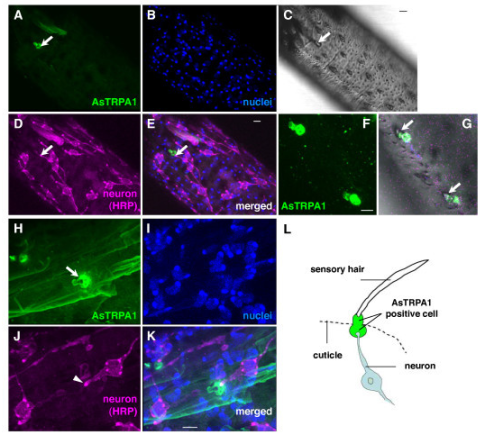
This is part of a complex figure from a 2011 scientific paper.
In addition to the pretty colors used, the message is that these
researchers identified TRPA1 ion channels on the proboscis
of a species of mosquito. They don’t just sense heat with
their antennae, but also their sucking parts. I wonder if the
interior parts also have TRPA1 to help them find a vessel
when the proboscis is inserted into the tissue.
But what was old is new again…. Scientists are again looking at heat as an attractant for mosquitoes. As compared to HA or LA socks, heat isn’t a strong attractor, but warm socks attract more mosquitoes than cold socks. On the other hand, a 2010 study says that heat and moisture is a greater attractor than heat alone, so it would seem that people working outside in the heat would be the perfect attractors for mosquitoes.

Since heat does seem to be an attractor, it would follow that female mosquitoes would have a receptor for heat. Voila, a new study shows that mosquitoes have sensilla on their antennae and palps that house TRPA1 ion channels. A 2011 study even showed that one malaria-carrying mosquito has TRPA1 receptors on its proboscis. We have talked before about how many mammals use this receptor to sense noxious cold as well as chemicals that cause irritation or pain.


On the left is a species of tick. You wouldn’t believe how big they
can get when feeding on blood. Look it up – I dare you. On the
right is a bedbug. The bedbug is not that closely related to the
tick, since the tick is an arachnid. Count the legs on each – spiders
(arachnids) have eight legs, insects have six. Both these animals
feed on blood, but no one has identified a heat sensor in them.
But in birds, reptiles and insects, TRPA1 is a heat sensor. The 2009 study showed that the TRPA1 were expressed on the female antennae only. But that isn’t to say that only female mosquitoes have TRPA1. A 2013 study indicates that A. gambiae mosquito larvae have functioning TRPA1 so that they can sense water temperature and stay in the most comfortable water.

So mosquitoes (most female mosquitoes) are finding suitable hosts for blood meals by using their senses of taste, smell, sight, and infrared detection. There are other vampire insects as well, ticks, bedbugs, etc. I wonder if they are using heat sensing too. These have yet to be reported on.

Next week, a related question – just how and why do mosquito repellants work?


Maekawa E, Aonuma H, Nelson B, Yoshimura A, Tokunaga F, Fukumoto S, & Kanuka H (2011). The role of proboscis of the malaria vector mosquito Anopheles stephensi in host-seeking behavior. Parasites & vectors, 4 PMID: 21272298

Albeny-Simões D, Murrell EG, Elliot SL, Andrade MR, Lima E, Juliano SA, & Vilela EF (2014). Attracted to the enemy: Aedes aegypti prefers oviposition sites with predator-killed conspecifics. Oecologia, 175 (2), 481-92 PMID: 24590205

Olanga EA, Okal MN, Mbadi PA, Kokwaro ED, & Mukabana WR (2010). Attraction of Anopheles gambiae to odour baits augmented with heat and moisture. Malaria journal, 9 PMID: 20051143

Liu C, & Zwiebel LJ (2013). Molecular characterization of larval peripheral thermosensory responses of the malaria vector mosquito Anopheles gambiae. PloS one, 8 (8) PMID: 23940815

Wednesday, June 18, 2014

Sneaking Up On A Snake

Biology concepts – thermosensor, sight-hunters, snake hearing, mutation, TRPA1, pit vipers

We have been talking about taste sense for many weeks. I
remember a 1975 movie called, A Boy And His Dog, starring a
very young Don Johnson. It was a post-apocalyptic story of a
guy, his dog, and cannibalism. The best line of the movie? “Well,
she might not have had good taste, but she sure tasted good.”
Of course, this isn’t the kind of tastes we have been talking about.
We’ve come a long way since we started talking about taste sense. We have learned about how TRPV1 capsaicin receptors sense pain and heat. We have also learned that TRPV1 capsaicin receptors have cousins that sense cold - TRPM8 and TRPA1. They may generate pain, and they certainly help to warm us when we are cold.

We have even learned that in rare cases, the cold receptors can be heat sensors, like in chickens and insects where TRPA1 sense hot instead of cold. And this leads us to today’s exception. It’s time to talk about how these relatives of taste receptors help animals to become better hunters and to better sense their environment. Today let’s focus on snakes.

Snakes have a number of ways to catch prey (see this post). Some lie in wait, blending in with the jungle or background until a moving potential dinner catches their eye and moves across their path. Vision is their primary way of finding dinner. As a consequence, most sight-hunting snakes are diurnal (active in daylight).

Here is the southern black racer. You can see it has big eyes with
round pupils so lots of light can enter – it’s a sight hunter. Many
grow to be 5 ft. (1.5 m) long, so they can look intimidating. But
they are not venomous and will usually exit the seen if disturbed.
The non-venomous Southern black racer (Coluber constrictor priapus) is a sight-hunting snake of North and Central America. It’s called a racer because it is quick, reaching 4 mph (1.8 kph) in a very short time. Even though it is a constrictor, it typically doesn’t coil around the lizard, mole, or bird (I said they were quick) that it catches. It prefers to crush them into the ground to suffocate them. Sometimes nature can be a little rough around the edges.

Other snakes use the combination of scent and taste that we talked about a while back. The Jacobson organ (more scientifically called the vomeronasal organ, VNO) in their mouth can sense the molecules that the tongue pulls in from the air. Like it or not, every organism has molecules floating off of them continuously. Snakes' VNO can pick these up. See this post for more on the VNO.

Some snakes “hear” their prey coming. True, snakes don’t have an outer ear opening or the small bones that convert sound waves into mechanical waves in our middle ear (see this post for an explanation). But they do have a cochlea, the organ for sensing the vibrations and converting them to a nerve signal. Many snakes can sense the vibrations that their prey generate when they move through the environment using this cochlea and their lower jaw.

Similar to something called bone conduction hearing in animals with ears like ours, vibrations that travel through the bone can also cause movement in the hairs of the cochlea. As we discussed previously, the bending of the sensory hairs of the cochlea are transduced to chemico-electrical signals that travel to the hearing centers of the brain.

This is from a scientific paper showing the bone hearing of a python.
The red is the lower jawbone. The bark blue is the quadrate bone
and the green is the equivalent to our stapes bone of the middle
ear. The light blue is the inner ear space and the purple is where
the cochlea is housed. Vibrations go from red, to blue, to green to
light blue, to purple. You can see how sound waves would find it
tough to get to the cochlea.
A 2008 study showed that many snakes rest their jaw bones against the ground. The vibrations caused by moving animals are transferred from the ground to the bone, and from the bone to the buried cochlea. The sensation in the brain is a lot like muffled knocks, not unlike the bass that is turned up too loud in peoples’ cars.

This was followed by a 2012 study that showed pythons have very sensitive vibratory hearing, but poor sound pressure hearing. Almost all their hearing input comes from the vibrations they sense in the ground or tree, or whatever they happen to be lying on. So be on tip toes, that snake may hear you coming.

But how does any of this relate to a receptor for painful cold and controls mammalian breathing rate? Well, another way some snakes find their prey is by sensing the heat they give off – even from a few meters away.

Pit vipers are a subfamily of the Viperdae family, called Crotalinae. There are two types of vipers; all of them have hinged fangs, the ones that are folded up into the upper jaw when the mouth is closed, but protrude for striking as the mouth is opened. Pit vipers differ from true vipers in that they have pits (duh!); more about these below. True vipers live exclusively in Africa and tropical Europe and Asia.

In America, where I live, there are a lot of pit vipers. Cottonmouths, rattlesnakes (all 30 species), water moccasins, copperheads – these are all pit vipers. From southern Canada to Argentina, and from Eastern Europe to parts of Asia, pit vipers are not rare. Eyelash vipers (Bothriechis schlegelii) of South America are arboreal (live in the trees). They have bright coloring, but sit still and wait for their prey to happen by. They strike from above, so they scare the heck out of jungle hikers.

On the left is the eyelash viper. You can see it doesn’t mean business
because its hinged fangs aren’t extended. In the middle is the two-striped
forest pit viper. It is protecting it’s young, so the fangs are extended. On
the right is a sidewinder rattlesnake. Sidewinders are amazing and will
get their own post soon.
The amazing thing is that there aren’t any pit vipers or true vipers in Australia. The land of a million weird and painful deaths has nothing to offer in the way of hinged fang venomous snakes. I’m sure there’s a movement to import some.

But it’s specific part of the pit viper that we are interested in today – namely the pit. The pit organ is located between the eye and the nostril, on each side of the snake’s head. It is a hollow pit, so the actual business end of the pit organ is inside the snake’s skull.

The pit is lined with epithelium, but it also has a membrane that is stretched across the base. As a consequence of the location membrane, there are air pockets on each side of the membrane. The trigeminal nerve innervates the membrane and there are thermosensors in the cells of the membrane.

So, the pit organ is a thermosensor that helps them locate prey animals (or predators). But wait you say. Sure, pit vipers may use a thermosensitive ion channel to sense the heat given off by passing prey animals. But we just said they use a COLD sensing ion channel, TRPA1. What gives?

The pit on a pit viper is located between the nostril and the eye.
It would be easy to mistake the pit for the nostril. The cartoon
shows the pit anatomy. The air chamber helps cool the air
quickly and stops the TRPA1 receptors from firing again. This
is so the snake won’t get a residual image of something warm,
when the target may have moved in the interim period.
The explanation is two fold. 1) We said a couple of weeks ago that TRPA1 might sense painful cold on its own, or may work with other TRP’s to respond to very cold temperature. But whichever way it works, it is very similar to TRPV1 for heat sensing and TRPM8 for cold sensing. 2) Remember that in birds, lizards, and many insects, TRPA1 actually senses heat, not cold.

So maybe it’s not so terribly bizarre that pit vipers use TRPA1 to sense their prey. But before they touch it??? We eat chili peppers and we react to the capsaicin in our mouths and noses. We go out on a summer day, and the heat activates our TRPV receptors in skin and other tissues. We eat something cold (or menthol) and we feel the cold sensations it touches or tissues. But snakes feel the heat of their prey before they eat, from a distance away! There must be more at work.

And there is. The TRPA1 ion channels in the pit organs of pit vipers have a mutated version of TRPA1. Here’s how things work according to a 2010 study that identified TRPA1 as the heat sensor. The pit is a hole with a membrane stretched toward the back. Consequently, there is an air chamber on both sides of the membrane.  The membrane is highly vasculature and has the sensitive nerve endings with the TRPA1 channels.

The TRPA1 receptors are always firing, but at a low rate. Neutrally warm objects don’t change the firing rate, but warmer objects (as little as 0.001 ˚C warmer than background) will increase the firing rate. The receptor is mutated according to a 2011 study, with 11 amino acids of the pit TRPA1 divergent on only pit-containing snakes. These changes make the receptor so sensitive that it can react to infrared light signals (heat) from several feet away. That would be like our mouth burning over a chili pepper that we walked past in the supermarket.

Since the sensors are spread across the entire membrane, the effect on locating the source is sort of like vision or a pinhole camera. Light passes through the pupil and diverges before it hits the retina. This provides for a larger spread of the “image” across the membrane and allows for precise two-dimensional map of the target. The difference in heat between the target and the background gives a “picture” of the object that is warm.
The Taylor’s Cantil viper will play dead and then strike, but this
brings up an important point. DON’T get near a pit viper, even if
you are sure it’s dead. The pit is wired directly to the brain and
muscles. A dead snake, even one with a severed head, can still
strike as long as there is any residual neural electrical flow. People
die every year from snake bites from dead snakes.

The picture generated is also a little like hearing, since the heat will reach one pit earlier or more strongly. By comparing the timing and the strength of the signals from each pit, the distance and direction to the target can be detected by the brain (see this post for localization of sound waves).

Because the heat “picture” pit vipers pick up is based on the difference between the temperature of target and background, most pit vipers hunt when coolest, so temperature gradient between environment and prey is greatest. Prey will stick out the most.

Snakes can also use the pit more conventionally, as a thermosensor for its whole body. The basal rate of firing will tell the snake when to move to shade if it’s too warm or move to sun if it’s too cold. This is how it regulates its body temperature.

Pythons and boas can also have heat-sensing pits, but they are
5-10 times less sensitive because of their differing anatomy.
The amazing thing is that they evolved the same special power
independently from pit vipers, although they both use mutated
versions of TRPA1. The nostril has a black arrow and the pits
have red arrows.
The exception to today’s exception: some non-pit vipers have pits. In terms of evolution, pits evolved once in pit vipers, but they have sprung up several times in boas and pythons. These pits are less sophisticated (no membrane or air chambers), are less sensitive, and are located in different places.

Boas and pythons with pits have 3-4 simple pits in their upper lips. They don’t have the suspended membrane for sensing temperature, the TRPA1 sensors are housed within the epidermal cells at the back of the pit.

Next week – vampire bats and mosquitoes get into the mutated thermosensor act as well.


Christensen CB, Christensen-Dalsgaard J, Brandt C, & Madsen PT (2012). Hearing with an atympanic ear: good vibration and poor sound-pressure detection in the royal python, Python regius. The Journal of experimental biology, 215 (Pt 2), 331-42 PMID: 22189777

Gracheva EO, Ingolia NT, Kelly YM, Cordero-Morales JF, Hollopeter G, Chesler AT, Sánchez EE, Perez JC, Weissman JS, & Julius D (2010). Molecular basis of infrared detection by snakes. Nature, 464 (7291), 1006-11 PMID: 20228791

Geng J, Liang D, Jiang K, & Zhang P (2011). Molecular evolution of the infrared sensory gene TRPA1 in snakes and implications for functional studies. PloS one, 6 (12) PMID: 22163322


For more information or classroom activities, see:
Pit vipers –

Bone conduction hearing –

VNO (Jacobson organ) -